Face to Face with Siri's Co-Founder, Adam Cheyer
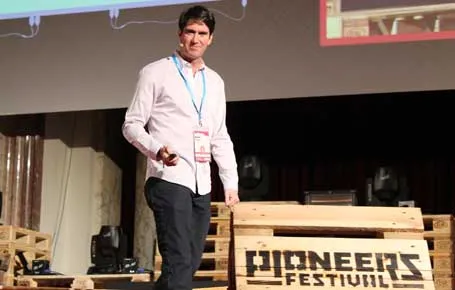
When I came to Silicon Valley on business in January, I wanted to attend some local Meetups. Unfortunately, that trip lasted only a week; I had to socialize with all sorts of luminaries and work day and night, so although two or three tech events made my mouth water, I never got to attend any. This trip is a little longer. The first thing I thought of after landing was to check Meetup. Soon I found three pretty good events: Adam Cheyer’s tech talk last night; “Search at LinkedIn” on 5/21; and “Best Practices for Software Engineers” on 5/22.
Yesterday was insanely busy; my boss had a morning meeting and an afternoon meeting to keep up the pressure. War rooms are in fashion now, so I sat there trembling for an hour and a half. Around six, I couldn’t stand it anymore and said to my boss: “Uh, I’m going to attend a tech talk given by one of Siri’s founders. Can I go? I promise I’ll come back tonight and keep working with the China team.” (I’m going to attend a tech talk from cofounder of Siri…can I go now? I’ll work with cnrd team later when I came back to hotel…) My boss was a little surprised—“You’re quite the operator. Fine, go, go.” I scurried off happily, though not before dropping by the stand-up meeting to show my face.
The talk was in Santa Clara; take 237 to Great American Pkwy and you’re there, less than ten minutes away. But at six-something, 237 was jammed like the East Fourth Ring Road. On the frontage road I had just floored my Jetta up to 60 mph when I hit traffic and had to slam the brakes, stopping dead right behind an Infiniti. Then came an endless stop-and-go crawl; it took half an hour just to get off 237.
When I finally arrived, dog-tired, the venue was packed and only a few seats in the last row were left. Siri’s founder was clearly popular! The young woman at check-in was warm-hearted; seeing I was from Beijing, she immediately said there were two visitors from Hong Kong and insisted on introducing me. She led me around in a half-circle but couldn’t find them. By then the event was about to begin, so she reluctantly went off to get ready.
Adam’s talk lasted a full hour and was packed with positive energy. I’ll share the parts I found important.
Starting Three Companies in His Forties
Adam opened by saying his approach to entrepreneurship was a little different from other people’s: he had reached forty without any startup experience, and then he almost simultaneously launched three startups—Siri, Change.org, and Genetic Finance. The key point is that all three were quite successful! Siri had tens of millions of installs, and after joining Apple reached 100M; Change.org has roughly 75M users; Genetic Finance has 1.5M computers working on hard problems related to finance and health.
Some people are so formidable that you simply have no comeback.
The Tools Adam Uses
Adam said none of this was really the point; the methods and tools behind it were what mattered. “Take what you want to take.” He mentioned the following methodologies:
- Verbally Stated Goals (VSGs)
- “Do more than you think you can”
- Timing the future (Trends + Triggers)
- Do something hard
- Visualize it
I strongly agree with all of these ideas.
VSG
The line from that evening that struck me most was: “Life is a book and you’re THE author. You’re on your own to fill in the chapters.”
In fact, each VSG is a goal you use to write a chapter of your life. He stressed that VSGs should be “tell everyone you know,” which helps you “commit yourself to the goal” and encourages “people [to] help.” I quite agree with the idea, though it varies from person to person—many people are more motivated when they keep their goals hidden in their hearts. I very much agree with seeing life as a book: first outline it, then write each chapter. Note that VSGs don’t all have to be lofty; they should also include the firewood, rice, oil, salt, soy sauce, vinegar, and tea of daily life. Some entrepreneurs I know are in the wrong state—it seems there is nothing in their lives besides their startups.
Adam gave some of his own VSGs. They overlapped in time and pointed in different directions in life. For example:
- 1980–88: “Graduate!”
- 1988–92: “Foreign Perspective”
- 1992–93: “Learn again (in CA)”
- 1993–1999: “Where can I work for 10 years and not get bored?”
Besides the lofty VSGs, there were also many practical ones:
- 1994–1998: Can I truly fall in love?
- 1999–2003: How to earn money for a house and a child?
Do more than you think you can
Adam said everyone underestimates their own capacity. Doing ten things a day feels stressful; cut it to three and it still feels stressful. So do as much as you can—there’s no downside. He said that when he went to study at UCLA, he had already “frittered away” several years abroad. He felt he didn’t have time to spend two years getting a master’s degree, so he set himself a nine-month target—the UCLA record at the time was fifteen months. And he graduated nine months later.
I, your humble programmer, don’t claim to have his high IQ and high EQ, but I have felt this firsthand. Before I started “Programmer’s Life,” my days were already tightly packed and I complained every day about being exhausted. Now I not only write several articles a week (about 7–14 hours per week) but also exercise (at least 5–7 hours per week); the time is still tightly packed, but I don’t feel much more tired than before.
We live in a rather tragic age. I remember reading the story of Tong Dizhou as a child (I don’t know whether it was true). He said: “I am not stupider than others. What others can do, I can certainly do too, if I work hard enough.” In that era, the tall, rich, and handsome types seemed a bit lazier and left some room for the underdogs. Not anymore—what makes it utterly depressing is that people with off-the-charts IQ and EQ are also damn hardworking, and they’re still talking about “do more than you think you can.” There’s simply no way out for the rest of us.
When you see someone rich, handsome, and brilliant who works harder than you and radiates more positive energy, what are you supposed to think? I bow down in admiration. Mindset matters—I often tell myself not to compare myself with others but with my past self, and just to make each day better and fuller. If you spend all day dueling HP/MP with these almost unbeatable bosses—people you couldn’t beat even with cheat codes—aren’t you just asking for trouble?
So, for the sake of your own goals, just work a little harder each day than the person you were yesterday.
Timing the future
Adam listed ten predictions he made in 2004 about the next ten years:
- All media becomes digital
- Structured: Disconnected -> Semantically Organized
- Unstructured: Editor -> Collaborative
- Unstructured & Structured -> Merge
- Social Networking takes off
- Personalization becomes ubiquitous
- Public & Private Content -> Merge (in the Cloud)
- Usable access is key
- Applications are similarly transformed
- Intelligent learning provides new insights
Whether these predictions were accurate, and whether he kept adjusting them over the past decade, is not important. Even the content of the predictions themselves is not important. What really matters is his thinking: if you want to do “the next big thing,” sit down and spend serious thought on what will take off in the next ten years. Then, combining that with your own strengths, figure out how to get a piece of it.
Predicting the future is a continuous learning process. I don’t think there’s any secret manual; only by predicting, failing, and adjusting repeatedly will your instincts improve. Adam picked several predictions he thought could work:
- Social networking takes off — Change.org
- Usable access is key / applications are similarly transformed — Siri
- Intelligent learning provides new insights — Genetic Finance
Once you’ve found what you want to do, you need to look at the trend/trigger. We all say that “the times make the hero”; when the typhoon rises, even pigs can fly. Siri was not built overnight. In his previous career and research, Adam had thought through more than fifty possible forms Siri might take, but Siri never had a good vehicle or a good ecosystem—for example, all kinds of programmable web services—until the iPhone appeared. In 2008, although the iPhone was still a niche product and phone companies were mocking it—“Apple need to be a ‘phone’ company to make a ‘phone’”—the iPhone’s momentum was already very strong, so they decided to make Siri an app.
I plan to set aside two days when I have time to seriously predict what will happen in the next ten years, and then think about what I can do.
Do something hard
Adam’s definition of a successful project/product is:
- Either 50M+ users
- Or $50M+ in revenue
- Or having created “differentiate technology”
On that basis, he advises choosing something with a large enough market and that others cannot do. “Hard to do” is a moat: the harder something is, the fewer people will do it. Thus “hard to do” separates you from everyone else into a different world.
Many “hard” things are only hard because we don’t understand them. Don’t “machine learning” and “natural language processing” sound difficult and impressive as hell? Yet a fifteen-year-old kid who hasn’t even finished high school can do it. You’re in your thirties or forties—do you still have the nerve to say this stuff is too hard?
Adam’s example was Nick D’Aloisio, founder of Summly. When this kid was seventeen, his company was acquired by Yahoo for $30M in cash. Even if Nick has an off-the-charts IQ, he was still just a teenager. If he dared to tackle these hard things (in fact, Summly’s vision was to summarize the web), how should we adults feel, spending all day on little social and e-commerce gadgets?
Do something hard.
Visualize it
Last point: visualize your goals. I once wrote an article about asking Oliver, the CTO of my BU, how one climbs step by step from engineer to distinguished engineer. He stood up and drew a diagram on the whiteboard:
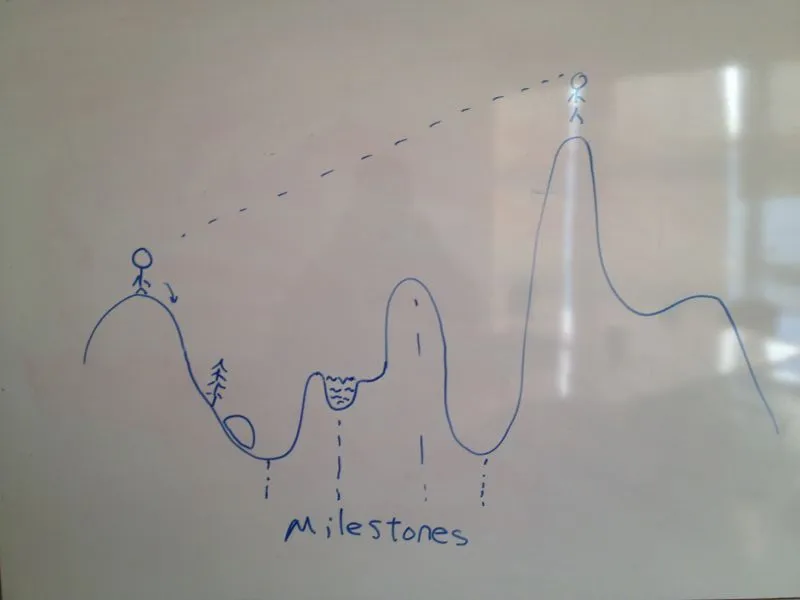
Pointing at the little stick figure, he said: “This is where you are now; this is where you want to go (DE). It should be deeply imprinted in your mind. You will go through ups and downs, encounter canyons, streams, rocks, smog, … When you are at the bottom of a valley, you can no longer see your destination. Many people get lost right there. But if you know clearly where you are going and keep that vision in your mind, then you can cut a road through every mountain and build a bridge over every river; all obstacles will become milestones, stepped over and left behind you.”
Oliver and Adam share the same tool for achieving goals. Adam said that while he was building Siri, he envisioned the sample app ads in Apple retail stores featuring Siri alongside Google, Facebook, Twitter, and others. He even imagined Siri becoming so successful that every Apple Store entrance would hang a banner: “Introducing Siri.”
That is the importance of visualizing your goal in your mind. It makes the goal like a bright lamp, guiding you forward all the way.
It’s all about people
Of course, no success is possible without people. No matter how good the method, it still depends on people to use and realize it. So: it’s all about people. No further explanation needed.
During the Q&A, I had wanted to ask: “Do you think Siri met your expectations?” But the room was too hot—too many people—and I couldn’t get a word in. After listening for a while, I quietly left.
Slides from the Meetup are here: http://www.adam.cheyer.com/papers/StoriesParallel.pdf