A Story Aboard CA985

After an eleven-hour flight, this programmer finally landed safely in San Francisco. It was a strange flight, the kind you don’t forget. Without quite meaning to, I played Lei Feng and did a good deed — even the airport ground staff praised me to the skies; all that was missing was a red Young Pioneer scarf around my neck and an official “Good Guy” card. Still, I’m confident that once you’ve read this, you’ll agree that in my position you’d have made exactly the same choice (probably a better one).
Here’s how it happened. I’d asked for a seat by the emergency exit — which, as it turned out, wasn’t such a great seat: a middle seat, wedged between the aisle and the window. On my left, an uncle bound for Santa Clara on business; on my right, a woman who lived in Las Vegas. She seemed perfectly normal until, shortly after takeoff, she asked a flight attendant for wheelchair service on arrival. I couldn’t help asking: “You look fine — why do you need a wheelchair?” And so she told me about the car accident years ago and its aftermath: as the plane descends, blood supply to her brain drops, her whole body goes limp, she has no strength left, and she needs a wheelchair. I was shaken. Everyone, it turns out, carries a story of their own fortunes or misfortunes.
She’d been settled in the States for over a decade — first running a gallery in SF, then moving with her husband to Vegas, where she now teaches children to paint. She showed me her paintings of flowers; genuinely lovely. I’m a crude fellow far removed from art, with no work of my own to show, so I showed her my one and only masterpiece — my little Xiaobao. I showed her photos, and the video I’d made for Xiaobao’s 180-day milestone. She has no children of her own but loves them dearly; watching Xiaobao’s various adorable expressions, and telling me how her sister’s grandchildren call her “Grand-aunt,” her face was pure happiness. I asked if she was going back to visit family. She was. To Tangshan, to see her parents.
“Tangshan?”
“Yes,” she said. “I’m a child who crawled out of the ruins of the Tangshan earthquake. I was only six or seven.”
I was stunned. I hadn’t expected there to be a story like that sitting next to me. She said her family lived in some county in Tangshan, right at the epicenter. When the quake hit, her father smashed a window and led all the children out. On the way out, she — silly child — thought it was fun, felt happy. Then it started to rain, a huge, huge rain. After much scrambling they hid under an olive-green makeshift tent, watching hot water gurgle up out of the ground.
So we chatted on and off — the earthquake, the painter, the gallery, the car accident, Vegas — and I felt her life alone could fill a movie. Along the way I helped her with whatever small things I could: pouring water, throwing out trash. My seat was right by the galley, after all. Besides talking, I didn’t neglect my own writing. I didn’t dare sleep on the plane (I was carrying some valuables and afraid of losing them), so I typed away and finished two pieces, “Wayfarers’ Travel Dreams” — next week’s articles were basically done.
San Francisco was in sight, the plane descending bit by bit, and her condition began to worsen. Suddenly she grabbed a sick bag in a panic and started dry-heaving. I assumed it was ordinary nausea and didn’t ask. After the plane came to a stop I asked how she was; she shook her head, her expression pained. I asked whether she had luggage I could get down for her. She said no, but asked whether I could wait a moment so we could go together once her wheelchair arrived — she had two large pieces of luggage and needed help pulling them. I thought, fine, it wouldn’t cost much time, so I got up to fetch my own bag. When I came back to the seat, she was sitting on the floor, still in pain. A flight attendant came over, asked a few questions, but didn’t report it up the chain or take any emergency measures. (Later she told me that oxygen at that moment would have helped a great deal.)
Eventually the cabin had nearly emptied. The flight attendant said the wheelchair service had arrived, so I helped her up and we headed for the door (oh, flight attendants). At the door, the wheelchair still wasn’t there, so the attendant sat her down in the first row to rest. That’s when an older ground-crew man (Taiwanese, it seemed) objected: she had to leave the aircraft, he said, or it would interfere with his work. The purser argued with him for a while to no avail, and finally just helped her off the plane. There she dropped onto the ground again, seemingly dazed, murmuring: didn’t I ask for wheelchair service? Why hasn’t it come? The purser hurried to explain that the wheelchair might have been commandeered by someone else — she’d clearly requested three. Then she turned on the young flight attendant who’d been sitting across from me and gave her an earful: how could nobody have notified anyone when a passenger had collapsed on the floor? So there they all were, a crowd of people arguing and shouting, and nobody actually solving the problem. And for some reason the purser and the attendants all seemed in a desperate hurry — in the face of a situation this serious, every one of them was rushing to leave. At last the wheelchair arrived. We got her into it; she was slightly better and took out her painkillers. I quickly flagged down a flight attendant and asked for water.
Then the purser remembered to ask who I was to her. I said I was nobody, just a random guy who happened to sit next to her. She asked if I’d help with the luggage. We went all the way down the green channel to the checkpoint. The purser hurried off, and before leaving explained over and over to the half-dazed woman that she had requested the wheelchair, that something had gone wrong in between, please forgive her, ground staff would help her shortly. Not long after she left, two female officers appeared — one Chinese, one Western. I explained the situation. The Western officer asked whether she needed an ambulance; she said no, she’d taken her medicine and would be fine in half an hour. The Western officer was skeptical and said that in her current state she couldn’t be allowed to board a connecting flight. The Chinese officer, hearing that I was nothing to her, just a random guy, was astonished — and gave me several thumbs-up in a row.
I cleared customs without trouble. But something seemed off with her passport and green card, and the African-American officer handling clearance insisted she go to the “dark room” (second office). I was somewhat bewildered — what was this about? What should I do — go with her or not? I trailed behind, my face a mask of black lines. More than once I wanted to just turn around and exit, to be a random guy to the bitter end — but the power of a promise is enormous; I was utterly powerless to resist it. Seeing me lagging behind, the Chinese officer waited a few steps for me. I shrugged at her, helpless. She said, you’re a good person, come along; hopefully it’ll be sorted quickly.
In the dark room (all the heroes with entry problems gather in this dark room), the Western officer muttered a few words under her breath — the gist being that she’d seen this kind of scam before: people with green-card problems pretending to be ill to slip past the clearance officers. I was startled, and my heart went cold. Had I been played for a fool — was this a setup from beginning to end? But she didn’t look like she was faking at all…
Fortunately, she wasn’t. We stayed in the dark room only a short while before everything was processed (a misunderstanding, apparently), and then went out to collect the luggage. We found mine and one of hers without trouble. While waiting for the second piece, a problem arose with her connecting ticket. I looked at my watch — I should have cleared customs an hour ago… Now the luggage wasn’t a big issue; apart from the Filipino kid pushing the wheelchair, there were these two officers with her, and the ticket problem wouldn’t be resolved anytime soon. My value there was no longer great.
So I said I was worried the person picking me up would get anxious, and I had to go — there was nothing more I could help with now. She called me over, gripped my hand hard, and said, you’re a good person. The two officers waved their thanks. Just as I was leaving, the Filipino kid grabbed me too and shook my hand, giving me a big thumbs-up (You’re a good guy). Hmm. So once I’m back in China, I really ought to consider going to Xiushui Market and buying myself a good-guy certificate.
Later she sent me this text message:
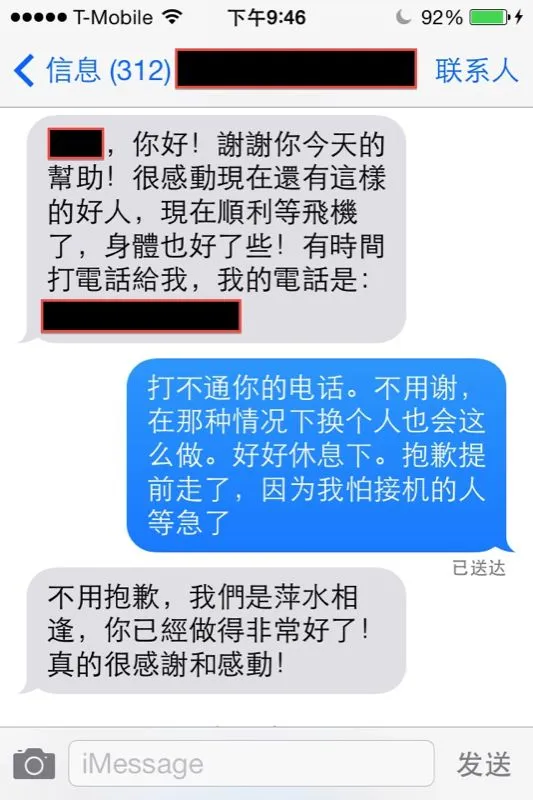
I hope everything goes well for her from here on.
It suddenly occurs to me that today is Mother’s Day. I’d like to think this is a special gift for my mother — she’ll be proud of this small thing I did.