Recommending an Old Book: *Mathematics: From the Birth of Numbers*
Tonight, walking past the secondhand bookstore near my home, I meant only to browse for a bit — and then, in a corner of the shelf, I came across a thick 1997 volume: Mathematics: From the Birth of Numbers.
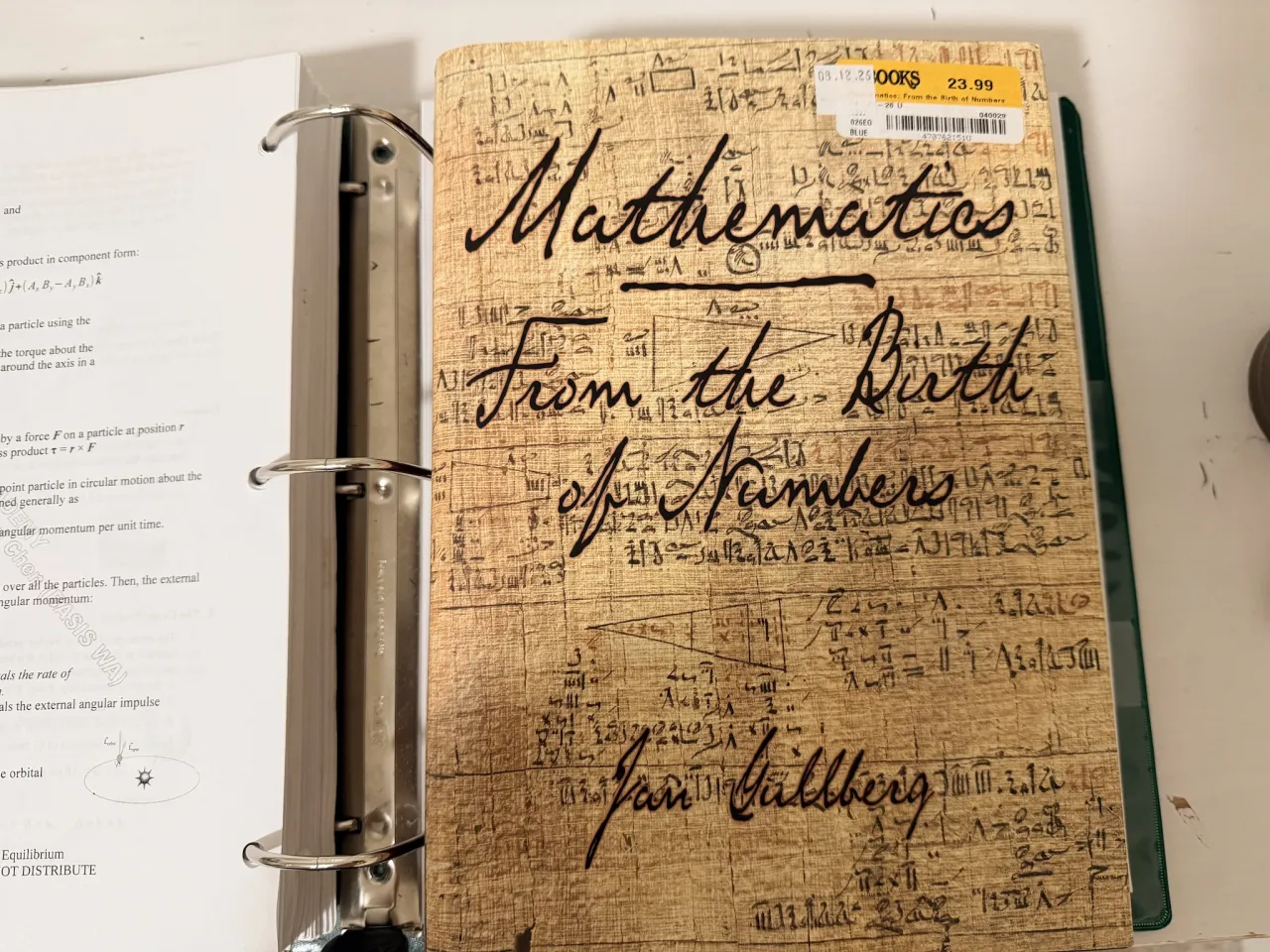
The book is heavy, and in remarkably good condition. Opening it to the preface, I stood there in front of the shelf reading for a long while. The author says the book took him a full ten years to write. Instantly I thought of Donald Knuth, whom I have always admired beyond measure — a decade forging a single sword, and that sword was TeX. Anyone willing to polish their work like that is, to my mind, an extraordinary person. A formidable one.
I carried it home, to serve as leisure reading for Xiaobao and me.
A Surgeon’s Book on Mathematics
The author, Jan Gullberg (1936–1998), was Swedish. His profession was surgery and anesthesiology — not mathematics.
He graduated from the medical school at Lund University in 1964, and afterward practiced medicine in Saudi Arabia, Norway, Seattle’s Virginia Mason Hospital in the United States, and Sweden. In 1980 a popular-science book of his won a commemorative prize from the Swedish Medical Association, and in the same year Lund University granted him an honorary doctorate.
Mathematics: From the Birth of Numbers was his second and final book, published by W. W. Norton in 1997:
- 1,093 pages of text across 34 chapters, weighing roughly 2.2 kilograms;
- more than 1,000 original technical illustrations, drawn by his son Pär Gullberg;
- a foreword by the British mathematician Peter Hilton — a homotopy theorist who worked on codebreaking at Bletchley Park during the Second World War;
- a first printing of 17,000 copies, nearly sold out within six months;
- and on May 21, 1998, the author collapsed at his post in the hospital where he worked, dead of a stroke at sixty-two.
In other words, the book was published less than a year before the author died. He presumably saw readers carry it away, one copy at a time, with his own eyes — but he never saw the long life it would go on to have.
His own attitude toward all this was a charming piece of self-deprecation: “At first, no ‘real mathematician’ would accept my book. Perhaps writing a mathematics book really is a bit crazy for me — like asking a mathematician to write a book on surgery.”
What Kind of Book Is This, Really
Before reading it, you need to correct one expectation: this is not a history of mathematics, and it is not a textbook. More precisely, it is a hybrid of three things: a map of the mathematical world, a museum of mathematics with a docent attached, and an encyclopedia running from arithmetic all the way to differential equations.
The 34 chapters follow one clear narrative arc: starting from the birth of “number” and “language,” passing through arithmetic, combinatorics, logic, sets, sequences, and equations, then into geometry, trigonometry, analytic geometry, vectors, matrices, and fractals, then calculus, series, and complex numbers, and finally arriving at harmonic analysis, probability, and differential equations.
I love this kind of synoptic sweep — a book like the master scroll of the Nine Yin Manual. Its greatest value is not that it treats any single field in exceptional depth, but that it lets us see:
- why a mathematical concept had to be invented;
- what difficulty in the old system the new concept resolved;
- how arithmetic, algebra, geometry, calculus, and probability connect to one another;
- that mathematics is not merely a system of formulas, but a language, a set of representational technologies, and a history of civilization.
In a single sentence: how humanity walked, step by step, from “there are three sheep here” to “using differential equations to describe the evolution of planets, waves, populations, and physical systems.”
Behind this lies one core conviction of the author’s: for every concept he explains, he first explains why. What difficulty did the old system run into, what problem did the new concept solve — rather than, as a textbook does, simply handing down definitions and formulas.
I believe this way of organizing material is exactly how an introduction to mathematics ought to work. Mathematics is, in truth, a marvelous discipline; it is simply that good teachers of it are scarce.
What Amazon Readers Think
This book’s reputation on Amazon is astonishing: the top-voted reviews are almost all five stars, and many are “long reviews” running over a thousand words. I’ve sorted them by theme.
He wasn’t a mathematician — and that’s precisely why the book is good
A highly rated 2005 review (Stan Vernooy, “A Desert Island book for math lovers”) opens like this:
“How did this guy do it? He wasn’t even a mathematician — he was a doctor. And he wrote a book that’s fascinating for both mathematicians and non-mathematicians.”
A British reader (Chris Whealy) puts it more bluntly: “The fact that Jan Gullberg is not a professional mathematician is precisely what makes this book so good.” The reason: his thinking was never confined to the tram-lined tracks of conventional mathematics teaching, so he could explain serious content in a relaxed way.
He explains why each concept was invented
Again from Vernooy’s review, which names the book’s most irreplaceable quality:
“He includes the history of how — and WHY — each major mathematical innovation was developed, placing the entire subject in a human and historical context that is missing from almost any other book.”
“However good your mathematics, this book almost certainly contains historical facts you have never seen; however poor your mathematics, you will find it readable and enchanting.” — a summary many people quote.
It’s a reference book, not a textbook
Nearly every clear-eyed review adds this warning. N. Mozahem (2011, five stars) puts it most plainly:
“It has been said that if you are to own one math book, then this should be it… However, you must be warned that this is not a textbook. In many cases the author does not explain how he got a certain result. Instead, he just writes it down.”
A four-star review (Bob Lewis) distills the impression into a wonderfully apt headline: “A mile wide; lacking a bit in depth” — “a whole textbook, or even a whole library, would be needed to do justice to the subject of a single chapter here.” That line has since become one of the most frequently quoted verdicts on the book.
It belongs within arm’s reach of every lover of mathematics
A teacher who uses the book in an advanced mathematics course (D. G. Frank) writes: “It should be on every math major’s bookshelf, and within arm’s reach of every math aficionado.” He himself assigns it as supplementary reading in his own course.
Vernooy’s review ends with just two words: “Unparalleled and irreplaceable.” He even says he first bought the paperback, then realized he had to buy a hardcover as well, “to keep on my shelf until the day I die — except when it’s on my knee or on my desk.”
Two other readers’ stories particularly moved me: one says he lost the book and immediately bought another (“it covers virtually everything from school mathematics to early university mathematics”); another says “the book is so interesting that if I’m heading out and know I’ll be waiting for someone, I take it with me.”
Humor and illustrations: a matter of taste
Amusingly, even the book’s flaws are contested. Some people detest the doggerel and cartoons scattered through it (Vernooy: “most of them aren’t funny, they’re just distracting”); others adore them (Mozahem lists “genuinely funny cartoons” among the book’s three great virtues; a 2024 five-star review says it “brims with humor, charm, history, and a love of numbers”).
These disagreements themselves are telling: the book has a personality. It is not an assembly-line product.
What Professional Reviewers Think
Publicly available material I found through AI search shows that in January 1999, the American Mathematical Monthly ran two reviews of this book in the same issue — one praising it, one damning it. Quite fascinating.
Arnold Allen’s review is nearly all praise:
“Gullberg’s book is clearly the overall winner. … It is a wonderful read. I take it with me everywhere I go.”
His favorite section is Chapter 4, “Cornerstones of Mathematics” — a chapter that displays ancient Egyptian duplation multiplication, Russian peasant multiplication, the Babylonian method for square roots, abacus multiplication and division, and the Pascal triangle in its different Chinese and European forms. He marvels that “the long multiplication we learned as children is only one algorithm among many.” He also singles out the book’s two-page treatment of Fermat’s Last Theorem as “just right for the mathematically faint of heart, while retaining a certain depth.” His conclusion: “This is a giant step forward for mathematics and for all who love it!” He even suggests that every high school mathematics teacher in America should be given a copy.
The other review, by Harold P. Boas, is far cooler in tone. He holds that the book’s most brilliant parts are the history, the recreational mathematics, and the more elementary material; but once it reaches calculus, some chapters increasingly resemble condensed versions of conventional textbooks, easily giving readers the impression that “mathematics is formulas and algorithms.” He also lists a number of typographical errors, one miscalculated indefinite integral, and problems with the treatment of Cauchy’s mean value theorem, and observes: the book gives readers almost no sense that a great deal of mathematics was developed in the twentieth century.
Two popular-science magazines form a similar contrast: Scientific American reviewed it favorably, while New Scientist was more reserved. Kevin Kelly, on his Cool Tools site, compares the book to an oracle: “It’s like an oracle; if you want to know what some obscure mathematical concept or theorem is (What’s a Cantor Set?), you go here. The book has wit and humor; you’ll need persistence.”
My Impressions After a Hasty Browse
Once I got the book home, I didn’t start at the beginning. I flipped through it haphazardly first. A book of over 1,100 pages turns like a visit to a museum: pause here, glance twice there, linger a while at any interesting figure in the margin. Yet amid the skimming, a few main threads surfaced with striking clarity.
Mathematics is a kind of “representation engineering”
This is the hidden thread that enlightened me most. A number is a semantic value; a notation is an encoding: 345 and CCCXLV are the same number, but the former makes a uniform algorithm for addition, subtraction, multiplication, and division possible, while performing the same operations in the latter is far more laborious. Analytic geometry translates geometric problems into algebraic ones; matrices translate systems of equations into transformations; Fourier analysis translates a time-domain signal into frequency components; power series translate complicated functions into polynomials.
Mathematics often advances not because the world itself has changed, but because we have found a better representation.
I adore this reading: the same problem, given a different representation, turns from impossible into possible. The most famous example in history is the logarithm. Sixteenth-century astronomers computing the product of two large numbers would routinely spend an entire day on it, and then have to verify the result repeatedly; after Napier invented logarithms, multiplication became addition, a matter of consulting a table. Laplace later said that logarithms “by shortening the labors, doubled the life of the astronomer.” A good portion of the formulas and symbols we memorized as children are, in essence, a “change of representation”: the same √2, written as a decimal, is 1.41421356…, never finished, but written as a radical sign, it’s done in a second. Why does a computer use only 0 and 1? Because a circuit’s switch naturally has only two states, on and off, and binary matches it exactly. People really did build decimal computers early on (ENIAC was one), and the result was so complex, bulky, and hard to maintain that eventually a change of representation made everything simple and clear. You see — even something like “can a machine do arithmetic” depends on the representation. Half of mathematical skill lies in knowing which language to put a problem into.
The same holds in software development: once you have modeled the system you are building in the most fitting way (the core data structures), everything else falls into place.
Mathematics advances through the failures of old systems
The natural numbers can’t do 3 − 5, so we get the integers; the integers can’t do 1 ÷ 2, so we get the rationals; the rationals have no √2, so we get the reals; the reals can’t solve x² = −1, so we get the complex numbers.
N ⊂ Z ⊂ Q ⊂ R ⊂ C
Each expansion of the number system is not mathematicians manufacturing ever stranger objects, but rather “making natural operations solvable within the system” — you can think of it as a type-system upgrade in the mathematical world. Anyone who has written code will smile here: isn’t this just patching an old type until you’re finally forced to introduce a new one? The history of mathematics is not a heap of knowledge points but a chain of “old system → hits a boundary → enlarge the objects or change the representation → new system emerges.”
Mathematics shuttles between the discrete and the continuous
The first half of the book is the discrete world: integers, combinatorics, graph theory, sequences, equations. The second half is the continuous world: limits, calculus, differential equations. And the most thrilling chapters are precisely the bridges between the two: series use discrete sums to approximate continuous functions, integration moves from discrete partitions toward a continuous limit, Fourier series describe continuous signals with discrete frequencies.
This reminds me of the first time I was stunned by “infinity” in high school: a single finite rule (say, the Fibonacci recurrence) can generate infinitely many numbers; and adding those infinitely many numbers together, endlessly, can still converge to a finite number: 1/2 + 1/4 + 1/8 + … = 1. There, in that equation, lies the answer to Zeno’s Achilles, who can never catch the tortoise. Infinity is not “very very many”; it is a process, a limit. The discrete is a rule of finite steps; the continuous is a limit of infinite fineness — and the most beautiful thing about mathematics is that it builds bridges back and forth between them.
Exactness and approximation are not a hierarchy
Basic education gives one a false impression: that every problem has a pretty, exact, closed-form answer. But this book walks from exact arithmetic all the way to series, approximation methods, and probability, displaying a more mature view of mathematics: understanding where the error lies, and why an approximation can be trusted, matters more than clinging to perpetual exactness.
For those of us raised on “the standard answer,” this is a loosening at the level of worldview: mature mathematics does not insist on being forever exact; it knows clearly what it knows, where the error lies, and why the approximation is trustworthy.
Mathematics is also culture, not merely curriculum
The book is full of marginal figures, historical images, anecdotes, and roads that led nowhere. School curricula give you only “definition → formula → exercises”; this book restores the deleted parts: where the problems came from, which detours our predecessors took, how notation evolved, and why today’s methods were finally adopted.
This is exactly why I think it suits “Xiaobao’s leisure reading”: it does not rush to teach you how to solve problems, but first lets you see that mathematics was walked out by human beings, step by step, and that behind every symbol lies a story.
After skimming it, I set the book by my bedside. Eleven hundred pages — I will probably never finish it, and that doesn’t matter. A good mathematics book is not meant to be finished; it is meant to keep drawing you back. At the very least, this one has rekindled the urge to open it in a middle-aged man who “was once decent at math and later forgot it all.”
Coda
This secondhand copy cost me 24 dollars. Back home, browsing the reviews on Amazon, I found the new book discounted to 35% of list price — just 26 dollars now. Unfortunately only one copy remained in stock, and I don’t know which fortunate soul will end up with it. Had I not happened, by chance, to decide tonight to accompany my wife and kids to the secondhand bookstore (ordinarily the three of them go without me), I would never have discovered it in that corner, and this lovely encounter would never have happened. The world is like that — wondrous, and full of unexpected delight.