Reflections on Akeelah and the Bee

Our little one recently came back from a piano competition with her wings clipped, and moped for days. To lift her spirits, my wife went out of her way to find an inspirational film — Akeelah and the Bee — and we all watched it together. Our daughter watched with real concentration, and I drew a good deal of strength from it myself — especially the reminder of how much a harmonious family matters to a child. I had meant to dash off a few lines recommending it to friends with kids, but my wife said she’d seen the film back in 2009 and was so utterly moved that she wrote her very first blog post about it — and with her permission, I’m reposting it here. All tips for this piece go to my wife. Consider this an official declaration.
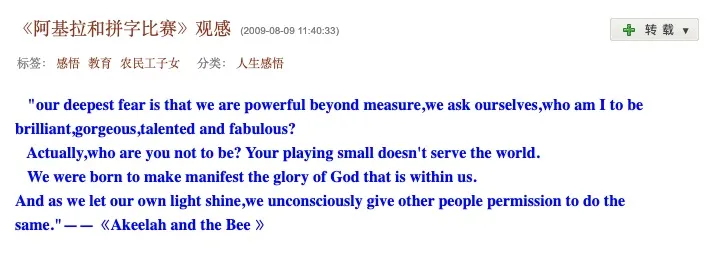
our deepest fear is that we are powerful beyond measure, we ask ourselves, who am I to be brilliant, gorgeous, talented and fabulous? Actually, who are you not to be? Your playing small doesn’t serve the world. We were born to make manifest the glory of God that is within us. And as we let our own light shine, we unconsciously give other people permission to do the same. - “Akeelah and the Bee”
Today I caught a 2006 Hollywood film on the movie channel, Akeelah and the Bee. It’s deeply moving and deeply instructive. It tells the story of an eleven-year-old girl who is heartbroken after her father dies when she is six, and who discovers that spelling — being drilled on words, over and over — eases the pain. So she keeps memorizing words and playing spelling games, and eventually gets the chance to represent her school in the spelling bee. Step by step, through preparation and competition, led by a professor, encouraged by friends and, later, supported by her family, she finally succeeds. Here is what the story taught me:
-
What each of us fears most is not other people (an opponent, say), nor any particular event (a competition, say), but ourselves. Overcome your fear of yourself and your self-doubt, and success will follow.
-
How much a family matters to a small child. This was my feeling from the very start. Her mother has several children, one of them a son who runs with the local toughs every day. When Akeelah brings up the spelling bee with her mother again and again, her mother either won’t listen or flatly refuses to let her compete. I came to understand this mother’s hardships later on, but I still believe that had she supported her daughter from the beginning, Akeelah might have succeeded sooner and with less difficulty. I often lament that many children from poor families fail to succeed, or even go astray; in truth it isn’t that their families lack money for material support — it’s that parents in such families often don’t know how to raise children, and many potentially successful kids get buried. This is also why I’m drawn to public-interest work, and why I’ve lately been following the education and upbringing of migrant workers’ children. (A pity I haven’t yet found a way to contribute directly — for now I’m still just watching closely.)
-
The importance of love. In the latter half of the film, when Akeelah’s coach is unwilling to keep teaching her, her mother tells her that the people around her are all ‘teachers.’ The film devotes many shots to showing how Akeelah memorizes the last and hardest five thousand words — through those ‘teachers’ around her: classmates, the old man at the grocery store, restaurant staff, passersby, the neighborhood toughs, and her family. Anyone can become your companion and mentor on the road to success.
-
I thought preparing for a spelling bee must be dreadfully boring — countless obscure, difficult words to memorize, and to what end? The story tells us that while you’re preparing for a boring competition, shift your angle and it becomes something interesting. Akeelah’s coach doesn’t have her memorize words for the sake of the contest; he has her read fine writing first. The friendship between Akeelah and her teammates, including the ending — where, so that a boy who was once her rival wouldn’t have to settle for second place one last time, Akeelah deliberately misspells a word, and the boy refuses to take first place that way (a lesson in kindness, honesty, and dignity) — all of this is what she gains, and what I, as a viewer, gained as well.
-
For success, how important a mentor is. He teaches us the method for reaching a goal, and more importantly, he helps us understand what our own purpose is. The film also exposes the drawbacks of Chinese-style education: the father of Akeelah’s biggest rival, a Chinese-American boy, is extremely strict, demanding that his son succeed no matter what; the day before the finals, while everyone else is relaxing and having fun, the boy is still memorizing words under his father’s supervision. Because his father, too, sees only winning first place itself, and ignores the purpose and meaning of competing.
-
Those who help others will have many friends. At her first competition Akeelah is terribly nervous; a boy comes over on his own initiative to chat with her, encourage her, and share some tips, and the two later become fast friends. Another of Akeelah’s rivals, driven by his father’s stern expectations, does nothing but grind away at word lists; strong as he is, he is not happy. Later, with Akeelah’s help, the two become friends, encourage each other, and in the end succeed together. Here I saw what a win-win looks like.
-
Respect others and talk with them more; everyone’s life is fascinating, and anyone might be your teacher. Akeelah’s brother hangs around with a local gang leader — yet this very man tells Akeelah that he once won first prize for poetry. Surprising, and quite moving.
-
When Akeelah qualifies for the finals she becomes a local celebrity; reporters interview her, classmates idolize her, and she turns into a little star. I honestly worried about her. In real life, plenty of newly minted stars (adults among them), and plenty of prodigies from accelerated programs for the gifted, end up losing themselves to the halo others drape over them. They catch sight of the moon and think they’re already radiant, and in doing so forfeit the chance to see the sun. I’m glad Akeelah didn’t lose her way: she knew what she was doing, and she knew who mattered most to her — and so she succeeded. I’m reminded of the line: To be the best of yourself. When you’re on the verge of losing yourself, that line is enough.
-
Akeelah’s feelings for her father may not be something everyone can feel. He is her spiritual mainstay. The moment in the film that moves me most is Akeelah looking up and smiling into the air: I did all right, didn’t I? The death of a loved one — above all someone closest to you — is a lifetime’s pain. But then, thinking about it, they can be beside us at every moment, encouraging us, speaking with us; that too is a happiness to be found in loss. In Akeelah I saw strength, optimism, and happiness.
That is what one ordinary inspirational film left me with. Gently, through the growth of a little girl, it taught me how to grow.
P.S. The words in this film really are absurdly obscure and absurdly hard. Two I most want to remember:
- Beautiful: p-u-l-c-h-r-i-t-u-d-e
- Love: L-O-V-E