The Remains of the Day (Part V)
(I)
For most of my children’s upbringing, I have played the part of the absentee manager. When it came to our eldest’s schooling — piano, skating, dance, drawing, reading, writing, arithmetic, science — it was always Mom who did the worrying, to say nothing of the younger one. I was busy with work all day: when I left in the morning the children were still fast asleep, and by the time I got home night had fallen and the whole family was waiting on me for dinner. Before dinner I went through the motions of hugging the kids and playing with them for a few minutes; after dinner I shut myself in the study to attend to my own work, read my own books, and write my own essays. When the children occasionally burst in seeking my attention, I mostly dismissed them with a sentence or two. By the time they were ready for bed, my staying at the bedside to tell a bedtime story or work through a math problem together had ironically become the longest stretch of time I spent with them all day.
My wife, understanding my endless work and idle pursuits, pleaded with me to carve out half an hour a day to read with the children. I agreed, made a great show of it for a few days, and then relapsed into my old ways. Later she lowered the minimum standard: at least one evening a week, half an hour to an hour, teaching Xiaobao Scratch. That too turned out to be a moon in the water, a flower in the mirror.
In the blink of an eye Xiaobao was about to turn seven, and Xiaobei three. Juggling two children, my wife was gradually running out of steam. Xiaobao had not yet formed any habit of self-discipline; without her mother at her side, piano, math, reading and the rest were a mess. And the little monster in Xiaobei’s heart had begun to stir, forever competing for Mom’s attention. Neither child would yield to the other, and there was no reasoning with either; the one holding the upper hand crowed with delight, while the one losing out rolled on the floor, threw tantrums, and wailed. Because Xiaobei was the second child, she had been shrewder since the womb, better than Xiaobao at reading faces and charming her parents, so in the contest for Mom’s attention it was usually Xiaobao who lost. And Xiaobao, being pure of heart and utterly guileless, would neither give in nor sweet-talk anyone; when angry she railed at heaven and earth, which only made her mother angrier still. My wife was worn ragged and often poured out her grievances to me; I voiced sympathy but took no action whatsoever. Then one day mother and daughter nearly fell out over piano practice, exchanging a great many harsh words in the heat of the moment that should never have been spoken. That night, as we were going to bed, my wife said to me through her tears: “You figure it out. If this keeps up, by the time she’s a teenager our relationship will be in ruins.”
My heart skipped a beat. I remembered the time Xiaobao had begged me to play with her, been refused, and slammed the door on her way out with the words: “Work, work, nothing but work! You’re a dad who doesn’t care about his kids!”
The next evening was the parent-teacher meeting for the new first-grade semester — the first one I had ever attended. Shamefully, Xiaobao had been at Sunny Hills for a year and I didn’t even know what the previous teacher, Miss Wolfe, looked like. American public schools get a new teacher each year, and the new one was Mrs. Dunn. I sat there lending an ear, but what gnawed at me was the question: “In my children’s growth, how do I fulfill a father’s duty and lighten Mom’s burden?” Reflecting, I recognized two problems in myself: 1) I had all this knowledge, and I was willing to spend time writing essays and giving talks to pass knowledge and skills on to others, yet I begrudged cultivating my own children. 2) I fancied myself a formidable learner, able to master whatever I set my mind to, yet I was too lazy to put in the work of learning how to educate children, to study the relevant knowledge. After turning it over, I decided to tackle problem 1) first — invest time in cultivating my children — and then deal with 2), continuously learning so that I might be qualified to educate them.
So in that classroom — the very room where Xiaobao sat through her lessons by day — with the very paper and pen she used for her studies, I solemnly wrote down the following plan:
Every night 8:30–9:10:
- Monday: History stories (explore the fascinating tales of the Twenty-Four Histories together, deepening Xiaobao’s identification with Chinese culture and her love of Chinese characters and the language)
- Tuesday: Mathematics (together we explore the wonders of numbers and cultivate her number sense)
- Wednesday: Scratch (Xiaobao adores programming; we’ll build fun things together to cultivate her logical thinking and her ability to break complex problems into pieces)
- Thursday: Exploration (Xiaobao asks me so many “whys,” and my answers are terribly shallow; through “exploration” we’ll kindle her curiosity and her capacity for finding deeper answers)
- Friday: Documentaries (a deep walkthrough of one documentary, broadening her horizons and touching the “unknown unknowns”)
- Saturday: Geometry (which is really just math, but I don’t want Xiaobao to feel she has math twice a week; geometry is a powerful weapon for explaining math from another dimension)
- Sunday: Roll the dice, or let Xiaobao choose what extra to study
As for long-term feasibility, I had no confidence in how far this plan could run — quite apart from whether I myself could stick with it, there was the question of whether Xiaobao, after the initial excitement wore off, would resist, feeling that “it’s nothing but study every day and no time to play.”
As for the feasibility of the content, I had even less confidence. I know what’s in my own belly: Monday, Wednesday and Friday are the easiest — a bit of light prep and I’m fine. Tuesday and Saturday will probably require some cramming on my part after a while — especially on how to teach dry mathematics vividly to a child not yet seven. Thursday is like Schrödinger’s cat: until Xiaobao reveals her question I have no way of knowing what kind of challenge it will be.
After the meeting I told my wife about the plan. She was delighted, because it would lighten her day by nearly an hour, leaving her to face only one little hellion. But she worried that my methods might be wrong, that I’d pull the seedlings up to help them grow, and end up destroying the child’s interest in learning. I said let’s give it a try: the material within her syllabus you keep teaching; I’ll take charge of broadening her horizons and nurturing her curiosity about exploring knowledge.
(II)
With the parent-teacher meeting as tailwind, the next day, September 12th, Xiaobao and I made our first attempt. It was Thursday, so our topic was “Exploration.” The questions Xiaobao threw out were: How many people are there in the world right now? Which countries have the most people? Will the population ever decline?
To make the lesson go well, I spent some time preparing, finding some videos we could watch together. I am a firm believer in build-measure-learn: if I’m going to do something seriously, I’ll record it in detail (especially my own perceptions) so that I can keep improving. So I opened a new WeChat public account, “Uncle Tian’s Curious Talks,” and put my scattered notes from preparing and teaching there. Through the iteration of teaching and recording, I kept thinking about one thing: how do I make a child fall in love with the lesson every night?
Making someone “obsessed” is both easy and hard. Games suck people in easily, so much so that we need “anti-addiction systems” to rescue those drowning in them; but learning something new, done the wrong way, not only fails to captivate but may trigger a backlash of aversion. The reason is that games build attraction through multiple senses — sight, sound, touch — and ignite our curiosity. With curiosity we’re willing to try and experience; and once we try, feedback comes quickly, and we adjust our strategy according to that feedback (the strategy is usually simple and easy, or can be improved through plain practice), yielding better feedback (clearing a level, higher scores, regaining health, extra lives, leveling up, making the leaderboard), which brings physical and mental satisfaction while our (in-game) abilities improve and unlock more unknown worlds.
If we abstract out this pattern, it is: build attraction — spark curiosity — encourage trial — immediate feedback — encourage further trial — heighten the sense of achievement and satisfaction — empower. I intended to apply this pattern to our daily lessons.
On September 14th, this strategy of building attraction and sparking curiosity was fully validated. That was a geometry day, and Xiaobao and I explored π. I scrounged a ball of string from Mom, taught Xiaobao to draw a circle of radius 10cm with a compass, and then we measured the circumference bit by bit with the string, finally computing a not-so-precise ratio of circumference to diameter: $π = 3.135$. This simple hands-on exercise greatly sparked Xiaobao’s interest in π — so much so that she later asked Siri for the value of π, wrote it down, and memorized it bit by bit — all fifty decimal places!
As the pattern kept rolling and evolving, our “classroom” grew ever more lively. We turned her little bicycle upside down to watch the pedals drive the chain; we lay behind the car’s rear end to look at the exhaust; we opened the piano to observe the strings vibrating; we used Go stones to do addition, subtraction, multiplication and division and to learn number bases; we used the “Activity” app to learn statistics and all kinds of charts.
(III)
Of all the lessons, the one I cared most about was math. Mathematics is the mother of science; everything in our lives, from the Dongfeng “Express” down to the activity app, is bound up with it. A child’s cognitive and abstractive powers grow out of a deep grasp of mathematics, yet math education in China or Singapore emphasizes mastery and drilling of knowledge points and is rather dull, while America’s Common Core, though it values different methods and approaches, still can’t escape dullness — so that children, mired in tedious repetition, tend to keep mathematics at arm’s length.
But mathematics itself should not be dull. It is beautiful and nimble, like the goddess of the Luo River in Cao Zhi’s dream — “Startled like a swan in flight, graceful as a wandering dragon. Seen from afar, radiant as the sun rising through morning clouds; observed close at hand, brilliant as a lotus emerging from clear waves.” Whether it’s the lovely golden ratio, the wondrous Pascal’s triangle, the uncanny primes, or elegant geometry, rigorous logic, mind-bending algebra, the world-illuminating calculus — or those formulas and theorems, each a crystallization of the sages’ wisdom, that yet inspire awe and dread — all of them leave one intoxicated, refreshed in spirit.
And yet our math textbooks, in China and America alike, are little more than formula manuals, and the teacher’s job is to fix those formulas in children’s heads so that they master, at the appropriate age, what the syllabus requires. And how is mastery achieved? Day after day of drilling — like joyless muscle training in a gym. But this robs children of the pleasure of climbing a mountain outdoors — of laying road when they meet a mountain and bridging water when they meet a river, of solving problems in the field — the pleasure that learning mathematics ought to afford, and the very path walked by Gauss, Euler, Descartes, Leibniz, and Ramanujan.
What we need, then, is a great deal of exploratory learning — smash the exquisite edifice that textbooks build out of formulas, and guide children to put up the scaffolding again, to follow the sages’ thinking and retrace the paths they explored, even to walk roads they never walked. Only such learning is truly meaningful; only thus does one acquire the real ability to solve problems, rather than the ability to memorize formulas and plug numbers into problem types. Of course, I don’t deny the importance of practice — “to learn and constantly practice it” — exploration should be supplemented with an appropriate amount of training for consolidation. But we must not mistake the branch for the root. A gorilla in a zoo, after training, can learn to use tools too; what sets us apart is that through exploration and reflection we can discover patterns and generalize them.
Gauss said: “What we need are notions, not notations.” I couldn’t agree more. All growth of the mind comes from solving problems oneself, not from being trained to solve them in prescribed ways and steps.
Regrettably, schoolteachers have neither the obligation nor the incentive to teach to the individual, to guide children step by step along the paths the mathematicians walked, solving the problems they solved. For a modern society, basic education must be universal. Thus the math teachers rolling off the assembly line of the teachers’ colleges are motivated first by guaranteeing the progression rate, enabling more children to reach an appropriate cognitive level at an appropriate age, rather than by cultivating children’s problem-solving ability. That’s one point. Moreover, in any country society is a pyramid, and the higher you go the narrower the passage; to avoid congestion, a filter is naturally required — and exam scores are the easiest-to-implement and relatively fairest ticket for large-scale selection. So from the moment mathematics was made an exam subject, the knowledge system chosen by the syllabus was bound to be the content easiest to set questions on, and what teachers teach is bound to be reinforced in that direction. Both of these determine that syllabus-facing content and exam-facing drilling are the mainstream of schooling. As a result, the history of mathematics no longer matters, no one cares about the lives of mathematicians, no one asks how they built this magnificent edifice step by step, and even the beauty of mathematics itself is cast aside. For to convey “beauty” requires a depth of knowledge, a capacity for discernment, an eye for appreciating beauty — and the one thing not required is the syllabus. Unless they genuinely love the subject, math teachers are unlikely to read Richard Courant’s popular book What Is Mathematics?, still less to take on the labor of Serge Lang’s Algebra.
This is the problem I see. It is also the problem I want to spend time solving — at least for my own children. I don’t mean to challenge the educational system itself — on the contrary, I think it is fair enough. My children will inevitably have to fight their way through the “thousands of troops and horses crowding a single-plank bridge.” What I want to do is fill in what schooling cannot cover — to truly “teach according to aptitude,” as Confucius, the greatest of teachers, did. With my two children, this is a challenge, but not an unreachable goal.
So the keynote of my math lessons with Xiaobao is to treat mathematics as an art to be explored, to get her deeply involved — posing questions, probing directions for solutions, trying, failing, trying again. I show her that the Fibonacci sequence is not just a pile of numbers and a few formulas but has many wondrous properties; I let her feel the beauty of continued fractions and the subtle connection between continued fractions and sequences; we walk a ballpoint pen around a polygon on the whiteboard and derive the formula for the sum of interior angles from the number of times the pen flips; we “walk” a triangle out on the globe and explore the conditions under which the proposition that a triangle’s angles sum to 180° actually holds; we memorize π together, play with Diophantine equations together, look at the charts from a run together and explore what the various statistical methods mean. Following π we come to know Zu Chongzhi and the method of exhaustion; in the crisis of irrationality surrounding the Pythagorean theorem and the square root of two we come to know Pythagoras and his school; through the axiomatic system of geometry we come to know Euclid; and through the logic of zero and one we come to know Boole and his foolish wife. The sharply demarcated math of elementary, middle and high school grows blurry at the edges, and mathematics ceases to be merely the dazzling array of formulas and symbols in a book.
In this process I gradually realized that dividing mathematics learning by age may be unwise: the various mathematical methods are continuous, not generational — we cannot discuss arithmetic without touching number theory, teach geometry without involving algebra, discuss elementary algebra while excising permutations and combinations, or address any topic while avoiding calculus. The extreme caution in the math classroom is unnecessary; the fact that algebra is taught in middle school and calculus in high school and college doesn’t mean the ideas of algebra and calculus can’t appear in a child’s head.
A Sage’s Moment
It is not worth an intelligent man’s time to be in the majority. By definition, there are already enough people to do that.
— G. H. Hardy
One Saturday, after Xiaobao’s skating lesson, Mom brought her to my office to rest before a dance class nearby half an hour later. On the whiteboard in my office, Xiaobao drew a number line:
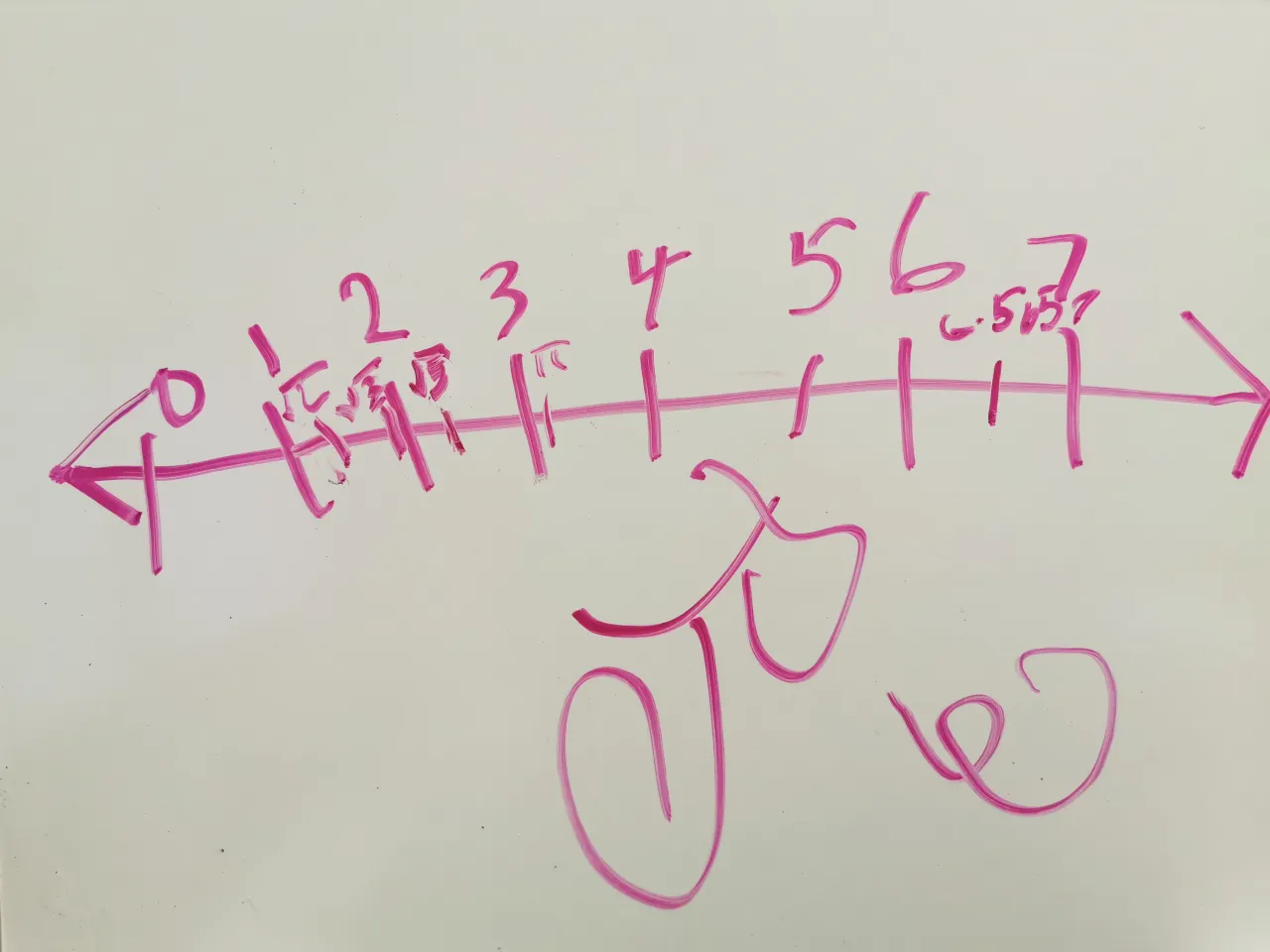
She said: “Dad, look, this is a number line. $\sqrt{2}$ is here, π is here. I’m going to invent a number called Lindsey. I’ll tell you its value: 6.5657. You’d better remember it well, because it’s as important as π.”