The Darkest Hour
(I)
On Planet Namek, after enduring hellish training that kept him teetering on the edge of death, Goku finally stands before Frieza wielding the Kaio-ken at twenty times its power. But the gap in strength is far too vast, leaving him no choice but to gamble everything — gathering all his power into a single blow, he unleashes the Super Kamehameha. It is almost his last hope. Alas, the all-out strike has little effect; it merely enrages Frieza. His power spent, Goku can barely move, like a lamb awaiting slaughter: this is his darkest hour — perhaps the darkest hour of all of Dragon Ball.
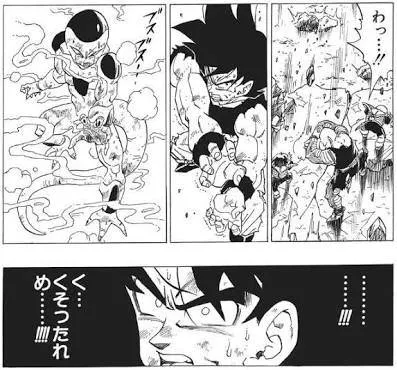
Vegeta had met the same fate not long before: the proud Saiyan prince, bearing battle power multiplied by his resurrection, grapples with Frieza for a while and then discovers in despair that his strength against Frieza’s is as a river to the sea. He feels that everything is over, that hope was a gaudy soap bubble that burst before his eyes — and in a mind seized by fear, only a mournful exclamation mark remains. So Vegeta abandons resistance, frozen like a wooden chicken, letting the enemy trample and ravage him at will.
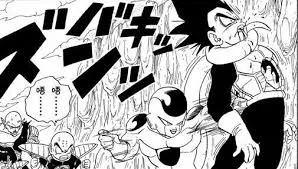
Fortunately, Goku is not Vegeta. In the face of fear, Vegeta’s courage — and most people’s — is a momentary flash, whereas Goku’s is a lifelong obsession. However powerful the enemy, his state of mind is the same as when he first faced his brother Raditz, who meant to destroy the Earth: a little afraid, yet inexplicably excited. For Goku, a man can be destroyed but not defeated. Surrender is simply not in his dictionary — with the last shred of his strength he endures wave after wave of Frieza’s blows, seeking only to focus his mind and gather enough energy from Namek and the surrounding stars for one final effort. At last, the Spirit Bomb — which King Kai judged capable of destroying the planet — is completed and strikes Frieza. The outcome is still grim: the Spirit Bomb, almost the universe’s last hope, fails to defeat Frieza. Yet without that tenacity, he could never have held on until the blood-boiling moment that may be the brightest in all of Dragon Ball: his transformation into a Super Saiyan.
(II)
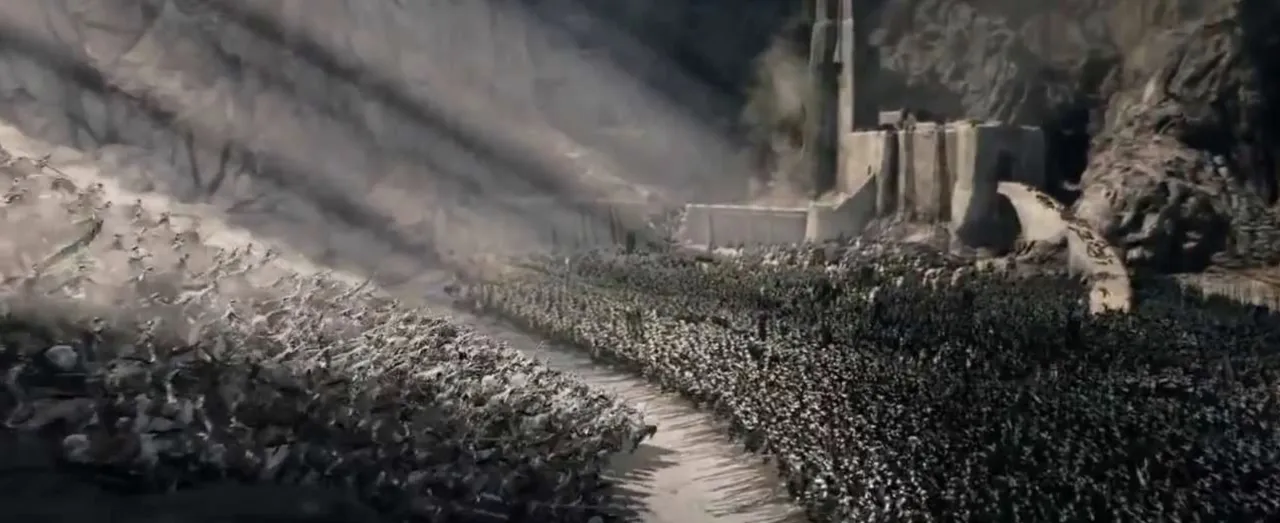
The Lord of the Rings trilogy is full of moving moments — Frodo and Sam’s resolute ascent of Mount Doom, Aragorn’s keeping faith with the Army of the Dead, Gandalf’s return from death after battling the Balrog. But the one I remember most is the bloody, all-night carnage at Helm’s Deep. Men and Elves fight side by side, spent in body and mind, and still cannot withstand the relentless waves of tens of thousands of Orcs. The outer wall falls, then the gatehouse, and then the inner keep is overrun with no suspense at all. The surviving old men and cripples, whoever can still lift a weapon, are handed all manner of arms — most of which can hardly be called weapons — and, trembling, prepare a final stand; the women and children weep in despair. Within the hall, the protagonists buckle on their armor, stretch limbs stiff from a whole night of fighting, mount their horses, and — like Commander Sun of the cavalry company in Drawing Sword — grimly prepare for the final, moth-to-flame charge. That is the darkest hour for the forces of good in Middle-earth.
In that moment, no one knows what hope is supposed to be.
Until — Gandalf, who promised to return “at first light on the fifth day,” arrives on time, and behind him ride three thousand exiled Riders of Rohan. At last, light pierces the darkness; at last, the white riders sweep through the Orc host like a tide.
(III)
King Wen was imprisoned, and so elaborated the Book of Changes; Confucius suffered hardship, and so composed the Spring and Autumn Annals; Qu Yuan was exiled, and thereupon wrote the Li Sao; Zuoqiu lost his sight, and the Discourses of the States came into being; Sunzi had his kneecaps removed, and the Art of War was set forth; Lü Buwei was banished to Shu, and the Spring and Autumn of Lü was handed down; Han Fei was imprisoned in Qin, and there came the Difficulties of Persuasion and Lonely Indignation. — Sima Qian, Letter to Ren An
Having defended Li Ling, he was savagely castrated; his old friend, condemned to be cut in two at the waist for the witchcraft affair, begged him for help, and he could do nothing. This was Sima Qian’s darkest hour. To answer his old friend Ren An’s plea and explain the anguish of standing by while a friend died, Sima Qian wrote this letter — generous in feeling, sweeping and extraordinary in its turns, unmatched through the ages. In it he marshals a roll call of the sages to state his resolve: every man must die once; since fate has abused him so, he endures humiliation and clings to life for one reason — “that I may yet accomplish something.”
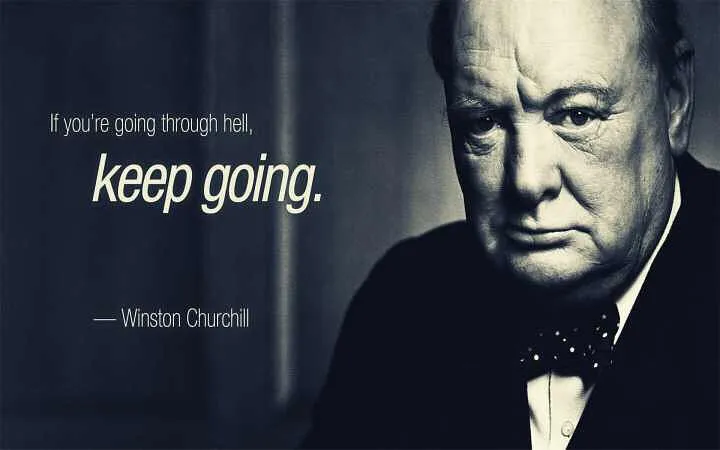
Old Yu’s “seek hope from despair” says much the same thing. And Churchill, the protagonist of Darkest Hour, understood this deeply.
The scene in Darkest Hour that left the deepest impression on me is Churchill talking with ordinary Londoners on the Underground — though in all likelihood it is the film’s invention. To the crowd with “confidence” on their lips and turmoil in their hearts, Churchill says: Lost causes… Lost causes are the only ones worth fighting for. Rendered into Chinese: (in the face of the Nazi war machine) some say we are doomed to fail. But only a doomed cause is worth staking everything on. Compared with the famous “we shall never surrender” speech in the Commons, this scene moves me more: it is, off camera, an old man speaking straight from the heart.
Just lately another old man, and the great company he built with his own hands, is passing through its darkest hour. “Since ancient times, few men live to seventy” — yet at such an age, for political reasons, first his beloved daughter was detained, and then his company was placed on a blacklist on “trumped-up” grounds. Truly, misfortunes never come singly. Facing inflamed netizens and media eager to fish in troubled waters, he is calm and objective, broad-minded yet iron-willed — it is deeply moving. That serene confidence convinces me that he, his family, and his company will break free of the cocoon and rise on the whirlwind, ninety thousand li into the sky.
This piece is dedicated to those friends who have passed through, are passing through, or will one day pass through their darkest hour. Pain is inevitable, suffering is optional. No obstacle is insurmountable.