What I Think About When I Travel
(I)
A business trip coincided with a four-day long weekend — long weekends here mean the office simply closes, and you can’t get in even if you want to. Before the break, my boss recommended a pile of places during our 1:1 talk, King’s Castle, Hearst Castle and the like — it would be a shame not to go see something. Traveling alone is actually rather dull: I asked around among colleagues and friends here, but either they had family plans long since made, or they were on duty for the holiday, so in the end I hit the road as a party of one. These past two weeks I’d been busy with work, then busy with various activities, then writing articles, so the trip itself was little more than an outline I mulled over half-heartedly, dragged out until Thursday. My plan:
Day 1: south lake tahoe
Day 2: yosemite
Day 3: universal studio
Day 4: Hearst castle, Highway 1
Originally a reader in Southern California (near LA) said I could crash at his place the nights of Day 2/3, but he has a girlfriend and a long weekend almost certainly means plans were already made, so I let it go.
I booked the Tahoe hotel only on Wednesday night, and the Day 2/3 hotel only on Thursday night — in a small town called Bakersfield, fairly close to Universal Studio, convenient for the round trip.
This morning (Friday), right before setting out, it occurred to me to copy down all the addresses and punch them into the GPS. Perhaps because I’m a programmer, I’m a meticulous independent traveler: before every trip I spend a great deal of time planning everything, and the whole journey is usually airtight. This time, though, I was all thumbs, the itinerary a tangled mess, no guides read, no information printed. If the GPS died on me right now, I might not even know how to get back to Sunnyvale. :(
By the time I’d straightened everything out, filled the tank, and officially set off, it was already 7:20 in the morning. Rise at dawn, arrive at dusk — that was roughly how it went. Not bringing a few CDs on this trip was a serious miscalculation; I scanned the entire FM dial and none of it played music that was my cup of tea. Suddenly I missed those classic FM tracks from my 2006 business trips, like “Because of You.”
I shut off the dreadful FM and rolled down the window to clear my head, cruising steadily at the speed limit +10. Then I noticed the GPS’s estimated arrival time: 11:20. Good God — four hours of driving! My head rang like a struck bell. I remembered it being only a little over three. I was already on the highway; regret was useless.
Driving on, the GPS kept telling me, in a voice verging on mockery, “drive xxx miles then keep left/right.” Past Livermore I had no familiar landmarks left and was entirely at her mercy. She told me to drive 12 miles and then keep left; I quickly converted that to about ten minutes, drove ten steady minutes, and waited for the next instruction. Handing your fate over to the GPS is actually rather lame; I keep telling myself to kick the GPS habit, but so far no concrete action.
I’ve said again and again that many things are forced out of us. The week I first arrived, I drove alone to the Livermore outlets. I’d been to Livermore before and remembered it as a conspicuous spot off the side of I-680. This mall was too new — its address wasn’t in the GPS — but by luck I spotted “Livermore” in the GPS history and was overjoyed. So I navigated there. The whole way, though, I was puzzled: this doesn’t feel like the right road, why did I leave the highway so early and start wandering along little streets? In the end it deposited me on a small street called Livermore in the town of Livermore. I got out, stood under the street sign, and laughed at myself. I felt the colleague who’d fallen for this same trick before was laughing back at me across the void. I got back on I-680 and, through considerable agony, found the outlets from memory. The human brain is a giant disk array: everything is stored, you just need to get hold of the handle to a certain slice of memory. Push yourself, and the handle turns up, and memory becomes reliable again.
After nearly two hours of driving, having endured every manner of instruction, I finally received one that broke me: follow Highway 50 for 94 miles, then turn right. That meant that for 94 miles even this insufferable machine wouldn’t speak to me — so who was I supposed to say “screw you” to? I began to feel sleepy, and worse, the Red Bull I’d bought was in the trunk. I never used to appreciate how wonderful it is to have someone in the passenger seat; now, not even a person — if there were just a dog there, I wouldn’t be this drowsy.
The best way to keep the brain awake is to give it something challenging to do. I started thinking: in what situations might I use this gocc I recently stumbled upon? Design a better document markup language of my own? Should I extend Markdown, and if so, how exactly? Video and audio tags are easy enough, but how to deal more elegantly with embeddable widgets like YouTube and SlideShare — how to make the markup language extensible enough that any site’s embeddable widget can be defined conveniently? How should the BNF for a cscope file be defined, and how about writing a cscope reader/writer with gocc?
Thinking along these lines, my brain slowly woke up. But I also grew thirstier and thirstier — evidently the brain consumes water when it works. I’d bought a case of water, but like the Red Bull they were stupidly stowed in the trunk. After missing several gas stations along the endless mountain roads, I finally snagged one by the roadside. Fueled up, drained, drank water. No need for Red Bull now; a brain past its drowsiness is like Beijing after rain — exceptionally crisp and clear.
The rest was smooth sailing; I reached the lake area ten minutes early, even. You can’t get into the hotel — the infuriating rule here is that check-in starts at 2 p.m. I went down to the lake, sat in a lounge chair in the sun, and worked through my snacks.
The clarity of Lake Tahoe’s water rivals, if not surpasses, that of Königssee in the Berchtesgaden region. Three-colored water, mountains rolling on and on — the scenery here is breathtaking. Basking in warm sunlight, listening to the waves break on the shore, I grew pleasantly tipsy.
When you travel alone, it is the inner self conversing with the inner self. I think deep in every heart there is a good Saga and an evil Saga — or a Sméagol and a Gollum — one carrying positive energy, the other negative. Most of the time the positive simply has the upper hand. Lying on the bench, looking up at that impudent blue sky, listening to children laughing not far off, I thought: this life is really good; if I could live out my days just like this, it would be quite delicious — so why the hell keep striving? It suddenly occurred to me that a reader once asked whether I’d read the story of the banker and the fisherman — the banker toils his whole life, then goes to the seaside to fish, and the fisherman tells him, I live like this every blessed day, and you wear yourself down to a nub like that — is it worth it?
I told that reader at the time: the banker has the right to choose; the fisherman does not.
Really, what are we striving for our whole lives? Isn’t it precisely the right to choose?
Out of high school, I could choose to go to university, or I could choose Lanxiang Technical School.
Out of college, I could choose a Fortune 500 or a solid startup, or I could choose a state-owned enterprise and coast.
After a few years of work, I could choose to settle in Beijing, or I could choose to go home and live quietly.
Tightening my belt, I could choose imported formula I trust for my kids, or the assortment of trustworthy and not-so-trustworthy formula on supermarket shelves.
Saving up more, I could choose a glorious self-drive tour of Europe, or spend it all on game cards and gear.
Every choice, every struggle, is really about giving yourself more choices.
And the right to choose can be passed down to the next generation. This is enormously important. The instinct of every living thing is to carry its genes as far forward as possible. Slack off like the fisherman, and his children will most likely be fishermen too, and may never in their lives see the world beyond the shore; the banker’s children may play music, dance, work in finance — and if they do well, perhaps even become programmers who change the world. ^_^
The “Gollum” thought was quickly nipped in the bud. I rose from the lounge chair and walked briskly toward the car.
(II)
Day two’s itinerary was Yosemite.
I set out a little after six, and the GPS told me arrival would be 10:45. I steeled myself: after yesterday’s ordeal, five hours doesn’t scare me — I’ll treat it as a scenic drive. Six o’clock isn’t especially early for a traveler. Last Saturday night, soaking in the open-air hot tub at the Staybridge hotel, a man who looked uncannily like the lead of Prison Break climbed in with his girlfriend. A few words in, I learned that their group had set off at 3 a.m. that day for Yosemite and would drive back at 4 p.m. So travelers do not fear early hours.
The first stretch was uneventful, just empty the whole way. Once I turned onto Highway 89, I stopped feeling calm. Winding mountain road the entire way, winding until my hands went weak. Taking a lesson from yesterday morning, I drank a can of Red Bull before setting off. But out on this road I realized Red Bull was entirely unnecessary: the road ahead was itself Red Bull. Up the mountain bend after bend, each curve jolting my adrenaline. The car the company rented me was a Jetta (roughly a Golf back home??), with decent power, but it had no W gear, and climbing was murder — especially those deranged 270-degree hairpins plus 45-degree upward slopes, which left little Jetta panting like a tractor, chug-chug-chugging for breath. Ordinarily I’m careless with her and don’t think much of her, but now she became my darling. Hearing the engine’s mournful wailing, I felt miserable.
The GPS told me Highway 89 ran for 86 miles. Looking at the road of trials ahead, five hours no longer mattered; I prayed only to get out of it alive. Ten miles in, there wasn’t a single car on the road, not a shadow of a person. Besides watching the road, I had to dodge the nimble little squirrels at play — they are the masters of these woods; I am merely a passerby. A friend says the highest state of driving is the unity of driver and car. After threading through these deserted mountains for a while, I seemed to catch a hint of that unity; my speed gradually opened up, and on the fast downhill S-curves the tires began to make a faint, happy scraping sound.
I have never been a car person. To me a car just moves me from A to B as fast as possible, nothing more. So even slight progress sends me into a dance. No cars, no people, dodging the occasional squirrel — with “driver-car unity” achieved I no longer had to worry about control, so I started watching the scenery and letting my mind wander.
On small roads, what I dread most is the tailgater, and what I love most is tailgating others. I learned the word “tailgate” from my former colleague KP. On a previous business trip I happened to share a car with him; he was house-hunting, and I tagged along. After we left the highway, since there was only one lane, a sports car behind us followed for two or three miles, very close, very rudely. That road was posted at 35 mph; I was doing 45, already at the outer limit of the unspoken rules I dared to exploit, and the sports car was still hounding us. I was furious. KP said:
He’s tailgating you for a while. You can just pull over if you feel annoying.
And so I learned the word. Gradually I developed the habit of tailgating others — better the phoenix’s tail than the rooster’s head — and someone like me, with mediocre driving skill and poor navigational sense, is ideally suited to following others and going with the flow. That way, whatever danger lies ahead, someone else has scouted it for me, and I just keep a decent following distance and drive on instinct.
But on the deathly silent Highway 89, no one broke the trail for me. Everything depended on me. If a tire blew now, or the engine quit, or I accidentally hit a deer, it might be hours before anyone found me and my plea for help. What would I do with those hours? There was no cell signal at all — I wonder whether 911 goes through without signal (duh)?
Loneliness is a rather frightening and rather precious thing. I grew up in noisy environments — big families, small cities, big metropolises — and from birth until now, complete solitude like this has, on reflection, probably never existed. Only when I started running did I begin to taste a little of that solitary feeling — even with people all around, the spirit and the consciousness are alone. Many peculiar ideas are born in solitude; certain qualities are forged in it too. Grit, for instance.
I thought of what I’d read the day before, idling by Lake Tahoe — a passage from Murakami’s What I Talk About When I Talk About Running, one I even copied out by hand: “It’s precisely by deliberately undergoing this pain that I discover, along the way, the sense that I am alive — at least in part. I now understand: the quality of existence is not a fixed thing like results, numbers, or rankings; it is something fluid, contained within the act itself.”
So what is this fluid thing he speaks of? It seems vague. I take it to mean the process, or the experience. And the fixed thing I take to mean the result. The result is merely a product of the process. After winning a battle Caesar said, “Veni, vidi, vici.” The result is covered by three words, but how brutal the whole campaign was exists only in Caesar’s heart and in his soldiers’. Just as I eventually reached Yosemite safely and posted a round of “I came, I saw” photos — but without walking this road yourself, you would never have the experience or the understanding.
The road slowly narrowed, narrowed until the double yellow line marking the two directions disappeared, and conditions grew more complicated — not even an extra layer of bricks along the cliff edge, just for form’s sake. Yet curves and steep inclines were no fewer, and my speed fell from 45-60 mph to 25-35. Earlier I’d been boasting about taking bends at nearly 60 mph; now I could barely manage 25. The surface turned slick as well; the morning mist was being scattered by the rising sun, fleeing to the ground. On the long descents the speed naturally climbed to fifty or sixty, and a light tap on the brakes brought a hint of skidding — but thank God the car stayed in my hands. I reckoned that driving this road in winter would truly be walking on thin ice.
Just then a pickup came barreling toward me from the opposite direction, towing an empty trailer. I froze for a moment, and so did the pickup — I suspect he too was marveling at seeing a car so early on this road. As we slowed and drew alongside, we each edged toward the shoulder and only just squeezed past. As we brushed by, we wordlessly gave each other a thumbs-up.
Only after the two cars had fully parted did I slap my thigh: I really should have asked how much farther this interminable mountain road ran. But it was too late.
After forty-odd miles I finally saw the long-lost double yellow line again. I assumed the nightmare was ending, only to find it was a small joke played by the road builders: the double yellow lasted half a mile and vanished, and the road narrowed once more. I sighed bitterly and drove on cautiously.
And so, driving on and on, quite by accident, the snow mountains I’d gazed at from afar by Lake Tahoe the day before were now at my feet. Seeing snow in midsummer thrilled me, and the thrill wiped away the fatigue of the journey. I pulled over and tested the thick snow with my own hands to check whether it was a hallucination. Looking around, my view was blocked by the trees, but I could well imagine the scene of people worn out from playing at Lake Tahoe lifting their eyes to the snow peaks. I was on that mountain!
Not long after the excitement of the snow, I came upon a snow-mountain lake. The water was astonishingly clear; the forest and its reflection were almost impossible to tell apart. Then a second, and a third lake of extraordinary beauty appeared one after another, like heaven’s reward for the hard journey just past.
Around mile 60 the double yellow line reappeared, and this time it was truly there. The road grew wider and wider; put your foot down and you’d hit 80 mph without noticing. Wary of speed cameras, I honestly cruised along at the limit +10. But the danger and thrill of moments before had vanished all at once, and I found myself missing them.
People really are a sorry lot. When I saw no human trace along the way, I envied the crowds; on the endless mountain switchbacks, I missed that rush of flooring it on the highway, that wind-and-lightning feeling. Now that the speed was up, I lost my spirit instead and began to pine for those deranged slopes.
I reached the Yosemite entrance station at 10:37 a.m. Actually arriving at the point the GPS specified took another two hours. Yosemite is so beautiful that any words I write would feel like a desecration of the scenery — perhaps I should find what the great writers have said about it and share that instead.
(III)
I left the central area of Yosemite around three in the afternoon on the 24th (the day before yesterday). By then it was swarming with people, and there was nowhere to park. The American long-weekend effect is very visible. On the 25th I was going to Universal Studio, and I’d considered staying in Yosemite until five or six, so I’d booked a place roughly between the two, closer to Universal Studio, called Bakersfield. But for that, I suspect I would never in my life have crossed paths with this small town.
From Yosemite to Bakersfield I chose Highway 41, then 99. According to the GPS I was first to loop west out of Yosemite, then head south. Fearing that going west would mean no more mountain charm, I ignored the GPS lady and insisted on heading south per the Yosemite map. The GPS lady is a stubborn creature too, endlessly telling me “in 0.x miles, make a U-turn,” and only after I’d gone more than ten miles did she reluctantly change course.
The mountain stretch of Highway 41 was delightful. I dawdled, stopping and starting, and took a full hour just to leave Yosemite. Once out of the mountains, Highway 41 gradually flattened into an endless straight road, two-way traffic, one lane each way, no median barrier. This arrangement put me straight to sleep. The sun blazed through the window onto my face while the AC kept driving the heat away to hold my body temperature in balance. The road was straight, the cabin comfortable, the sunlight dazzling — what could more effectively drag away consciousness and let the eyelids sneak a nap? Already short on sleep, I dozed off several times in a row; each time the car shuddered slightly I’d snap awake, slap myself hard, pinch my thigh — and soon lose consciousness again.
Danger is born in exactly this kind of comfort. I dozed off rather deeply, and what was deadly was that the car gradually drifted off course while I failed to wake in time — only when the car behind blared its horn did I come to. By then more than half the car had crossed the double yellow into the oncoming lane — luckily, the oncoming traffic was still some distance off. I hurriedly straightened the car, drenched in cold sweat. Glancing in the rearview mirror, the driver behind seemed to have picked up a phone and was making a call — he wasn’t dialing 911, was he? I’d seen plenty of “report drunk driver, dial 911” signs along the way. Could he think I was a drunk driver? Fortunately, as the miles rolled by, no police ever came knocking.
Judging highway design from a user-experience standpoint, I think several of the California highways I drove have problems — 41, 99, 5. What they share is a stretch that runs dead straight for a considerable distance (at least ten miles) with no variation whatsoever, which makes you terribly drowsy. Often we blame driver fatigue for accidents, but a stretch that is too straight, with scenery that never changes, is another cause: it drains the attention of a driver who might otherwise have been alert, and accidents follow.
As I said before, driving alone is dull. In fact it’s not just dull, it’s dangerous. On the highway, when drowsiness hits there’s no passenger to nudge you, to say nothing of the helplessness of being hungry with food you can’t spare the attention to reach. On this trip I made a point of buying snacks at a roadside gas station, but with no experience, most of what I bought was suited to a movie theater rather than eating at highway speed. So you can imagine how wretched it is to be hungry with the food right at hand and be unable to eat it — it drives the driver either to burn with desire, forget the steering wheel, and eat with reckless abandon, or to stomp on the gas and stare at the road ahead with bloodshot eyes, determined to reach the next rest area by sheer will and devour everything in sight. Both scenarios sharply raise the risk factor.
To escape these two miseries, I began to look forward to the coming Universal Studio (US for short) visit.
Among the amusement parks I’ve visited, I favor US. I went once in 2006; eight years on, such a golden opportunity has dropped from the sky — how could I miss her? The main reason I love US is that it fuses the film industry with the amusement park seamlessly, creating an immersive visual experience that lets you enjoy the fun of a game inside a movie scene. The pinnacle of this fusion, I think, is the Waterworld show and Terminator 3D. I won’t describe exactly how they work, but savoring the memory is thoroughly satisfying, and my stomach gradually stopped complaining of hunger. Revisiting this time, I hoped to experience the rides added over the years, especially Transformers and Despicable Me.
In the end I made it to Bakersfield without mishap and checked into a roadside motel, which I’ll skip over. After dinner at the Denny’s beside the hotel, all my thoughts were on the next day at Universal Studio.
At last, on the third day of the long weekend, early in the morning, after an hour and a half’s drive, I arrived at the place I’d been dreaming of. So many people — in all my time in America, including my last visit to US (also a long weekend), I’d never seen crowds like this. Of course, I was lucky: traveling alone, I went through the single-entry line everywhere, which let me see every show and ride Transformers and Despicable Me (DM for short) several times each. Seeing the 60-85 minute waits posted at their entrances made me happy.
Next I’ll use DM as an example to explain how a given attraction at US maximizes capacity. DM is a ride, but the four-seat “car” itself just pitches forward and back in place — it never actually swings like a roller coaster. All the visual effects are created by a 3D film on the giant dome screen in front, letting you enjoy the ride within a complete story. One run lasts about five minutes and seats around 100 people at a time.
As a player, you pass through five stages:
- Queue outside (time varies)
- Be selected to wait for entry into the inner hall to watch the warm-up film (~5 minutes)
- Watch the warm-up film and the rules inside (~5 minutes)
- The actual ride (~5 minutes)
- Exit (1 minute)
These five stages are sharply delineated, so parallelism is very high. While one wave is riding, an equal number of players are already locked in a small room watching the warm-up film (the DM protagonist lectures the players about the coming challenge — no spoilers from me), while outside, staff with iPads frantically arrange waiting positions from the outdoor queue. The moment a ride ends, one end empties while players who’ve finished the warm-up film enter their designated places from the other end and begin, and meanwhile the players picked outside file in to watch the warm-up film.
The whole thing runs as efficiently as a CPU pipeline. Every player is an instruction, passing through fetch, decode, execute, and retire.
We know that to keep a CPU running efficiently you must minimize bubbles in the pipeline; hence out-of-order execution, which drops dependency-free instructions into empty slots to fill the pipeline. The most classic example is the branch delay slot on MIPS — the empty slot after a branch is filled with an instruction that should have executed earlier, maximizing CPU performance.
At US, the ubiquitous single-entry line plays exactly this role. Often a family of three comes to ride, leaving one seat empty on the four-seat “car”; a couple would rather wait for the next wave than be split up. Such a seat is a chicken rib — nobody wants it, but if you don’t fill it you waste a great deal. Asking the queue right then who is traveling alone would only cause congestion, so a separate single-entry line exists, and when such a situation arises, “out-of-order execution” kicks in: one person is pulled from the single-entry queue to ride.
This is what domestic amusement parks should learn from US: an efficient pipeline, supplemented by out-of-order execution, to maximize an attraction’s throughput per unit time. On top of that, videos play throughout the queueing process so the wait is less tedious. Over and over, riding and thinking, I wondered: has Universal Studio hired an Intel CPU expert?
(IV)
The roadside motel is the emblem of American road culture. As I said in yesterday’s piece, I booked a motel right beside Highway 99. Cheap, convenient, clean enough, with two or three fast-food places nearby — for a passerby, what could be more comfortable than a place like that? In the hotel parking lot I saw several BMWs, which shows that middle-class people of some means hardly spurn a roadside motel.
On the road I kept marveling at the standard of California’s infrastructure — a dense web of freeways knits the entire state into a highly efficient system. Of course, in terms of traffic efficiency Germany may have the world’s most efficient road network, since most stretches of the autobahn have no speed limit. When I traveled in Germany I rented a Mercedes B260, topped out at 190 km/h, and was still whooshed past by all manner of fine cars in the passing lane. In California speeds are strictly limited to 65-70 mph, that is, 110 to 120 km/h. The unwritten rule is that limit +10 mph won’t get you in trouble with the police, but even so, this greatly lengthens travel times. In Germany, 700 kilometers takes five to six hours (you can’t stay at top speed the whole way, after all — curves, connector roads and so on bring it down); in California, 700 kilometers takes seven to eight hours. The fluidity of traffic is like the fluidity of capital: the faster it flows, the higher the turnover, and the more — and larger — things you can do.
From my less-than-professional experience, Germany’s network still lags California somewhat in coverage. Of course, judging as a traveler is a bit arbitrary; if I’m wrong, readers please correct me. California’s freeways basically reach third- and even fourth-tier cities; in any municipality, drive ten miles out and you’ll generally find one. It may also be, of course, that as a young country America carried no historical baggage — especially in the West — so cities gradually grew up along the highways; that may be a sounder explanation for the coverage.
Coming back from Universal Studio to the motel, I took Highway 101 to 5, then 99. Eight or nine miles short of where I-5 meets Highway 99, the mountain switchbacks begin. Watching the distant peaks draw nearer inch by inch, then plunging between two of them, is a strange sensation. This stretch is mostly downhill; lose concentration for a moment and the speed hits 90 mph, so it’s not a stretch to drive when you’re feeling too high. Why? Because the clever cops are lying in wait below. On one descent I inadvertently crept up to 85 mph when a siren suddenly wailed behind me. I panicked — that’s it, a ticket worth several hundred dollars. Instinctively I stomped the brakes down to 75, and a patrol car swept past me on the side; only then did I relax.
I crossed paths with the police twice on this trip. The other time was at a highway rest area. After leaving the freeway I saw a patrol car parked behind another car, the officer checking the occupants’ documents. I was foolish enough that, with that vast rest area to choose from, I didn’t park elsewhere — no, I parked right next to the car being inspected. The officer seemed quite startled, watching me get out and walk away. Creeped out by his stare, I cursed myself and fled the scene as fast as I could. I imagine the officer was thinking: this guy isn’t the cavalry, is he?
After relieving myself, I faced a dilemma. To be back or not to be back, this is a question. I’d meant to wait until he finished and left before reappearing, but after a while the officer was still standing at the rear quarter of my car, seemingly not going anywhere soon, so I took a deep breath and went back to drive off, heart pounding. Fortunately, no further wondrous tales unfolded; otherwise I might have fallen in love with this land.
I have a bad habit when driving: I keep my passport and driver’s license in a bag, and the bag in the trunk. Again and again I remind myself to put the bag on the passenger seat, and again and again I forget. Sometimes on the road I daydream: what if the police pulled me over right now? In the movies the suspect puts both hands on the wheel and slowly rolls down the window; the officer gets out, one hand on his gun, approaches warily, then demands ID. Could I tell him my ID is in a bag in the trunk? How would he react? Cuff me first and then search the trunk, or draw his gun and order me slowly out of the car, then follow me at gunpoint while I fetch my documents from the trunk? Just picturing it is a thrill. Unfortunately, I don’t egregiously speed, I don’t drive at random, and I’ve worn a good-guy face since the age of three, so I never once crossed paths with the police.
On Highway 1, my greatest revelation was the harmony between people and nature. Highway 1 hugs the sea, with many stretches right on the coast. There are several parks along the way, and plenty of wildlife can be spotted at the coastal vista points. At one vista point on Highway 1 I saw a colony of seals; the seals could sleep with such carefree abandon, and I could photograph them from very close by. You rarely see this back home.
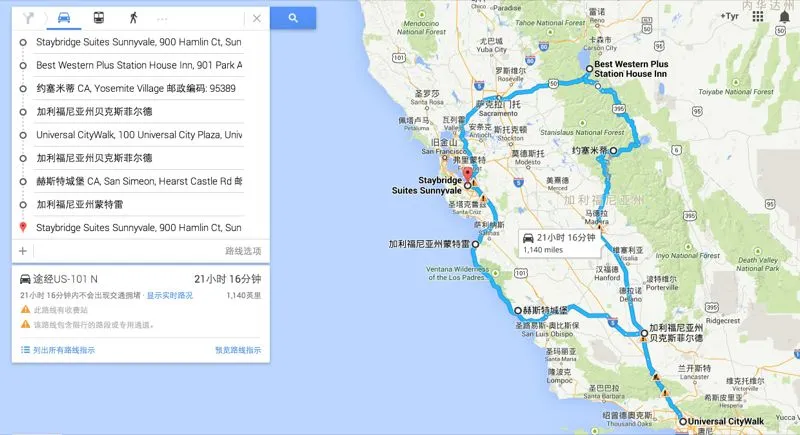
The image below is the entire route I drove on this trip; Google Maps shows a bit over 1,100 miles, but I actually covered over 1,400, which doesn’t include circling Lake Tahoe or wandering around inside Yosemite. Racing around like this for four days looks crazy to any traveler. With my wife and kids along, I certainly wouldn’t drive like this; and had I planned carefully, I might not have either. But sometimes the beauty of travel lies in having a destination while being unsure what exactly you’ll meet or discover along the way. The endpoint and the result matter less; what matters is the process.