Just Like That, I Ran My Third Official Marathon — in Portland
Signing Up
My entanglement with the Portland Marathon came about purely by accident.
In 2014, still buzzing from the Beijing Marathon, I wanted a taste of the six majors. Chicago and New York both rejected me in turn, so I settled for second best and signed up for Portland. I had no idea Portland was one of a kind. Running the whole thing, my takeaway was this: “The Portland Marathon is really a citywide music festival that happens to be held under the name of a marathon.” I fell deeply in love with racing here.
In 2016 I signed up again, then cancelled early because of a business trip. In 2017 I was incorrigible — signed up, trained dutifully (for a stretch I ran forty-odd minutes along the San Francisco waterfront nearly every midday), but decided my body wasn’t race-ready and stayed home. In 2018 I moved to the Seattle area — closer than ever — but there was too much else going on, so I didn’t even register. In 2019, looking in the mirror at my steadily expanding body, I was suddenly seized by the mood of the Imperial Uncle Liu Bei, who “sighed and wept aloud”: “Once my thighs never left the saddle, and the flesh melted away. Now I no longer ride, and flesh has grown upon my thighs. The days and months gallop on; old age is near.” So I registered again, trained again, and resolved that come what may, I would run.
Training
For a marathon, training is part of the race, and the race is the coda of the training. Like the hero of the Eroica Symphony, before you stride triumphantly toward the final victory, you must pass through three stages: from boundless ambition, to utter despair, to rebirth from the ashes. That was exactly the arc of my training.
After registering, sometime around May, I began my first session. There’s a small path outside the office; running to the end and back is about 3.6 km, and I used that stretch to rediscover the feel of running. I hadn’t run in ages, but I was still in the phase Cao Gui described — “the first drumbeat summons all the courage” — and riding pure marathon enthusiasm, I ran at noon every day and nudged the distance up little by little. Gradually 3.6 km became 5 km, which I sat at for a long while, and in early July it became 7 km. Then my calves started acting up: after each run, a raised lump would appear on the side of my calf. Around that same time I happened to watch Li Yongle’s explainer video on varicose veins, and it scared the daylights out of me — I genuinely had some early symptoms. After that I ran much more cautiously, and after every run I’d massage my calves for a full half hour while eating lunch, only stopping once the symptoms faded. I ran restrained like that for over a month, and the varicose veins showed no sign of improving.
Misfortunes, as they say, never come singly. On August 12, under a fine sky and a gentle breeze, I was eating hotpot and singing songs — no, listening to podcasts and running — when I lost focus, clipped my foot on the curb, and went down hard. To protect my hard-won P30 Pro (mainly to avoid kneeling on a washboard when I got home), I didn’t break the fall with both hands; instead I took it on my forearms and the backs of my hands, getting intimately acquainted with the concrete.
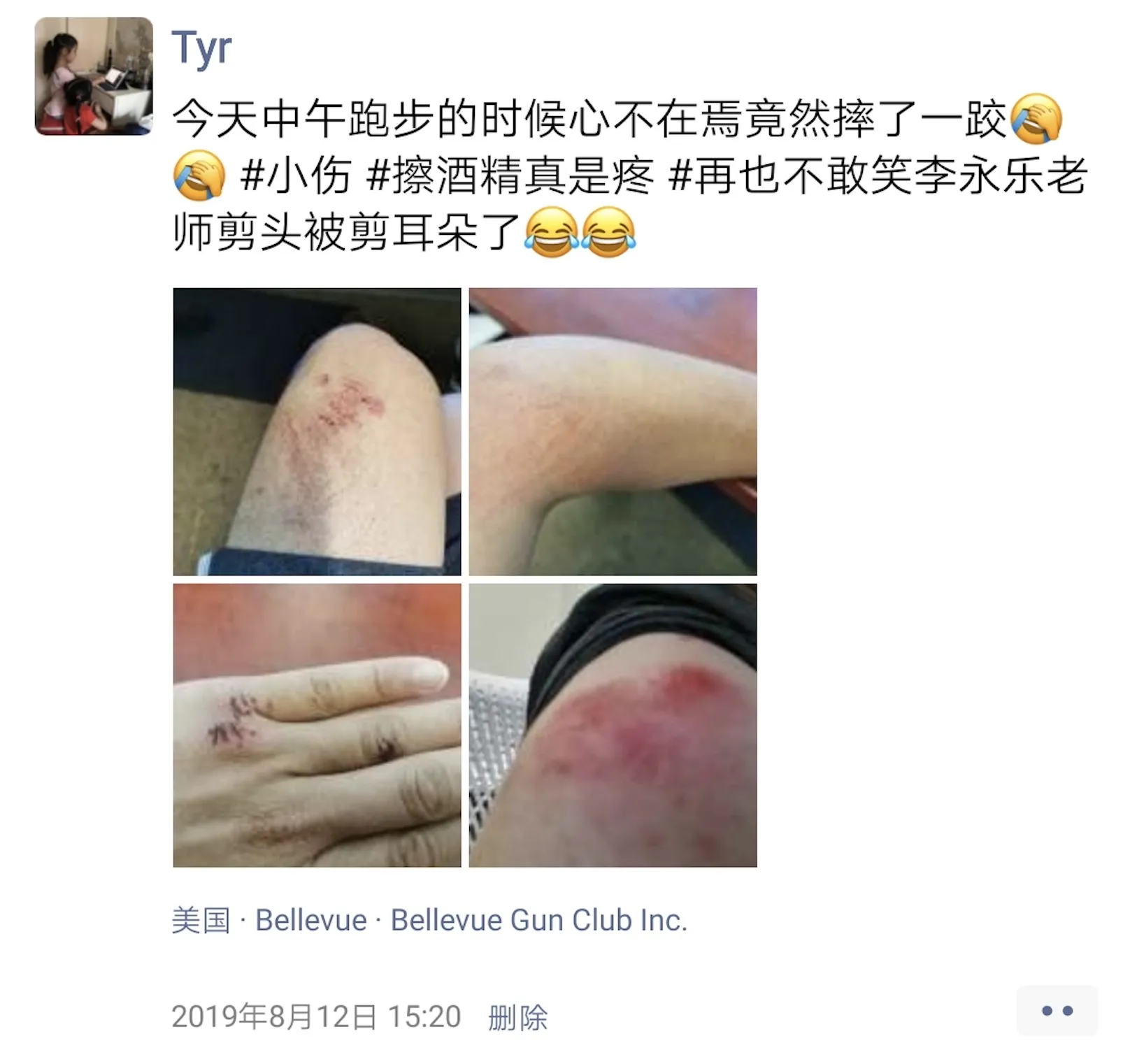
The cars passing by were startled out of their wits. One driver poked his head out to check on me. I waved him off and just lay there on the ground, gasping, half annoyed and half amused, letting the several patches of road rash burn. Oddly enough, ever since that fall, the lumps on my calves seemed to be on their way out.
That weekend I let loose with a three-hour LSD (Long Slow Distance) and felt none the worse. I figured this marathon was in the bag.
In September I deliberately trained a lot of hills — the area around the office is nothing but rolling ridges anyway. I still remember that big climb around kilometer 27 in 2015, and I wanted to run up it this time, not stroll up it.
Race Day
On the morning of October 6 in Portland, the weather was bitterly cold and raw. Half an hour before the start I checked my jacket, then stood shivering in the wind, fending off the chill with a steady supply of energy chews and warm-up drills. Four or five minutes after the gun, I crossed the start line right behind the 4:40 pacer. I figured I could hang with her, and with her, have a shot at beating my Beijing Marathon PR of 4:48.
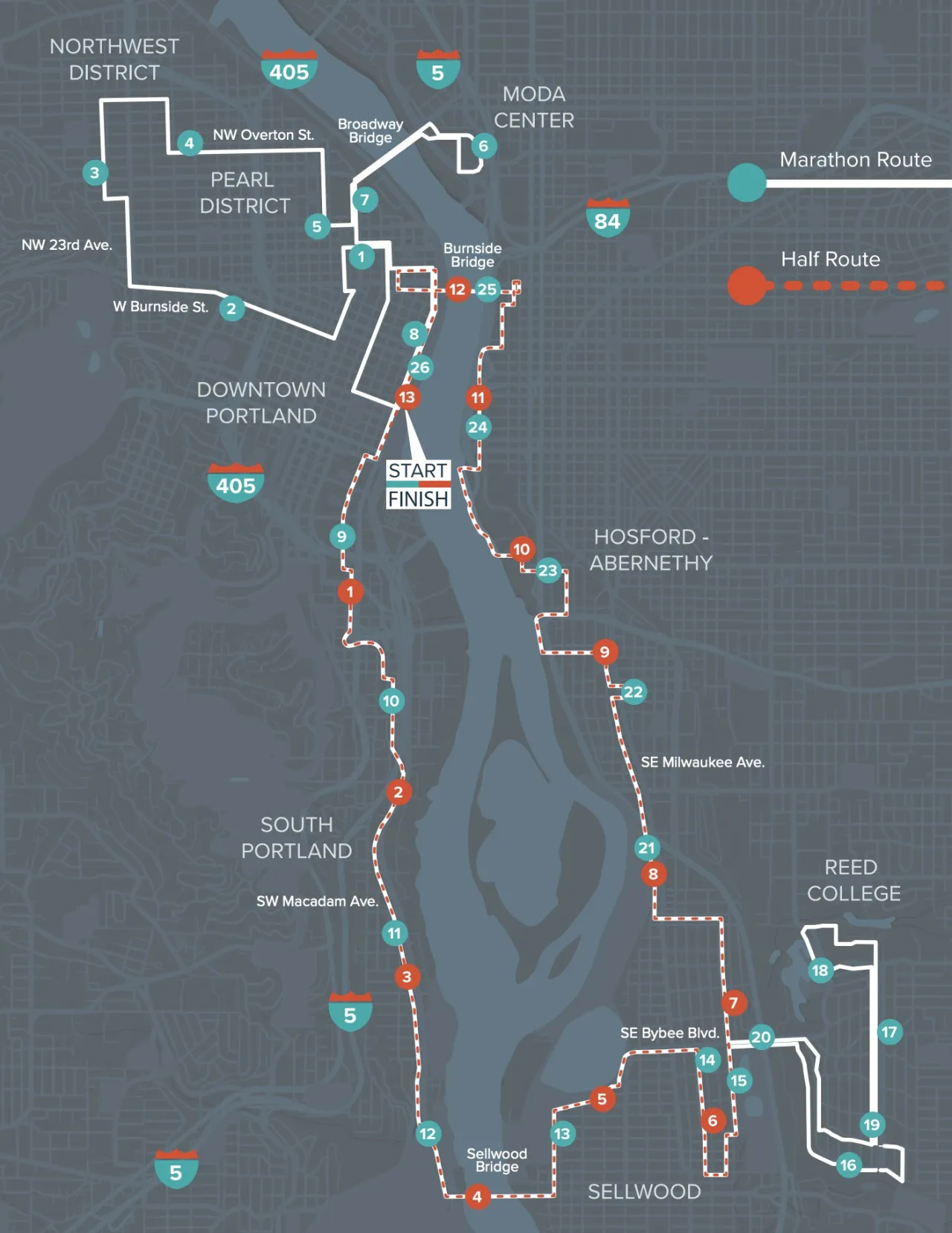
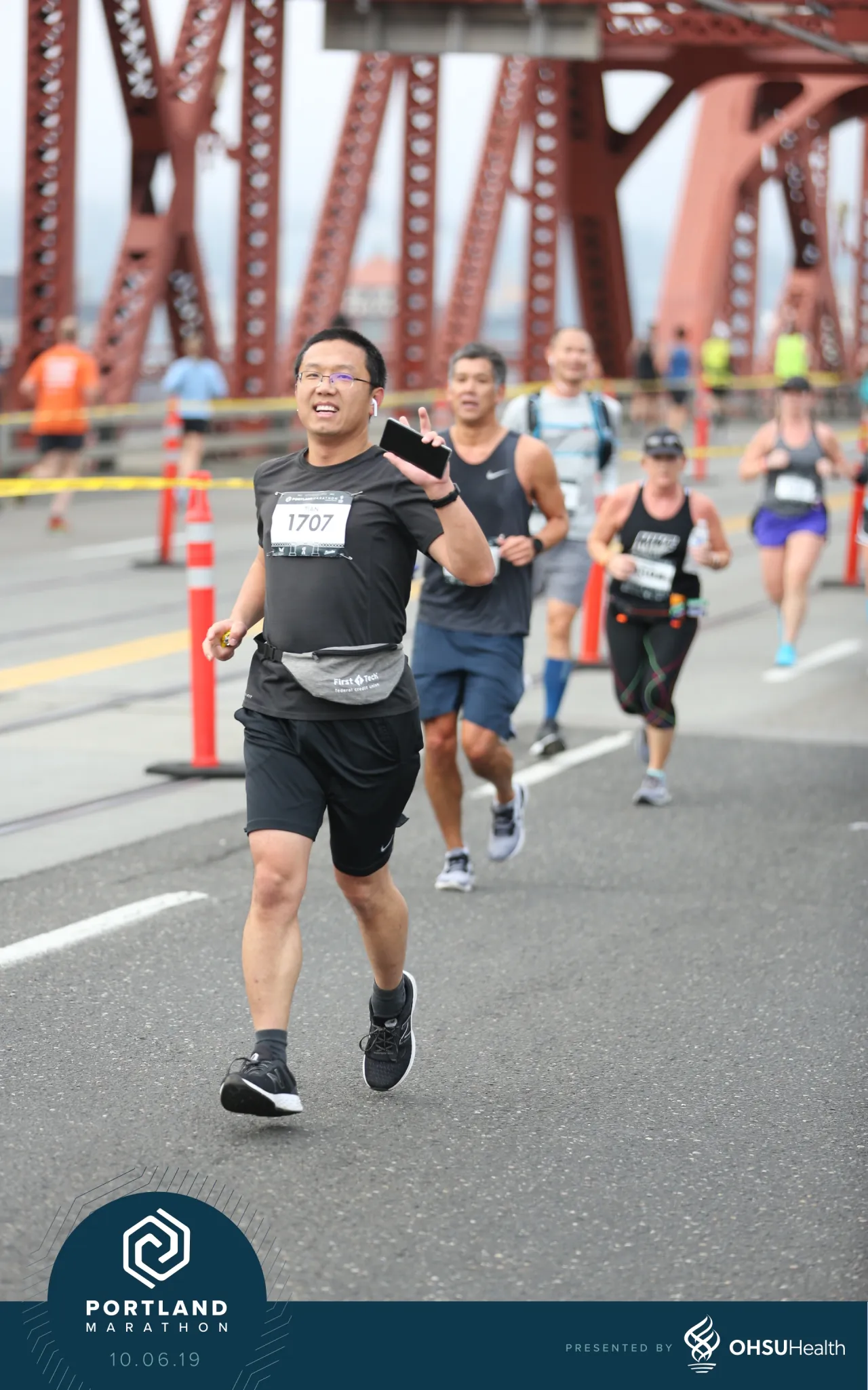
For the first few kilometers, the 4:40 pacer held almost exactly 6’25, dropping to about 6’45 on the climbs. This course was completely different from the one I’d run before — it was up and down nearly the whole way — and it was a good thing I’d trained specifically for hills, or I’d have been miserable. After six or seven kilometers I decided the 4:40 pacer was going absurdly slow — or maybe I was just feeling too good about myself — so at the first aid station I passed her.
After that, on nearly every uphill I’d overtake a whole crowd of walkers, yet I never once caught sight of the 4:20 pacer’s tail. On the contrary — on a bridge just past the halfway point (around mile 15), I saw the 3:40 pacer coming the other way. I had no map on me and didn’t realize there was actually an eight-kilometer (five-mile) gap between us, so I gloated inwardly: could it be that I’m really not that far off four hours?
It was all an illusion. Past the bridge, around a residential neighborhood, the pack entered the famous Reed College — Steve Jobs’s alma mater, though he dropped out before long. I remember vividly the celebrated “connecting the dots” from his Stanford commencement speech: the serif typefaces Jobs studied at Reed, with no idea what they were good for, ended up on the Mac by sheer serendipity. Reed’s campus is beautiful and serene; our arrival shattered its calm, and the students along the route whooped and hollered us onward.
Past Reed College, two old men ahead caught my attention. Old Man A caught up to Old Man B, drew alongside, and asked: “How old are you?” Old Man B answered in a booming voice: “Sixty-five! And you?” Old Man A said proudly: “Sixty-nine! A few years your senior, ha!” Then the two of them laughed heartily. Watching their backs, I was filled with envy — if only, at sixty-something, I could still have the constitution to run a marathon and leave some youngster marveling that he can barely see my back.
On the next climb the old men slowed, so I passed them and carried on with my own journey. Maybe it was the payoff of months of training, maybe it was the gel packet I downed every 5K — either way, past 32 km I still hadn’t hit the wall. My wife texted to say they’d parked and were playing by the river near the finish, waiting for me to arrive. I sent them photos of the scenery along the way for a preview. This year’s Portland Marathon was superbly organized: every runner was like a package at SF Express with a tracking URL, so my family could open it and follow my progress in real time — my wife knew my per-mile splits, average pace, and projected finish time more precisely than I did myself.
Along the way, apart from the dips caused by unavoidable forces like bathroom stops and big climbs, my pace held between 6’20 and 6’40. It was so steady it surprised even me. In the last two or three miles, everything was fine — no leg cramps like last time — but the soles of my feet were burning, and it was getting unbearable. The thought “just stop and walk” circled in my head, but another voice quickly pushed it down: this could be the first marathon of my life where I hold an almost perfectly even pace the entire way! Only a few kilometers left! I remembered the sign planted in the ground as I ran through a residential neighborhood earlier: “If it doesn’t challenge you, it doesn’t change you.” I’d turned that line over in my mind for a long while at the time; now it became chicken soup, seeping into my heart. Just then my wife called to ask whether Xiaobao could run the last three hundred meters with me. Can she? I said. Buy the ticket after boarding — let’s give it a try.
In the final kilometer, Huawei Health was already congratulating me on finishing a marathon while I still had roughly 600 meters to go. I frantically scanned the cheering crowd for my wife and kids, and finally spotted them not far off. Xiaobao and Xiaobei were shouting “Daddy! Daddy!” non-stop with excitement. I rushed over and grabbed both kids for a flurry of kisses. After a photo with Xiaobei in my arms and Xiaobao holding my hand, I took Xiaobao by the hand for the final sprint. When the spectators saw the two of us running hand in hand toward the finish, the cheers rolled on and on, thumbs-up everywhere I looked. Xiaobao was thrilled — it was the first time she’d ever experienced an atmosphere like that. As we were about to cross the line hand in hand, the announcer boomed with relish: “Here comes Tian Chen, from Issaquah! And his lovely daughter!” (I can’t recall the exact wording.)
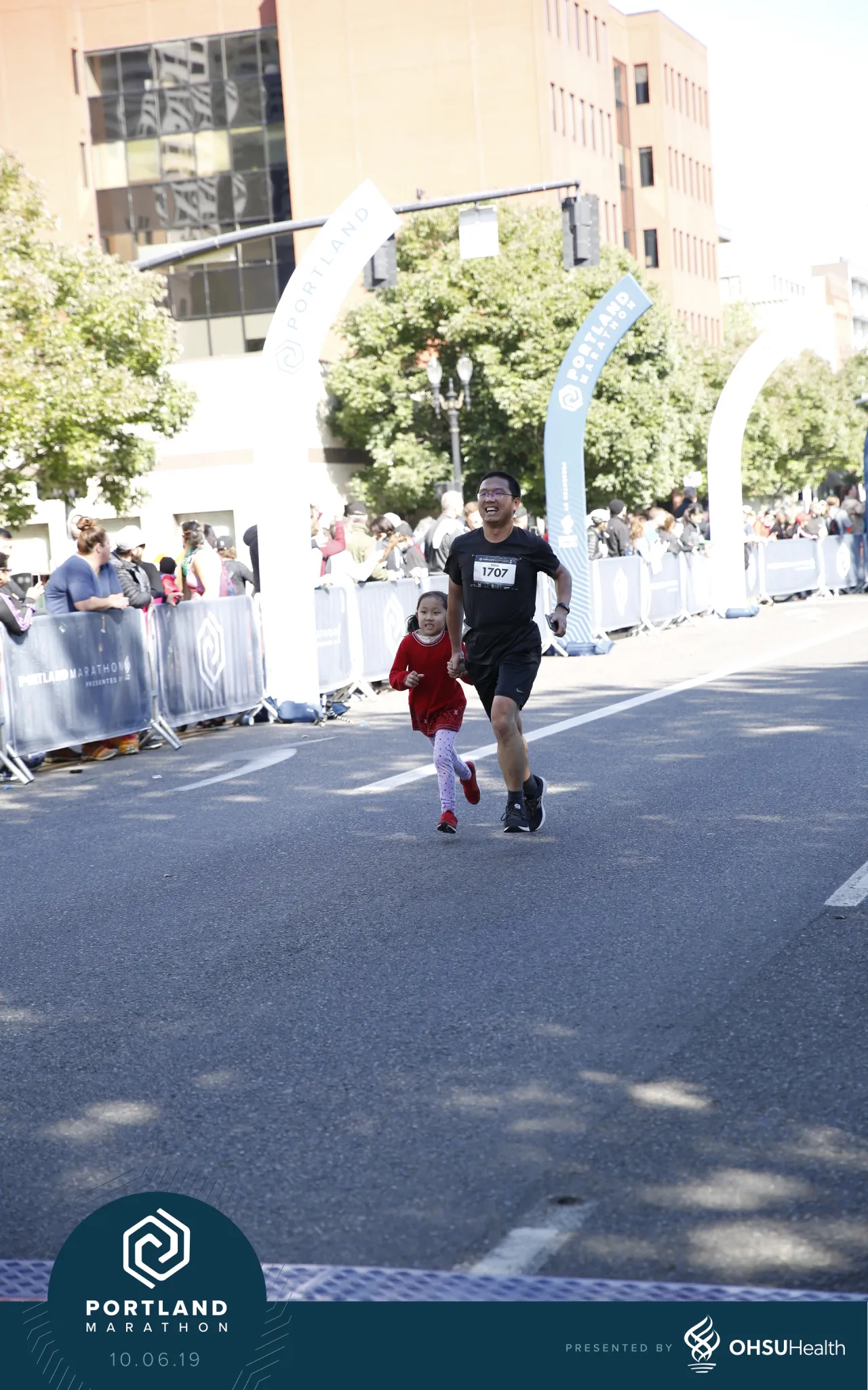
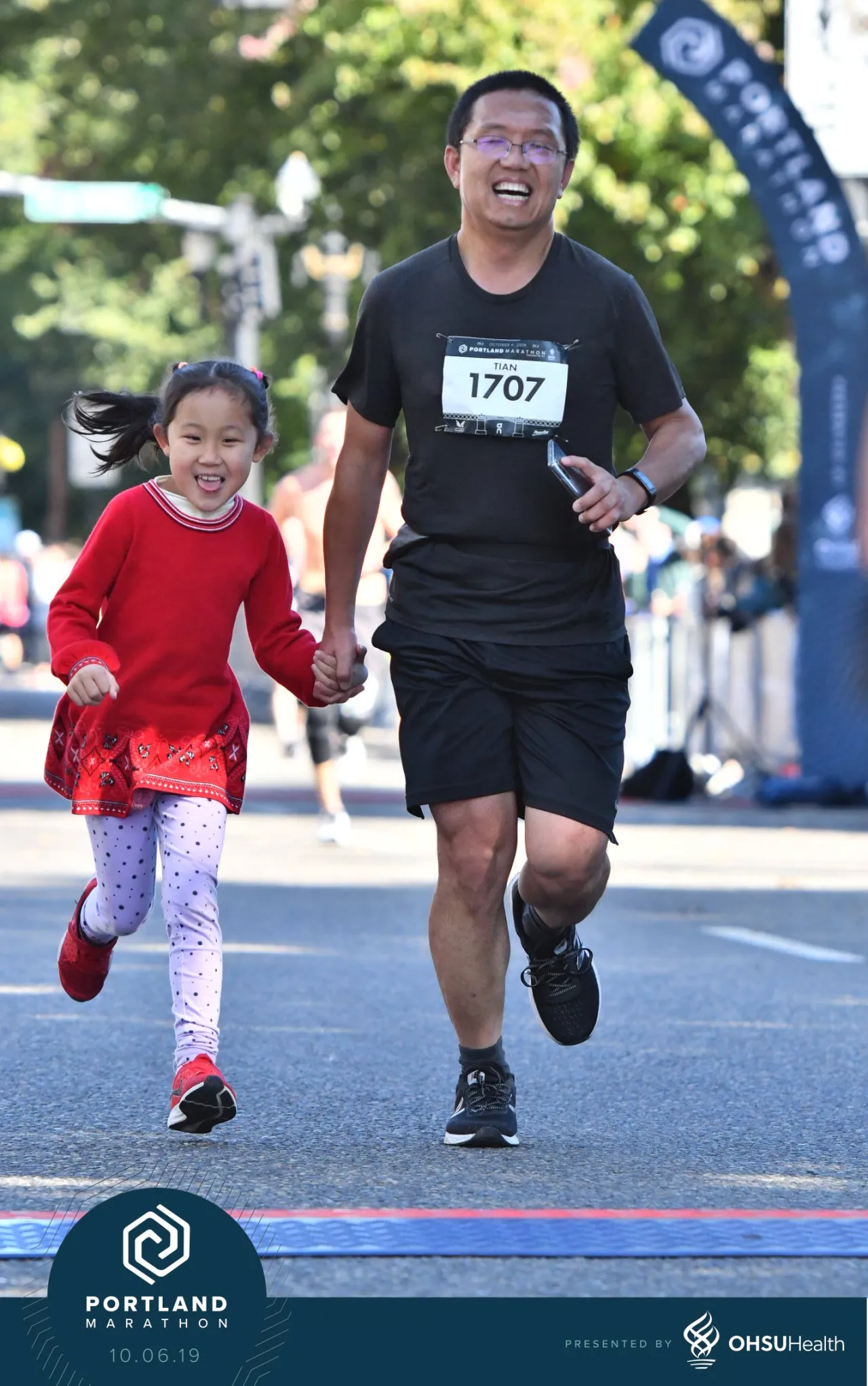
Xiaobao asked, happy but puzzled: “Daddy, why did they say your name and know you’re from Issaquah, but they didn’t say my name?”
I laughed and said: “Because Daddy signed up for the race. Look at my bib: 1707. With that, they can look up my registration, my full name, and where I live.”
Her face lit up with understanding: “I knew it! Then next time I want to sign up too — I want to hear my name when I cross the finish line!”
As I crossed the line, I glanced at the clock: 4:36, plain as day. I knew my net time had to be better, maybe even under 4:30! In the recovery area, Xiaobao and I feasted — whatever was there, we ate it. I walked laps around the recovery area eating and drinking, and after downing two bottles of water and making sure my mild dehydration had improved, I did some light stretching and then dashed off to meet my family.
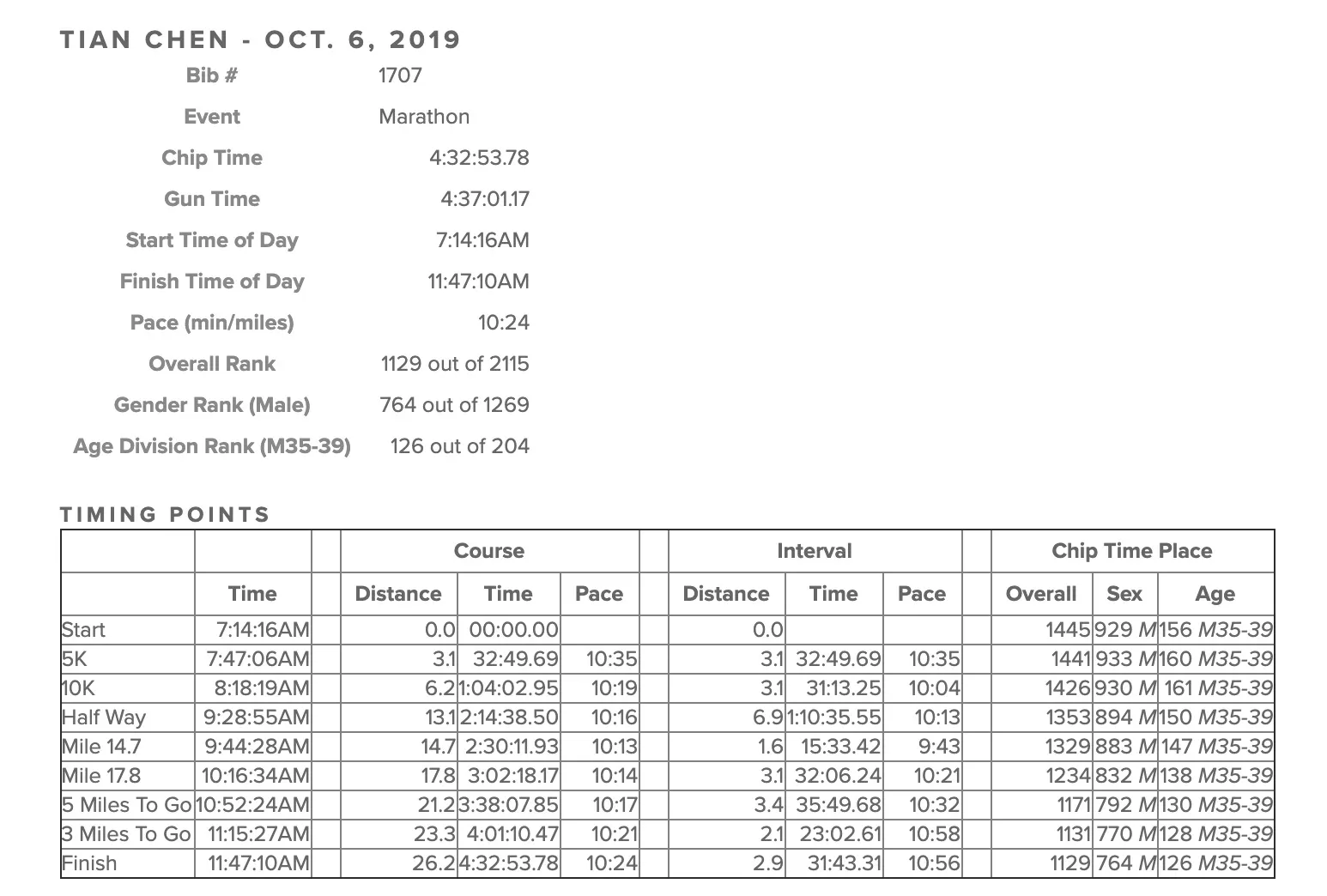
Later I got my official time: 4:32. I was as happy as a hundred-jin skinny man. At thirty-seven, I had finally caught up with my thirty-two-year-old self.
While I Run…
It seems you can’t talk about running without Haruki Murakami — ah well, he probably won’t win the Nobel this year either.
In my previous posts about running, I always found some way to work in “Pain is inevitable, suffering is optional” as self-encouragement. This year there was very little pain in the whole process, let alone suffering. Still, I love that particular bowl of chicken soup, and every so often I chew it back up and let the flavor roll around on my tongue.
When I run, I let my thoughts roam wherever they like. On ordinary noontime runs, a math problem will pop into my head — say, how to express the square root of 2 as a continued fraction — because I’m preparing that evening’s math lesson for Xiaobao. Or a question will surface: why did King Fuchai of Wu rush off to assert hegemony at Huangchi instead of first dealing with the menace sleeping beside his own bed? That one’s from my own private book of ten thousand whys.
During this Portland Marathon, I spent the whole race reviewing and pondering one thing: what is it, exactly, that makes me happiest? Or put another way — what is the ultimate happiness of my life?
When I was old enough to understand things, Halley’s Comet and the mysteries of space were regulars in children’s science magazines. Back then, whether in Xinjiang or Jiuquan, the summer night sky was a white ribbon wrapping countless stars, breathtakingly beautiful. The elders would point up at the sky and teach me: that’s the Big Dipper, that’s Vega… Cooling off outdoors on a summer night, gnawing on watermelon, counting the stars — those were the inexhaustible joys of my childhood. So from an early age I harbored a heart set on becoming an astronomer.
As I grew up and followed my parents south to Guangdong, the stars in the sky grew hazier by the day. At middle- and high-school reunions, slouching at a street stall, picking snails out of their shells and chatting, my gaze had already shifted from the stars above to the girls in Baleno T-shirts and Jeanswest jeans — for a boy whose heart had just awakened, what could be happier than chatting with the girl he liked?
The four years of college had two great joys: video games and writing code. I was genuinely no good at games, so the enthusiasm faded; but code — immodestly, I was the best in my department, and by sophomore year I was already going out on weekends to earn money with my craft. The way I collected my “wages” back then was wonderfully surreal: every month they’d hand me a bundle of about thirty hundred-yuan notes, and I felt the joy of money clenched in my palm.
After graduation, work became the source of joy. Every task I owned, every person I met, was a brave new world. Even though the place I lived had a bathroom I had to share with everyone, I could be brushing my teeth and still be thinking about how to optimize route-table structures in OSPF (a routing protocol) — “Eureka,” “Eureka,” delighted to the point of bloom.
After working a while, I decided a full life was what happiness meant. So I read, I recharged, and I even carved out time from a punishing job to earn a degree — dog-tired, but at the end of the day I’d close my journal, take a deep breath, and feel the joy of growth radiating from every pore. That was truly pain and pleasure at once.
After that, the happiness in my life changed like a carousel, faster than Japanese prime ministers turned over back then. I sorted them into a few categories:
- The upward, growth kind of happiness: growth in my career, in income, in assets, in my social circle, in experience, and so on
- The adventure and self-challenge kind: my first taste of the forbidden fruit, becoming a husband, becoming a father, managing a team for the first time, founding a startup for the first time, publishing a book for the first time, going abroad for the first time, emigrating for the first time, becoming a father of two for the first time, and so on
- The relax-and-recharge kind: the joy of family life, of writing code, of solving problems, of sharing knowledge, of exploring the unknown, of writing, of reading, of running, and so on
Growth happiness and self-challenge happiness have a shelf life. Around a peak experience or the achievement of a goal, the joy gradually decays. So unless you keep driving yourself with a whip, what follows the passion is a hollow, sage-like lull. Which, of course, fits the build-measure-learn spiral perfectly.
The joys that aren’t aimed at any goal at all, that simply put you at ease, can last an awfully long time. Things like falling into the arms of your family after an exhausting day, talking about all sorts of interesting subjects around the dinner table; writing code and tools that have nothing to do with work, purely for fun, or because “it ought to exist”; and learning something, chewing it to pieces, forming your own reading of it, and passing it on.
A while back, for convenience in reading the Zizhi Tongjian, I built a filmstrip edition of it, so I could read a passage anytime and anywhere. In fact I didn’t stop at that one repo — I followed the same pattern and, one after another, built editions of the Shiji, the Zuo Zhuan, the Mencius, the Analects, the Xunzi, the Han Feizi, the Laozi, and the Zhuangzi (laozhuang.qiaopang.com), plus the Book of Songs, the Three Hundred Tang Poems, and Three Hundred Song Lyrics (shici.qiaopang.com). They’re my bathroom reading. This code, this time and energy, does nothing at all for my development skills, and they’re hardly proper products — but they are a source of joy, and every time I sit on the toilet and listen to the Book of Songs without understanding the words, revisit “Song of the Pipa” that I memorized in full as a child, or hear Xunzi expounding on Laozi, there’s a particular savor to it.
https://shijing.qiaopang.com/16.html#5
https://shici.qiaopang.com/01.html#73
https://hanfeizi.qiaopang.com/21.html#10
And yet even this isn’t my ultimate happiness. Many times friends have asked me: if you retired one day, what would you most want to do? My answer is always about the same: teach. If some university thought well enough of me to make me a lecturer, nothing would please me more; if not, maybe I’d just teach something on my own. I never realized that this thing I most want to do is, apparently, my ultimate happiness.
Back at Juniper, I was already pushing hard to run BBL (Brown Bag Lecture) knowledge-sharing sessions within our Beijing team. Later, when I founded my own startup, Tuke Circle, the lunchtime talks practically never stopped. Then I brought the practice into Tubi, and into ArcBlock, where it became part of each company’s culture. In the early days such events are always a strain — when no one volunteered, I’d happily step up myself and share what I knew. Company after company, I’ve labored to build an atmosphere of sharing knowledge and skills. That can’t be a coincidence; it’s because I love this thing deeply, and sharing knowledge is, for me, an incomparably joyful process.
These days I share what I know with Xiaobao every evening, and I enjoy it more than I enjoy my own work or my own personal growth — doesn’t that prove I can draw a greater happiness from it?
Isn’t that my ultimate happiness?
On the road, sorting through these thoughts, I suddenly had an epiphany, as if I’d heard an oracle. Many people like to quote what Murakami wrote about how he stumbled onto the writing life: “I can still recall the clear sky, the feel of the grass that had just turned green, and the pleasant sound of the baseball.” At that moment, something quietly floated down from the sky, and I accepted it without a doubt.”
My feeling was almost exactly the same.