The Remains of the Day (Part IV)
(一)
In the blink of an eye I have spent 1,666 days in America — four years and two hundred and five days. If a person’s career is forty years long, then a tenth of mine has already been spent on this soil. Looking back, the five-year plan I made when I first arrived has fared rather well:
In the blink of an eye I have been in Silicon Valley for two and a half years.
Two and a half years is only 1/16 of a career of some forty years — seemingly negligible, yet for a five-year plan it is decisive. When I set foot on this land at the end of 2014, what I had in mind was simply to spend five years here: first gain a foothold, then settle in. A very simple plan.
A foothold is the foundation, and it shows in “home” and “work.” Zhuangzi said: even Yao and Shun, who held all under Heaven, left their descendants not so much as a needle-point of ground to stand on. My family sacrificed for my dreams, so I had to prepare that “needle-point of ground” for them. After two years in hiding, having saved some money and fleeced a round of wool from my elders (sigh — at thirty I ought to have stood firm, and I had not), I finally managed to buy a humble little place. “Home” was more or less settled.
“Work” does not come in one step. The shared pain of every foreigner working in America is the question of status. Friends back home never understand: you’ve already bodily scaled the wall, so why the fuss over a green card? Only those inside the experience know what it tastes like. If you slip up for a moment, either your I94 expires (the time of lawful residence), or your EAD expires (the time of lawful work), or your visa expires (the time of lawful entry), and you’ve courted a pile of trouble for nothing. And even if you yourself are careful, and your lawyer is careful, the great lords of USCIS (the immigration service) might doze off for a moment, and you could be the one who suffers. A friend of mine once ran into this unprovoked disaster: he renewed his EAD several months early, yet it wasn’t approved until two months after it had expired — for two months the company could not “employ” him or pay him a salary.
I was relatively lucky — I scavenged up an O1a Visa, which let me skip PERM and go straight to EB1A, saving myself the three-to-five years of grinding toward a green card. Even though the 485 gave me a year of thrashing about through various coincidences, I finally got my green card last month — more or less complete. For ten years I won’t have to fret over anything to do with status — entry, work, residence, all of it — and I can focus my mind on my career.
Excerpted from “The Remains of the Day 4.1,” written in 2017 and never published.
Over nearly five years I have changed cities five times: Sunnyvale, Cupertino, San Jose, Redmond, Issaquah, and two states: California, Washington. In June, while preparing a UK visa, the form asked me to list every address I had lived at in the past two years, and I was astonished to discover that between June 2017 and June 2019 I had moved like a fugitive through four cities and four addresses. I had thought that once I bought a house and had a foothold, I would settle down — but I found that “settling down” is a luxury for me. Before the bed in my humble home was even warm, I had flown off to Seattle.
Friends often ask me to compare the San Francisco Bay Area with Greater Seattle. If you were to pick five American regions best suited for Chinese people to live in, the Bay Area and the Seattle area would surely both be on the list: pleasant climate, a reasonable income-to-expense ratio, a work environment neither too sluggish nor too cutthroat, and, most vital to our bellies, Chinese food from every region, everywhere, and tolerably good. For programmers, these two places are almost the only two options for settling down — the large and small tech companies hold up the job opportunities in both regions, hold up a patch of sky for Asians, and, of course, hold up the housing prices.
In terms of taxes, Washington State levies no state income tax. Moving from California to Washington means a sudden 10% more on the payroll; but because there is no state tax, Washington’s sales tax is the highest in the West, a little higher than California’s.
In overall cost of living, the Seattle area is relatively lower than the Bay Area: housing is tolerable (70–80% of the price) and rent is reasonable (around 80%). Since housing is the biggest monthly expense, monthly living costs in the Seattle area are considerably lower than in California. But you gain here and lose there — grocery prices in the Seattle area (1.5×) and utilities like water, electricity, and gas (~2×) are a good deal higher than in the Bay Area. My wife always complains that at the 99 Ranch in the Bay Area, she has to rack her brains every week just to reach $30 worth of groceries (for a coupon); here at Asian Family Market, a casual trip blows past $50 in no time.
Running a car costs considerably more in the Seattle area. Gas prices don’t seem to differ much — both hover between three and four dollars — the main difference is in insurance. I use Metromile (base fee + per-mile billing), and after switching from California to Washington and changing my address, the premium nearly doubled. I got quotes from Costco, Geico, and others, and they were even higher than my Metromile price. Fortunately, running a car in America is no big deal — the cost of keeping two cars here may be less than keeping one in Beijing.
In terms of living environment, each has its merits. The American West is famous for its fine mountains and waters and its loneliness; on weekends most people live a pastoral life of “picking chrysanthemums by the eastern fence.” Compared with the Bay Area, the mountains and waters of the Seattle area are closer to where people live — sometimes after dinner, around eight, we drive ten minutes to Lake Sammamish State Park; the kids run wild in the playground, and my wife and I lean by the lake, enjoying the flowers, the moon, and the autumn waters; within half an hour on weekends there are waterfalls; within three hours there are the crisp, graceful snow mountains, the largest national park in America, and the world’s largest temperate rainforest.
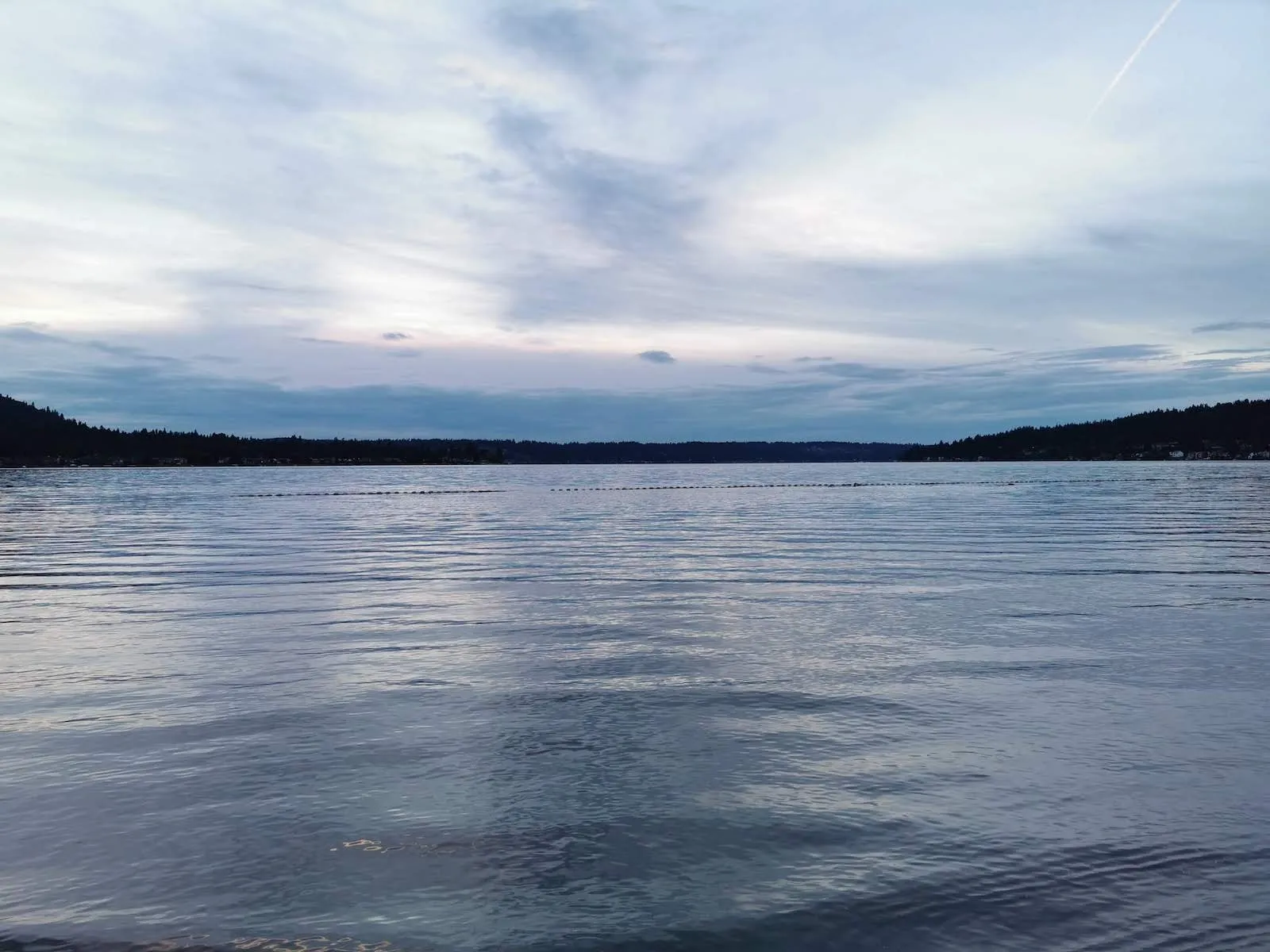

But Seattle has a lot of rain — before I came, my colleague Ma warned me that it rains 80% of the time here and a person would get depressed. After more than a year, maybe I’m just lucky, but on the whole my feeling is that the awful gray weather and the bright sunny days are about half and half. From October to April each year, the endless drizzle is like an invisible wall pressing you into the house and restricting your going out — no wonder Starbucks was born here, and Twilight made its home here. Many people who have basked in California sunshine, during Seattle’s sunless half-year, grow listless, and their hearts turn as gloomy as the weather.
I’m fine — I’m not particular. California sunshine I love — it oxidized me from a dusky bronze into deep charcoal; Seattle’s chill I also love — it reduces me from charcoal back to dusky bronze. I’ve always been the type to make myself at home wherever I am, so long as I have my wife and children for company — as Su Dongpo said: “Ask whether Lingnan is good or not — he answered: where the heart is at peace, there is my home.”
(二)
Two weeks ago I went back to China on business and saw many friends. Some I hadn’t seen in half a year, some in over a year, and universally everyone’s belly had added another growth ring. Maybe we really are getting old — the topics on the dinner table for us post-80s, besides work, startups, and children, are illness, aging, death, and dying. Márquez said: “While your parents are alive, you and death are separated by a cushion; once they are gone, you sit directly upon death.” Watching the children grow up day by day, I suddenly realize that we ourselves have become that cushion, growing thinner bit by bit as we account for those above and below and around us.
Under the year-after-year shade of the “blessing” of 996, many friends’ health is far worse than before; their medical reports are full of alarming conditions, so much so that my own moderate fatty liver is too embarrassing to bring out. A friend joked that he’s like an Alto that has run 500,000 kilometers in five years without a care for maintenance — shifting gears grinds and grinds the cogs, and pressing the gas sputters black smoke.
996 squeezes the body — fortunately the industrious genes of the Chinese nation, inherited over thousands of years, can still hold up; the anxiety of middle age tortures the spirit, and that is the last straw that breaks the camel’s back.
Friends who diligently play the good Chinese employee: when the economy is good, those without homes worry about homes, those with homes worry about trading up for a home in a good school district; when the economy is bad, everyone worries whether they’ll still have the chance to “enjoy the blessing.” A dozen years ago, full of high spirits on a forum, we wrote stirring words and pointed out “where should a thirty-five-year-old programmer go” — and now that we’ve actually reached that age, we find that the news and daily life are all about such-and-such company clearing out frontline employees over thirty-five; such-and-such company plans that middle management will never promote anyone over thirty-five. Thirty-five is like a curse that keeps the stoop-shouldered middle-aged man — elders above, children below — from straightening his back in front of the fresh-faced twenty-something.
Friends who scrupulously play the good Chinese boss: when the economy is good, add headcount and work overtime, with user acquisition and retention flying together, push the sales numbers and core metrics up another step, fight a bloody path out, and raise the next round; when the economy is bad, tighten the belt, achieve more, faster, better, and more economically, survive the winter, outlast the competitors, and earn the next round, break out a stretch of sky. Good or bad, it’s up the knife mountain and down into the sea of fire; every day riding a roller coaster, violently living between high and low, high and low — days no one else can understand. As the saying goes: those who know me say I am grieved; those who don’t ask what I am seeking.
At any rate, whether in the halls of power or in the far reaches of the jianghu, we have all become Lord Wenzheng of Fan — advance and worry, retreat and worry; wine into a sorrowful gut, pushing each anxiety onto the stack, turning them into a fat belly.
Two friends who had never crossed paths came down, one after the other, with thyroid cancer. They opened the buttons at their collars to show me, and the post-surgical scars on their necks were shocking and heartbreaking.
Alas! Long I sigh and wipe away my tears! Ten years of dreams in the imperial capital, a fistful of bitter tears!
After returning from Beijing to Seattle, the return jet lag that hadn’t appeared for a long time tormented me for a week. In the small hours of last Sunday, unable to sleep, I lazily scrolled through my social feed. Suddenly I saw terrible news: a friend had passed away. I remember that two years ago, when my colleague Chun introduced him to me, he said his last stint (at a startup) had been too exhausting, and he planned to leave Beijing for a while and go back to his hometown to rest, so he wanted a remote position. We talked for a long time and I took quite a liking to him; I wanted to bring him into Tubi, but at the time CTO Ma felt his English wasn’t good enough and worried that remote communication would be difficult, so he vetoed it. Thus we missed being colleagues by a hair and became mere “like” acquaintances on WeChat, occasionally exchanging a line or two. I’ve added quite a few friends on WeChat, and I always see so-and-so’s death announced by some other friend’s repost, but a living, breathing friend in the prime of life, someone whose lifeline had crossed mine, passing away — that was the first time. Gazing at his avatar, I could still clearly recall the scene of us sitting on the sofa seats at Dream+, in the Qiming International Building on Wangjing North Road, discussing js-bridge and all sorts of esoteric front-end hacks with such relish.
Feeling gloomy and unable to sleep, I opened Avengers: Infinity War as if possessed. When I saw young Spider-Man clinging to old Iron Man, turning to ash and dust, murmuring, “I don’t wanna go” — poor little spider, for all his talent to save the world, dying with his aspirations unfulfilled — at that moment, my tears poured out.
In a daze, I scribbled down these words:
On the journey of life, we are forever racing against time. Illness and death, in the most decisive way, pull us off the track. Before we are afflicted by disease, we can still be considered masters of time — we can choose whether this journey is a leisurely stroll or a sprint, a rest and recovery or a gathering of strength; but after falling ill, that choice is stripped away step by step: first talent is ruthlessly imprisoned by the IV tube, then the drive to advance is slowly worn down by pain, then influence recedes like the tide — and after it recedes, one doesn’t know whether a few scattered intimates will remain; in the end, only optimism stands stubbornly upright by the dim light of hope, seeking with kinship a chance to turn things around.
Stripping a person of the right to choose his time is not the worst. When Thanos snaps his fingers and the reaper’s scythe falls, a person’s future time is suddenly zeroed out, and there is no longer any chance to turn things around. This is the deadliest thing of all. The departed are gone forever; the living are haunted by grief.
I have always prided myself on being an optimistic fool, but that Sunday I was truly choked up.
(三)
The topics modern Chinese most don’t want to talk about: one is sex, the other is life and death.
On life and death, the ancients were quite candid.
Confucius said, “You do not yet know life; how can you know death?” To know the way of life is to know the way of death. Toward life and death, he first held life in awe and cherished it — he said, “Do not enter a state in peril, do not dwell in a state in disorder”; he despised those who “wrestle a tiger bare-handed or cross a river without a boat, and die without regret,” who slighted life, and was unwilling to work with them; on that premise, he “would not seek to live at the expense of benevolence, but would sacrifice life to fulfill benevolence.” He also faced death calmly — when his beloved disciples Boniu and Yan Yuan passed away, his reaction was: “It is gone! It is fate! Such a man, and such a disease! Such a man, and such a disease!” and “Alas! Heaven is destroying me! Heaven is destroying me!” — full of grief, yet accepting the mandate of Heaven. Precisely because of this, he “did not resent Heaven, did not blame others,” and when his ideals could not be realized, he would “set out on a raft and drift to the sea.”
Mencius held that life springs from sorrow and calamity, death from ease and pleasure. Confucius’s “sacrificing life to fulfill benevolence” and Mencius’s “giving up life for righteousness” became the moral standard of Confucianism. Confucius “knew the mandate of Heaven”; Mencius “cultivated himself and awaited it” — actively striving, cultivating himself, facing his own mission. For Mencius, the gentleman also has anxieties about his own life — not only anxiety about the present moment, but a lifelong anxiety: “Therefore the gentleman has lifelong worries but no calamities of a single morning. As for what he worries about, there is this: Shun was a man; I too am a man. Shun set an example for all under Heaven, one that could be handed down to later generations. I, on the other hand, have not yet escaped being merely a common villager — this is what is worth worrying about.” So what should one do when anxious? “Be like Shun, that is all.” With such a grand perspective, one will not have anxiety over personal circumstances from one day to the next.
Laozi’s attitude toward life and death was not to tread into the place of death — “Emerging, he enters life; entering, he goes to death. Of those who follow life, there are three in ten; of those who follow death, there are three in ten. Of men who strive to live, who move yet every motion leads them to the place of death, there are also three in ten. Why is this? Because they live their lives too richly. I have heard that one who is good at preserving life, walking on land, does not meet the rhinoceros or the tiger; entering battle, he is not struck by weapons. The rhinoceros finds no place to thrust its horn; the tiger finds no place to set its claws; the weapon finds no place to lodge its blade. Why? Because in him there is no place of death.” This is in the same spirit as Confucius’s not “wrestling a tiger bare-handed or crossing a river without a boat.” So he advised us to be pure of heart and few of desires: “Dwell in good places, keep the heart deep as an abyss, deal with others in benevolence, speak with good faith”; to know oneself, not to contend, to be soft and weak like water, not to be excessively “strong” — “Thus the hard and strong are companions of death; the soft and weak are companions of life. For this reason, weapons that are strong will be destroyed; wood that is strong will be broken. The strong and great are placed below, the soft and weak are placed above.”
Toward death, Zhuangzi was especially openhearted. He said, “Man’s life between heaven and earth is like a white colt glimpsed through a crack — gone in an instant.” And so when Zhuangzi’s wife died and Huizi came to offer condolences, he found Zhuangzi sitting on the ground, drumming on a basin and singing. When Zhuangzi himself was about to die, he would not let his disciples bury him lavishly; he wanted “heaven and earth as my coffin, the sun and moon as my paired jade, the stars as my pearls and gems, and all things as my grave goods.” Isn’t that grander than a lavish burial? His disciples were frightened, afraid that “the crows and kites will eat our master.” Zhuangzi smiled: “Above, I would be eaten by crows and kites; below, by mole-crickets and ants. To rob one to give to the other — how unfair that would be!”
As children we all memorized the story of “Bian Que Meets Duke Huan of Cai,” who concealed his illness and refused treatment until it was beyond cure. Compared with Han Fei’s piece, the Grand Historian’s “Biographies of Bian Que and Canggong” is more worth reciting. Because after telling the story, the Grand Historian set out his own view of life:
If the sage could foresee the subtle beginnings of illness, so that a good physician could attend to it in time, the disease could be cured and the life preserved. What people suffer from is that illnesses are many; what physicians suffer from is that methods are few. Thus there are six diseases not to be treated: to be arrogant and self-willed, heedless of reason — this is the first not to be treated. To slight the body and value wealth — the second. To be unable to regulate food and clothing — the third. When yin and yang are disordered and the vital qi of the organs unsettled — the fourth. When the body is so emaciated it cannot take medicine — the fifth. To trust in shamans and not in physicians — the sixth. If any one of these is present, the illness is very hard to cure.
This view of life is still quite scientific even today.
First, when ill, follow medical reason; do not be arrogant and dismissive. Second, have a clear sense of which matters more — life or wealth. Third, don’t binge-eat or drink to excess, and don’t sacrifice warmth for style. Fourth, maintain good living habits: rest well, stay up late and work overtime less, relax, worry less and be anxious less, so that yin and yang don’t fall into disorder and the five organs don’t lose their proper function. Fifth, exercise daily and build a strong body; don’t let yourself grow frail and sickly. Sixth, don’t go messing around with folk remedies, taking random medicines, or undergoing inexplicable “therapies” — find a real doctor, not a witch doctor or a “master.”
As modern people, if we were to add something to this view of life, it would be:
Seventh, cherish time; live toward death. Buy some insurance and designate the beneficiaries; write a will early and set up a living trust.
Postscript
The second season of The Reader (朗读者) had an episode about life — I recommend everyone watch it. I quite like this opening:
Life is such a profound subject; it contains every most extreme experience in the human world. Life can be as tenacious as that which may be destroyed but cannot be defeated, or as vast as “for what my heart holds dear, I would not regret even nine deaths.” If life had color, would it not look like Van Gogh’s Sunflowers and The Starry Night? If life had a temperament, would it not sound like Beethoven’s Pastoral and Eroica? The meaning of life is so weighty that no matter how wholeheartedly we give ourselves to it, it is never too much — because we are born as human beings, born for all beings.