How to Choose the Right Job
In fact, Paul already answered this question in Hackers & Painters: choose work that possesses measurement and leverage.
Let’s go into detail. Note that the wording below is similar to that of the Agile Manifesto — when you have the right and the ability to choose, prefer the former over the latter. But that doesn’t mean the latter is bad.
First, the choice of industry. A booming industry beats a stable one. In the software industry, for example, the internet is growing far faster than traditional software.
In a booming industry there are far more opportunities; the market keeps expanding and the pie keeps getting bigger. This fits leverage very well. In a stable or slow-growing industry, the map has already been carved up; by and large, the good positions and career opportunities (though not absolutely) have already been claimed by those who entered the industry before you, so leverage is weaker.
Having chosen the industry, look at the company. Likewise, a company on the rise beats a mature, stable one. When a company grows at rocket speed, an individual who performs fully has a strong chance of getting onto the fast track of their career. This is still a question of leverage. The painful part is: how do you tell which company is on the rise? Half of it comes from studying and grasping the trend, half from luck (if you’ve invested in stocks for a long time, you’ll understand). We’re all Monday-morning quarterbacks; wind the clock back to before the event, and few would have believed that Apple under Jobs’s return could rejoin the ranks of first-tier companies, and almost nobody in early 2012, when Weibo was at its hottest, would have foreseen its decline (it has risen again over the past two years). Choosing a company is sometimes like choosing a stock: as long as you’ve done your homework and formed your own analysis from all kinds of material, leave the rest to luck.
Once the company is settled, look at the team. A small team that values individual ability beats a large team that overemphasizes collective wisdom. If possible, avoid teams where you’re a “cog” from day one. Of course, if you inevitably end up a cog, strive to be worth more than a cog. Companies and individuals define an ordinary position (non-executive) differently: the company wants every ordinary position to have a backup and to be replaceable; the individual wants to be unique and irreplaceable on the team. The advantage of a small team is that your work is far more measurable. When a piece of software takes five thousand people to build, you’re a fleck of foam in the ocean; but when a product takes only five people to build, even averaged out, you’re one-fifth of it.
While evaluating the team, also evaluate the boss. A boss who dares to fight, to strive, and to take responsibility beats one who is overly gentle and accommodating. Don’t choose a boss who won’t take responsibility (you might become the scapegoat), and don’t choose one with no ideas who only wants to hold onto his position. At work, don’t think of the boss as someone who manages you; you also need to learn to manage your boss — especially how he allocates his time and energy.
When choosing a team, also look at your teammates. Prefer a team with more excellent teammates. Excellent people tend to become your benchmark and push you forward. It’s the same principle as a footballer going to Europe to play rather than staying home. Standing out like a crane among chickens feels good, but over time you may become a frog at the bottom of a well.
The Relationship Between Company and Individual
When work tires me out, I walk to the window and admire two roads converging in my field of view: the north–south Zhongguancun East Road, which starts at Tsinghua and runs south into the belly of the capital (the North Third Ring); and the east–west Chengfu Road, which begins at Peking University and stretches east to the center of the universe (Wudaokou). The two roads meet right below my office — flashy, prosperous, a perfect illustration of the old saying: “All under heaven bustle for profit; all under heaven rush for gain.” People from north and south converge at this intersection and then leave again, each leaving the others only a receding silhouette (these days I actually miss the clamor of Wudaokou).
I once attended a management training the company provided, covering the X model. The relationship between a company and an individual is much like this intersection. The overlap between the company’s future (Chengfu Road) and your career (Zhongguancun East Road) is the middle of the crossroads — a snapshot of you and the company at a single moment in your respective journeys. As long as you need each other, this intersection can be wide enough: the company can further your career, and you can bring real benefits to the company. But after all, each side has its own demands: the company won’t need you forever, and you shouldn’t cling to this one intersection forever and miss out on a more spectacular life.
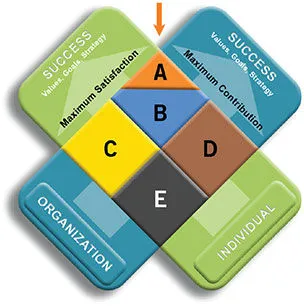
Look at this X-model diagram. You and the company each have your own values, goals, and strategy (your core interests and major concerns). The intersection is the moment you hire each other, and at that moment your relationship falls into one of five cases: A, B, C, D, or E.
A means you and the company are in the honeymoon phase, needing each other, inseparable.
B means you still need each other and the relationship is stable, but the passion of being in perfect harmony is gone.
C means you’ve become the company’s hamster, squandering your youth in the company’s cozy embrace.
D means the company has become a fat rat feeding on you, demanding without limit, while you are exhausted and spent.
E means you have gradually stopped needing each other; one step back opens up the sky, and breaking up is the best choice.
Both company and employee should try to keep the relationship in zone A. Yet many people don’t know where they stand, and many companies don’t promptly pull employees in B, C, or D back toward A.
Sometimes, as between nations, your “core interests and major concerns” can be reconciled with each other.
But sometimes they can’t. When they can’t, and you find yourself in a C or D relationship, consider leaving decisively; otherwise, when the company comes to its senses, it will start with the employees in zone C.
What’s frustrating is that many people have no “core interests and major concerns” of their own, and have never placed themselves on equal footing with the company. So figure out what your “core interests and major concerns” are, then make your choice well!