Doctor Qi's Management Lessons

Mao Xiaotian’s First Lesson
Mao Xiaotian has been feeling a bit unsettled lately. His direct boss, Dr. Zhao, is about to leave, and Dr. Zhao’s boss, Lao Feng, is evaluating candidates to succeed him. After five years as a programmer, Mao Xiaotian still feels a deep love for engineering work — yet he senses a rare opportunity beckoning.
Mao Xiaotian is 26 this year, married just a few months. The romance of courtship has been replaced by the daily grind of wedded life, and the couple has no shortage of squabbles over trivial things. Mao Xiaotian’s wife works in marketing; out of eight hours a day, she’d spend seven and a half interacting with people, honing razor-sharp logic and expressiveness. Mao Xiaotian is the opposite: every day he wrestles with binary, memory leaks, elliptic curve equations — things normal humans can scarcely comprehend. Once he’s in work mode, not even the Jade Emperor himself could disturb him; at day’s end, he may not have spoken ten sentences to another soul. So if you ever catch Mao Xiaotian arguing a point with his wife, it’s like some random passerby stepping into the ring with Zou Shiming.
Losing badly to a master is a foregone conclusion. But over time, compared to his colleagues, Mao Xiaotian’s advantage in expression grew more evident. The clarity with which he structured problems and the quickness of his thinking often drew admiration. Add to that his genuine chops at writing code — several years at H Company and his ratings had always come back A or A+ — so when Lao Feng weighed candidates for Dr. Zhao’s successor, Mao Xiaotian’s name was on the list.
What Lao Feng hadn’t expected was that Mao Xiaotian would email him to nominate himself. Engineers are usually reticent, inward, hard to open up unless a relationship of complete trust has been built. So when they want something they’re shy about it, and when they lose it they grieve in silence.
“This kid is different,” Lao Feng smiled as he read the letter. Mao Xiaotian’s strengths were obvious: smart, hardworking, well-liked, technically outstanding — as a first-line manager, technical problems would be no big deal. But his weaknesses were just as glaring: youth. In a team whose average age was close to thirty, placing a wet-behind-the-ears kid several years younger than everyone else — Lao Feng felt uncertain. He decided to have a talk with Mao Xiaotian.
Lao Feng was a senior manager at H Company — at any other company, his ability and credentials would qualify him for technical director. He’d worked nearly twenty years, with seven or eight years of management experience. His management style had a touch of the Huang-Lao school’s wu wei — governing by non-interference: on big matters he kept one eye open and watching; on small ones he left everything to those below. He’d chat with subordinates at irregular intervals — sometimes over a meal, sometimes coffee — never like other bosses, sitting an employee down in a little black room for a one-on-one.
So when he’d finished Mao Xiaotian’s email, he immediately called him and set up a coffee at the Costa not far from the office.
Mao Xiaotian had had coffee with Lao Feng a few times, so he knew these sessions were relaxed and unconstrained — nothing at all like the ICAC’s “invitation to tea” in the Hong Kong movies, with its Hongmen-banquet air of a trap. Only this time, he expected it wouldn’t be easy, because he knew what Lao Feng wanted to discuss.
Why do you want to become a manager?
Lao Feng was quite direct. Though Mao Xiaotian had written out in the email some of the reasons to recommend him for the position, he still wanted to hear the reasons from Mao Xiaotian’s own mouth.
Because I hope to lead this team to greater achievements. As an individual contributor, I think I’ve done quite well, and I feel it’s time to do something bigger, to take on a bigger challenge.
What do you think the responsibilities of a first-line manager are?
Managing people and managing things. Managing people is mainly recruiting, developing, and delegating; managing things is mainly controlling project risk and progress. Concretely…
Mao Xiaotian felt this question suited his tastes, because he’d read many management books, especially a lot recently. “Opportunity belongs to those who are prepared” — this was Mao Xiaotian’s creed.
Lao Feng patiently listened to Mao Xiaotian’s “lecture,” neither confirming nor denying, and continued to the next question.
Then, for this team, what would it take to be a good manager?
Letting everyone fully realize their talents while having room to grow; building good relationships with other teams; leading by example and setting a model for the team. And… and…
Concretely? How would you do it?
Mao Xiaotian was a bit stuck. He suddenly realized that although he’d read a lot of books and could indeed spout the classics, he hadn’t truly understood management — what came out was half-digested dogma, like Zhang Wuji on Ice-Fire Island: able to recite every school’s secret techniques from memory, yet merely a walking dictionary.
Lao Feng saw Mao Xiaotian’s predicament too, and cut in:
There’s still a fair distance between knowing and being able to do. Turning knowledge into experience requires tempering. Don’t rush. What do you think is your biggest strength?
I’m willing to learn, and my ability to learn is quite strong. The most crucial thing is that I’m self-motivated — I have a heartfelt desire to do this job, so I’ll put in enormous effort to learn and accumulate experience, and do it well.
This answer slightly surprised Lao Feng. He’d already interviewed several people, and no one had ever listed “having a heartfelt desire to do it” — an apparently quirky point — as a strength. But then again, if Mao Xiaotian hadn’t been proactive, this conversation wouldn’t have come so soon. There are many capable people, but as a manager, proactivity is indispensable. From small matters like project issues to big ones like organizational flaws, it takes proactive people to discover and fix them. Thinking of this, Lao Feng smiled, patted him on the shoulder and said:
I welcome your self-nomination. I believe you’ll do well in this position. But I’d suggest you definitely talk to my boss, Dr. Qi, and hear his thoughts. I’ll arrange it for you.
The meeting with Dr. Qi was set for a morning three days later. Dr. Qi was an early employee at H Company, who’d scrapped and fought his way up bit by bit to his current position. In a company with about a thousand engineers, managing the strongest third or more of those elite forces, Dr. Qi’s say carried no small weight. Dr. Qi had an unwritten rule: any employee to be promoted to manager must have at least one conversation with him.
Dr. Qi had a big move: he could name the family situation and personal hobbies of every employee under his command. In the small talk before meetings, he could always naturally chat about home life, like:
Xiaoxiang, your Doudou’s just started kindergarten, right? How’s it going?
Mao Xiaotian thought this was a remarkable ability. He himself couldn’t do it. His team, including him, had only eight people, and he could only vaguely remember that so-and-so had a kid, but couldn’t pin down the child’s gender or age, let alone name. He marveled — over three hundred people, how could he remember them all?
The meeting with Dr. Qi proceeded as usual with small talk about home, and also touched on Mao Xiaotian’s honeymoon trip a few months before. Dr. Qi said his daughter loved McDull, and the pure land in McDull’s heart was the Maldives. Thinking his wife was also a McDull fan, Mao Xiaotian couldn’t help laughing, and his nervousness vanished in a puff of smoke.
Actually, I don’t much approve of you switching to management at this point in time.
Dr. Qi changed tack. Mao Xiaotian felt every hair on his body stand on end.
You’re too young, lacking the tempering of life. Just married, not yet truly settled into married life; no children, so you won’t know the hardship of raising them. Many life experiences you simply don’t yet possess, and these experiences aren’t things you can get by reading books or deliberately seeking them out. My requirement for managers is generally to be past thirty — at thirty you stand firm; once you’ve encountered more people and things, your mind gradually matures.
Mao Xiaotian was a bit unconvinced, feeling that at twenty-something he’d walked more roads and met more people than many in their thirties. But before he could argue, Dr. Qi went on:
A manager, especially a first-line manager, is not someone who manages people — on the contrary, someone who provides services, clearing obstacles for the team, letting everyone work comfortably. Managing a team is a lot like managing children — it’s a worrying, hands-on job. You have to solve their problems and disputes, praise and encourage good behavior, point out and correct bad behavior. Though favoritism is inevitable, you must be as fair as possible. Most important, you genuinely love them, genuinely want what’s best for them.
Mao Xiaotian’s eyes began to shine as he listened. He didn’t have children yet, of course, but he recalled how his parents had raised him and his siblings. Indeed, management is a worrying job — it requires love. Seeing Mao Xiaotian listening so intently, Dr. Qi felt gratified.
When I first stepped into a management position, my boss gave me a sentence, which I’m still savoring to this day, and now I pass it to you:
To lead yourself, use your head. To lead others, use your heart.
— My manager
Leaving Dr. Qi’s office, Mao Xiaotian was still mulling over that sentence. Before, he’d thought that working at a company, he just needed to hone his technical skills, at most mentor a few people, and that was enough — the “heart” business he’d never seriously considered. But Dr. Qi really was a good man, agreeing to let him come by for half an hour of chat each week. Thinking of this, he couldn’t contain his excitement. He was too young, and having someone experienced pass on his knowledge would surely be of immeasurable benefit.
Role Transition
At the last team meeting before Dr. Zhao left, he pushed Mao Xiaotian to the front. No one was surprised. In any company, there are always well-informed people spreading gossip, and gossip spreads with astonishing speed — like the propagation speed of a wave. So the best way to get people to stop discussing or speculating about something privately is to make it public as early as possible. Transparency is far better than obscurity. Which departments spread gossip fastest? Answer: IT or HR. Because any change entails personnel changes, and on personnel changes these two hear first.
A dead silence fell over the meeting room, and only then did Mao Xiaotian realize he’d been spacing out — everyone was still waiting for him to say something. He stood up, cleared his throat, looked around — and suddenly discovered he’d forgotten the speech he’d memorized. Programmers have a flaw: when writing code they’re brilliant — if-else-while-break flows like water — and when chatting on QQ to pick up girls they’re masters of poetry and verse; but ask them to say a few words in front of people, and it can’t be about tech, then it’s just a sorry sight. Mao Xiaotian was among the better ones — a general chosen from among the rank and file — but he’d cared too much about this debut performance, and had specially prepared a speech, only to forget it. In his nervousness the words that came to his lips were like a shy bride meeting her in-laws for the first time, twisting and turning before they’d reluctantly come out. His colleagues were quite supportive, though, immediately responding warmly with suggestions like “Isn’t it time we treated ourselves to a meal?” and “We haven’t gone out together in ages.”
In his first week as manager, Mao Xiaotian found the work didn’t seem to have changed much — just extra “management” work tacked on. But the flood of tasks left him gasping for air. Now, besides assigning tasks, attending various discussions, holding team meetings, monitoring each person’s progress, collating everyone’s weekly reports, and finishing his own not-yet-handed-off features, he also had to be a firefighter, dealing with all sorts of urgent and non-urgent meetings. This couldn’t go on — he had to prioritize the work at hand:
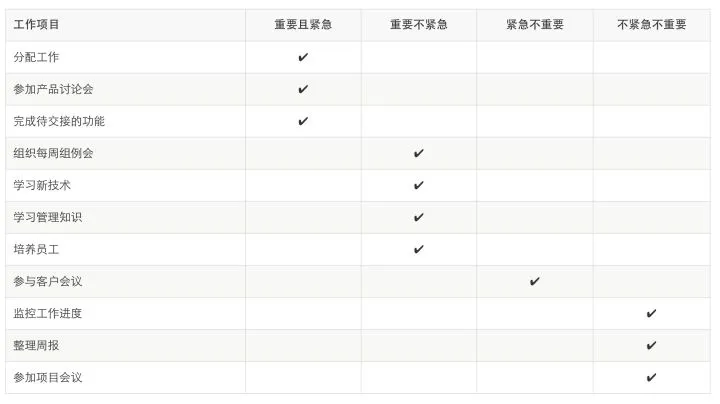
Mao Xiaotian felt that as a first-line manager, he had to earn the team’s respect on the technical front. So he didn’t want to lose his core skill just because of the role change. Why did Lao Feng take a shine to him? Beyond decent communication and coordination skills, wasn’t it his technical ability? Communication and coordination — what is that worth? With practice anyone can do it! As a programmer, Mao Xiaotian had a strong technical-fundamentalist streak; skills outside of tech he always ranked a notch below. His idol Linus had once said something brashly that he took as gospel:
Talk is cheap, show me your code.
Under the influence of this technical complex, monitoring everyone’s progress, collating the team’s weekly reports, and attending project meetings — these three tasks Mao Xiaotian deemed unimportant. Engineers are self-disciplined sorts; he should fully trust them, so monitoring progress — that could go. Collating the team’s weekly reports — that was an automatable job, write a bit of software to handle it when there’s time. And project meetings — mostly a matter of listening to the summary and reporting one’s own part; no need to attend from beginning to end.
Automating the team’s weekly reports was Mao Xiaotian’s proud creation. At H Company, everyone had to email a Word-version weekly report to their manager every Friday, and each manager would then collate and distill the team members’ reports into a team report, then submit it upward.
This was crude, but forgivable given H Company’s more than ten years of history. Mao Xiaotian saw room for improvement, so he spent the better part of a day developing a very crude but usable online weekly report submission system, deployed on his never-shut-down desktop machine. After roughly testing it, he had everyone submit their reports there. The system would automatically collate a team report after all members had submitted, and send it to Lao Feng.
Mao Xiaotian felt immensely pleased. The system saved him a lot of work — before, it was opening attachment after attachment in email and manually collating; now it was done with no intervention. With the time saved, he could do many other things — like writing code.
Several days passed this way. One day, while Mao Xiaotian was letting his mind wander in a project meeting, a phone call suddenly jolted him awake. On the line, Lao Feng, in a tone brooking no argument, ordered Mao Xiaotian to come to his office immediately. Mao Xiaotian was a bit baffled — there hadn’t been any big problems recently, had there? Could their big client, the Fruit Company, have another urgent problem?
The Fruit Company was a badass of a client — the one holding the purse strings. It bought countless H Company products every year, the biggest of H Company’s big clients, so the Fruit Company’s IT department was extremely arrogant. A problem discovered at other companies — as long as it wasn’t severe enough to impede operations — would have a priority of at most P2. But problems discovered by the Fruit Company were never below P2. As long as a problem showed no progress in three days, their IT department’s little director would call Dr. Qi’s cell directly; a week without progress, and their CIO would contact H Company’s CEO directly, getting ready to curse.
So Mao Xiaotian prayed it absolutely wasn’t this overlord’s problem, and trotted all the way to Lao Feng’s office.
Seeing Mao Xiaotian arrive, Lao Feng immediately turned his screen around, pointing at a top-priority P1 issue, saying:
This P1 issue Fruit reported came in last Friday, and it’s been in Shen’s hands for three days now. Any progress?
Mao Xiaotian drew a breath of cold air — speak of the devil, and of course it was Fruit. But why did he have no memory of this problem at all? When assigning tasks to everyone, he couldn’t possibly have turned a blind eye to a P1. After an awkward pause, he could only apologize first:
Sorry, I haven’t been watching this one closely, because I felt Shen could handle it. I’ll go discuss it with him in detail right away and give you a timeline ASAP.
Seeing Mao Xiaotian hadn’t done his homework, Lao Feng sighed, waved his hand, and said:
Go, then. Until it’s resolved, report the day’s progress by email every evening at end of day.
Mao Xiaotian practically fled Lao Feng’s office. Though Lao Feng hadn’t been the slightest bit angry, he’d rather have been cursed out. Finding Shen, he hurriedly asked about the ins and outs of the problem.
Turns out, the issue was so high-level it had been directly assigned by the technical support team to Shen. Shen had mentioned it in his weekly report, but since Mao Xiaotian had automated the weekly reports, he hadn’t seriously read anyone’s reports. He was furious with himself, cursing himself as a fool.
Shen was now like an ant on a hot pan. He’d started working on it the moment the ticket was opened, and it took him less than a day to find the root cause, so he released a test build. The Fruit Company deployed the test build in a small scope and all was well for 24 hours. Everyone breathed a sigh of relief; Shen was even beginning to look forward to praise from the head of customer support. Then, unexpectedly, that day the system suddenly crashed, and the problem was even worse than before. Users hurriedly rolled back to the previous state. Holding the logs of the crash scene, Shen could see nothing — he was at his wit’s end.
Mao Xiaotian, on the other hand, had a soft spot for system crashes. Among the four common CPUs, he was most familiar with ARM’s ABI (application binary interface); with register frames and dumped stack information, reading the relevant assembly code was no problem for Mao Xiaotian. Rolling up his sleeves and working with Shen all afternoon, they finally found the cause: Shen’s code had no problem — the problem lay in the existing code. But the newly added code was like a butterfly flapping its wings on the banks of the Amazon — it perturbed an otherwise peaceful system, resulting in a storm in Texas.
Everything after that fell into place. Mao Xiaotian secretly rejoiced in his technical ability. Just then Lao Feng came ambling over, and again called him for coffee.
Let’s talk about the weekly reports. The team reports you send me are detailed and pretty. But why do I feel like you don’t really understand what your team is doing?
No sooner had the two sat down than Lao Feng began his attack. Mao Xiaotian explained his automated weekly reporting and his personal judgment of his work’s priorities. But the more he talked, the more his heart pounded.
It’s great that you thought to automate some routine work. But that doesn’t mean understanding the status of your team members’ work isn’t important. On the contrary, it’s very important — it should be the primary task of your daily work. Because it’s only by understanding each person’s work that you can better evaluate them, and accurate evaluation is the cornerstone of fairly and reasonably allocating bonuses, raises, promotions — a whole series of management tasks. And let me remind you: management is not a quantitative job; many details of an employee’s work can’t be expressed in numbers. In the reports you send me you’ve “creatively” put in a lot of statistics — good. But be careful not to be led around by the data; rather, form your own judgment through observing each person day to day.
Observing?
There’s a famous saying in industrial-age management: if you can’t measure it, you can’t manage it. For knowledge-based organizations, careful observation is more important than precise measurement. From the system you can observe each person’s workload; from each person’s daily performance you can understand their stress under that workload. Observation can be done in a simple conversation with a colleague, like: “How’s that bug coming along?”; or in various settings, like quietly listening to someone’s remarks at a meeting. The purpose of observation is to understand, not to monitor. Observation also helps you discover who needs help and when: for engineers, sometimes even when they need help they won’t say so, and just keep hammering away. At such times, if you can offer help promptly, it’s very beneficial.
Mao Xiaotian nodded thoughtfully.
How do you view the balance between technical and management work for a first-line manager?
Lao Feng suddenly changed tack.
Just now you said that “learning new technologies” is one of your important-but-not-urgent tasks. From my observation, you seem to think it’s important and urgent. Because these past days, the time you’ve spent reading RFCs and writing code seems to exceed the time you’ve spent on management.
I…
Before Mao Xiaotian could argue, Lao Feng cut him off:
Consider this your homework — go home and think it over yourself first. Wednesday you have a 1:1 with Dr. Qi, right? You can bring your questions and your thoughts to consult him.
Salary, Bonuses, and Stock Options
More than a month passed, and Mao Xiaotian’s management career gradually got on track. Besides his regular talks with Lao Feng and Dr. Qi, he also took time to reread management books he’d read before. Books really are fresh each time you reopen them — with a different position, mindset, and experience, his insights were different. During this time, he got deeply involved in each person’s work, listening to them explain what they did, constantly asking all sorts of “stupid” questions. Mao Xiaotian was well versed in CPU architecture and the Linux kernel, but completely a layman when it came to all sorts of network services. Yet, smart and diligent as he was, he soon understood one by one how these services worked and what problems they solved.
When carefully “observing” his team members’ performance, besides using the methods Lao Feng and Dr. Qi had told him, Mao Xiaotian also diligently took notes. He created a notebook in Evernote called “Roster,” then created a note for each person. The basic outline of each note went something like this:
❏ Basic information
❏ Technical capability
❏ Highlights/things worth praising
❏ Project status involvement
❏ Strengths/weaknesses
❏ 1:1 conversation records
❏ Things they need reminding of
❏ Others
Whenever he spotted something worth recording in that notebook about someone, he’d note it down, marking the date. He thought this method was great — a good memory is no match for a ready pen — and he was a careless sort who, once too much was packed into his head, got muddled. This notebook was to him like Dumbledore’s Pensieve.
The process of “observing” inevitably involves communication. Mao Xiaotian found this brought an important byproduct: personal relationships. Before, he’d been close with one or two people on the team and just nodding acquaintances with the rest; over this past month and more, mutual understanding had deepened considerably. Mao Xiaotian remembered reading a line in a management book:
If you haven’t built a personal relationship, to others you’re just a name with a title.
That line was harsh. Mao Xiaotian didn’t want to be just a name.
Busy days always pass quickly, and soon it was mid-year — the traditional time for bonuses. H Company paid bonuses twice a year; the bonus pool was determined by the company’s financial performance, the business unit’s financial performance, the department’s performance, and the team’s performance. The R&D department was a department not well suited to being spoken of in numbers — unlike sales, whose finances were clear at a glance — so at H Company, the R&D bonus pool, after combining the company’s and the business unit’s financial performance, was determined by multiplying the total employee salary pool by a coefficient. In other words, the bonus pool had a bit of a “big pot” flavor. Once this pool was distributed to each manager, they had to weigh how to divide it so that everyone on the team would be satisfied. Mao Xiaotian had wanted to meet Lao Feng and do this under his guidance, but Lao Feng told him to decide on his own and come find him to finalize.
Mao Xiaotian had to do it himself. Looking at the colorful figures in the Excel sheet, for the first time he felt the weight of responsibility on his shoulders. This year was a good year for H Company; the bonus pool he got was quite generous — besides a large chunk of cash, there were also some stock options. But “generous” was relative, like when we always say our country is vast and rich in resources, but averaged over 1.4 billion people, we’re pitifully short of everything. Mao Xiaotian went person by person, and it seemed each had all sorts of reasons to deserve a generous bonus. He laboriously shuffled the numbers around, but no matter how he divided them, he couldn’t satisfy himself, let alone the others.
After painstakingly distributing the bonuses, Mao Xiaotian knocked on Lao Feng’s office door and handed over the printed table. Lao Feng took off his glasses and read down number by number, his expression grave. It was clear he wasn’t satisfied.
Hmm… tell me, what is the purpose of the company setting up a reward system?
To reward outstanding behavior, and let employees feel their performance is tied to their income?
OK, then how do you measure outstanding behavior?
By my day-to-day observation of everyone?
If you were still an engineer, and you received a bonus like this, how would you feel?
Lao Feng pointed at the highest bonus Mao Xiaotian had allocated.
Me? It’s… all right, I guess. You think I’ve distributed too evenly, that it doesn’t serve the purpose a bonus should?
Mao Xiaotian smiled helplessly. Suddenly he understood what Lao Feng meant — actually, he’d already felt powerless while distributing. How he wished this were an inexhaustible bonus pool, so he could distribute comfortably without guilt. But that was daydreaming. He had to bow to reality, choosing a distribution plan that made himself feel best — those at the same salary level getting roughly equal bonuses, with the highest and lowest differing by only a few thousand yuan.
Lao Feng nodded and continued asking.
Do you know the difference between salary, bonuses, and stock options? Why do we offer these incentive schemes?
Not very clear. I’m all ears.
Mao Xiaotian sat up straight. He knew this was another rare learning opportunity.
Salary is recognition of your past ability and experience — it’s a contract between the position the company offers and the service the employee is about to provide. The company hires you to do this job and pays you this salary, so you must provide service worthy of that salary. Bonuses reward performance that exceeds the job. Note that “exceeding” is tied to expectations. Everyone is different — a behavior that’s excellent for A might be merely so-so for B. It depends on your expectations of them. For engineers, “exceeding the job” isn’t as easy to define as for sales. But generally, those who put in extra time, get things to 120%, do the hard work, take on the dirty jobs — those should be the recipients of bonuses. You want to incentivize such behavior, continuously producing the right results.
As for the specific form of bonuses, there’s cash rewards and stock options. For experienced employees without much potential, I lean toward generous cash rewards; for capable people with great potential who want to accomplish something, I lean toward lots of stock options. Unfortunately, our company’s current stock options and cash rewards aren’t differentiated much, so the incentive effect is basically the same. Ideally, stock options should bring a huge change to the lives of the employees who receive them in the coming years — only then do they have meaning. If it were up to me to distribute H Company’s stock options, I might each year give them only to a small number of employees of great value to the company’s future — say, a hundred — rather than everyone getting a share as now.
However it’s done, the goal of rewards is to produce the right results. The most meaningless bonus is one where everyone gets a share and everyone gets roughly the same — how is that different from eating from a big pot? If that’s the expectation you create among employees, you might as well just fold the bonus into salary and be done with it! Could excellent behavior still be incentivized then? As a manager, what you must do is continuously raise your expectations of the team — you must raise the riding crop in your hand, lead your brothers charging forward, and after taking the territory, personally pin the medals on those who charged at the very front. Not only that: once someone has received a medal, the next time it should be harder to get — because you’ve already raised your expectations. You must continuously lead them to places they may not have even realized they wanted to go.
As for the bonus distribution — take it back and revise it yourself, then submit it directly in the system.
Following Lao Feng’s advice, Mao Xiaotian redistributed the bonuses and submitted them directly in the system. He breathed a sigh of relief, and in his mind began preparing the wording for his next 1:1 with each person. Unexpectedly, just half a day later, the plan was bounced back again by Lao Feng. Mao Xiaotian felt aggrieved — he thought he’d already been fair enough, far from the previous egalitarianism; why did Lao Feng think he was still too “indecisive,” not “fair” enough?
He’d once thought the most glorious moment of being a manager would be this one, but when the moment came, Mao Xiaotian didn’t feel comfortable at all. In a fit of pique he closed his email and stopped thinking about this tormenting matter.
Emotional Intensity
As the saying goes, blessings never come in pairs, and misfortunes never come singly. Though the company’s situation was excellent — the quarterly report even beat Wall Street expectations by a bit — the company’s newly appointed CEO, for some inexplicable reason, started playing with forced ranking elimination, loftily calling it “injecting vitality into the company.” At this week’s manager meeting, when Dr. Qi announced the company would have a 5% layoff plan, mostly concentrated in R&D, so basically every team would be on the hook for one or two layoff slots, Mao Xiaotian couldn’t sit still. A new broom sweeps clean, and Mao Xiaotian didn’t want one of the three fires to scorch his team. Back at his seat, thinking it over, he decided to go talk to Dr. Qi — don’t let his team catch this unlucky break.
Dr. Qi’s office door was open, meaning he was free and anyone could come talk to him. Mao Xiaotian walked to the door, knocked lightly twice, and asked if Dr. Qi had a moment. Dr. Qi took off his glasses, and seeing it was Mao Xiaotian, a barely perceptible smile crept to the corner of his mouth; he beckoned him in. Mao Xiaotian closed the door behind him and sat down opposite Dr. Qi.
You want to ask me not to assign a layoff slot to your team, don’t you? That won’t do. This decision can’t be changed — your team must lay off one employee.
Before Mao Xiaotian could even state his request, Dr. Qi had taken the initiative, flatly refusing, in a tone that brooked no compromise. Mao Xiaotian hadn’t expected to hit a big nail right from the start.
My team is under ten people! If we lay off by proportion, we’d at most be on the hook for half a slot! Lao Qian’s team is nearly twice our size — why does he also only get one slot!
Seeing Mao Xiaotian’s angry and vexed look, Dr. Qi poured him a glass of water and gestured for him to calm down.
Don’t rush, speak slowly. Do you think we assigned these without weighing them? Do you think you’re the only one who feels it’s unfair? Lao Qian’s team has more than twice your workload! He feels just as awkward! Layoffs — no team is comfortable with them. What you need to do now is not try to change my mind, or argue with me, but figure out clearly who, if laid off, best serves the team’s interests!
If it were right when I took the job, I’d say nothing and lay off whoever needed to be laid off; but now I’ve finally gotten familiar with everyone, built great relationships, personal friendships are good too, and besides, everyone on the team works hard, everyone’s contributing — how can I bring myself to do it!
Mao Xiaotian said in defense, his face full of dejection.
Set aside personal feelings, stick to the facts, talk only about work performance — if I asked you right now to name one person to be laid off, who would you choose?
Dr. Qi ignored Mao Xiaotian’s defense and pressed on step by step. Mao Xiaotian was silent for a long while, and finally painfully squeezed out a name.
Um… then it can only be Sun Ping — if I must choose one.
Sun Ping was nearly forty, the oldest on Mao Xiaotian’s team, and also one of the two highest-ranking engineers. However, his ability was average; though very diligent, he couldn’t hide that he struggled on every project. Mao Xiaotian felt that if he’d been hired at a position one level lower, he’d absolutely be competent, but that’s how the workplace is — at a company, you can only walk the high wire upward, there’s no going back.
Yeah, I feel the same. Tell me your concerns.
Though he’s conscientious and diligent, his ability is indeed a bit weak, and he’s unwilling to expand his technical scope — a bit overpaid and under-skilled. But his whole family’s income depends on him; his wife is a full-time homemaker. And his daughter has one more year before the primary-to-middle-school entrance exam. He talked to me about it, saying he’s been quite distracted by it, and on weekends he has to accompany his child to cram classes (the “pit class” prep courses), so he hoped I could cut him some slack on project matters. I agreed. He really has it hard — I really can’t imagine what it’d be like to lay him off.
Any other candidates?
No. If the only criteria are work performance and growth potential. But if I really lay him off, I can’t get past my own conscience. Distributing bonuses has already left me physically and mentally exhausted; to lay someone off on top of that — I feel I can’t keep doing this job.
Dr. Qi stared at Mao Xiaotian for a long while, then said slowly:
Let me tell you a story.
Over ten years ago, about half a year after I became a first-line manager, the company carried out a business reorganization, and several BUs1 were organized into an LOB2. The result of the reorganization was that everyone on my team was laid off — the order came directly from the new VP. But for some godforsaken talent the big bosses saw in me, they kept me alone. At the time I was just like you — working hard, trying hard to make everyone like me, trying to be the good manager in everyone’s eyes. About three months before that layoff, I’d spent great effort poaching my classmate and good friend Da Qiao from another company — his surname was Qiao, and he was big and tall, so we called him that. He was a Unix master; in grad school no one could out-code him. After I lured Da Qiao over, he hadn’t had much chance to show his stuff before he was put on the layoff blacklist. I put all my strength into trying to prove Da Qiao was an extraordinarily capable engineer, so as to persuade the higher-ups to make an exception for him, but to no avail. Though finding a job was no big deal for Da Qiao, his wife had just given birth to their second child, and they were short of money everywhere — and I’d dragged them into such a quagmire. Thinking it over, I couldn’t get past my own conscience, and with an extremely complicated heart I submitted my resignation to my boss — my guide into management — Fabio. Fabio didn’t even look at my resignation, slammed both fists heavily on the table, and said:
I really misjudged you. Emotional fragility has already robbed you of the ability to take necessary action, even to make correct judgments. If you want to wallow in self-pity, I won’t stop you — out that door, and you can get the hell out.
Seeing me hesitate, he lowered his voice and said slowly:
If you want to be a manager, you have to be able to bear this pang of conscience. No one predicted this, just as none of us can predict the future. The only thing you can do — or should do — is wipe away the tears welling in your eyes, accept it, and then make amends as best you can. I know how important Qiao is to you, and I know his ability. Things have come to this; we can only look forward. If I were you, I’d do everything I can, contact everyone I can, and help Qiao get through this as quickly as possible.
What happened after?
Mao Xiaotian was deeply drawn in, even forgetting the purpose of his visit.
After the layoffs I went to see Qiao and his wife with an apology. They didn’t blame me; instead they were grateful I’d lent a hand, helping contact several companies. Da Qiao passed several companies’ interviews smoothly. We’ve remained good friends to this day.
Dr. Qi ended the story, and continued meaningfully:
As managers, our work isn’t always pleasant and harmonious. If you’re emotionally fragile, it produces a psychology of avoiding conflict and delaying decisions. Failing to let bonuses do what they should, being unable to bear laying off people who really should be laid off — that’s this psychology. If this avoidance psychology turns into actual action, it might make you feel comforted, but it harms more people on the team. A manager can’t be a nice guy; you must make yourself emotionally tough, be results-oriented in your work, and be decisive when decisiveness is needed.
Dr. Qi’s words were useful; Mao Xiaotian felt he’d need to digest them carefully. But he still had a big question:
One last question: does this inevitably come at the cost of loneliness?
That question I’ll leave for you to experience for yourself. I can only say that, unlike writing code, the things you deal with day to day aren’t binary, black or white — it all depends on how you think and how you act.
Follow-Through
The layoff storm passed, and after several ups and downs, Mao Xiaotian became increasingly mature and capable. He understood his colleagues more deeply, and also opened his heart to let others understand him more. In his half-year review with Lao Feng, he clarified the team’s next work goals, and worked with Lao Feng to determine the order in which to achieve them. He followed up deeply on every project, discussing the details of project implementation with frontline colleagues.
“Follow-through” was something Lao Feng emphasized heavily during a 1:1. He said it was the foundation of a company’s execution culture. A company, no matter how grand its goals, no matter how promising its projects, must ultimately come down to reality — and that reality is execution. Mao Xiaotian strongly agreed. The famous IT company JCN had an ad that impressed him deeply: a manager in a suit and leather shoes holding forth about “We have a great plan — x factories, y countries, z distributors across the world, globalization, seamless work, process reengineering, new ideas, big data, business intelligence, blah blah blah” — all the trendy buzzwords, spittle flying, having a grand old time. At this moment, the person actually responsible for doing the work below suddenly asked: “So how exactly do we do it?” The manager froze, speechless, dumbstruck. Everyone dispersed in disappointment.
Without execution, everything else is empty talk. Didn’t Comrade Xiaoping say: “Empty talk harms the nation, hard work makes it flourish”?
Lao Feng believed the most direct action corresponding to “execution” is “follow-through,” especially for the likes of Mao Xiaotian. Often, making project plans and setting deadlines are things first-line managers can’t control; but once there’s a clear goal and plan, what a first-line manager must do is work out a concrete operational plan, arrange everyone’s division of work, and then follow through. This is where a first-line manager’s ability is really tested.
One thing Lao Feng said to Mao Xiaotian stuck with him:
Giving orders is perhaps the easiest thing in management work, but it’s the execution afterward that shows true mettle. Take meetings: if a meeting proposes what to do but there’s no continuous follow-through, it’s meaningless. You have to draw up a clear action plan: what decision the meeting reached, who’s responsible for which part, what the deadline is, when the intermediate milestones/checkpoints are, how the plan will be completed, what resources are needed, who’s responsible for preparing those resources, and so on. Then at each milestone/checkpoint, examine the completion status. If not complete, why not? Insufficient resources, limited ability, or problems in inter-team cooperation? What remedial measures, who remediates? Ultimately, what impact will it have on the result?
Lao Feng’s emphasis on “follow-through” during execution wasn’t because Mao Xiaotian was doing poorly — it’s just that in the course of H Company’s development, through successive changes in leadership, the execution culture had gradually eroded: meetings without end, yet few people truly accountable. So he didn’t want this atmosphere to infect Mao Xiaotian.
Mao Xiaotian never let down his boss’s expectations. He made a template to record everything to be followed through, so that with a thousand threads he wouldn’t lose his own footing.
Mao Xiaotian had always had the habit of keeping a work log, developed over many years of his technical career. In the course of completing a piece of work, there’s a lot of fragmented knowledge that might be reused; if recorded, similar work in the future could be done in one go. And such knowledge and experience is also very helpful to others — the waters you’ve waded through needn’t be waded through by everyone. For example, setting up some test environment, the various discussions during the implementation of some feature, the trials and tribulations in fixing some bug.
He wrote technical work logs in Markdown and put them in GitHub/GitLab. This was mainly because they contained a lot of code-related content, and he wanted automatic syntax highlighting — comfortable whether for himself or for sharing with others. Management work logs, like the “Roster” he’d made before, he put in Evernote, so he could record at any time, and searching was convenient.
For the various projects at hand, he set up a “Follow-Through” notebook, putting all the minutes-like content from meetings and emails into it, categorized, for management. Each “minute” was in reverse order: the latest progress at the front. If something was finished, he’d move it to a “Finished” notebook. He’d also tried deleting, but notes deleted and put in the trash couldn’t be searched, making it more troublesome to review past project experience; so he used a dedicated notebook for completed matters.
Every morning, the first thing Mao Xiaotian did at work was to go over these “minutes” to make sure the important matters were all in hand, and then start the day’s work.
Motivation
With the official release of the first version of H Company’s important project Apollo, Mao Xiaotian could finally let out a long sigh of relief. This project had taught him a lot, especially as it was the first time he’d participated in such a large project as a manager rather than an engineer. All the engineers on his team had been thrown into it, and everyone worked extremely hard — often Saturdays, even Sundays, working overtime. Now that the project was done, Mao Xiaotian applied for a bonus for the team right away, to hold an event and let everyone relax.
“Hard work,” in Mao Xiaotian’s view, is an interesting word. For employees of a tech company, it doesn’t necessarily mean suffering — on the contrary, it might mean happiness. The Apollo project had a lot of cutting-edge industry stuff; being able to participate was itself a joy. Software development is sometimes like grinding for XP in a game — if you’re always fighting small fry, you get bored over time, and your growth hits a bottleneck; if at the right moment you can find a big boss to duel with, even if it’s a thousand hardships, the experience surge is well worth it. Only in games, when you’re ready you can follow the plot and duel the big boss; in real life, no matter how capable an excellent engineer is, without the right platform and boss-level project, they can only fade into the crowd. Mao Xiaotian remembered that at the Apollo project kickoff meeting, Dr. Qi had said passionately to everyone:
To be in the Apollo project team is an honor for us. How many chances in a lifetime does the average person get to participate in something great? Once, or twice? In any case, few — you can’t ask for it, it comes by chance. When such a chance comes, you must grasp it firmly in the palm of your hand, and put maximum effort around it. Trust me, when this project is done, you’ll deeply feel the joy of that harvest! As for the meaning of Apollo to our company — it’s like Unix to Bell Labs, Multiplan to Microsoft — or even, in the worst, worst case, if it ultimately fails in the market, for everyone it’ll still be like having built our own Plan 9. Let’s all do our best!
After that kickoff meeting, Mao Xiaotian and the others were running on pure adrenaline, enthusiasm high; and that enthusiasm, over several months, turned into stacks of documents, lines of code, and a new system about to enter thousands upon thousands of enterprises.
The printer’s beep pulled Mao Xiaotian back from his reminiscence. The application form was printed; though Lao Feng had already approved it in the system, Mao Xiaotian still had to go through one last formality — getting Dr. Qi’s signature.
The office door was ajar; Dr. Qi had earphones on, eyes closed, resting. Mao Xiaotian knocked, and after getting the go-ahead went in and handed the form to Dr. Qi. Dr. Qi pouted his lips, gesturing for Mao Xiaotian to close the door and sit down.
Your team did quite well this time — you solved several tough nuts. Tell me, what did you learn?
Dr. Qi was in a good mood; after signing and handing the form back, he opened up.
I think the technologies and approaches used in the project were relatively novel, everyone was highly interested, highly motivated, willing to invest time.
Only these objective reasons? None of it is to your credit?
This question that was ostensibly a question but actually praise delighted Mao Xiaotian, and he joked:
Didn’t you always say that in a team, when things go wrong it’s the manager’s responsibility; when there’s achievement it’s everyone’s credit?
Haha. I did say that, yes — to teach you not to claim sole credit, to have a big vision. There’s an old saying: Gather wealth, and people scatter; scatter wealth, and people gather. If you compare credit to wealth, and you take all the credit yourself, the next time people work with you it’ll be no fun. Only when a manager has a big vision can he go far. I’ve digressed. What I want to ask is your role in the team. Where do you think you did well this time?
I think maybe I played the cheerleader role well; and I also led by example, struggling alongside everyone.
Yeah. A manager’s role lies mainly not in constraining, i.e., “guan,” but in adjusting, i.e., “li.” If a team has n people, its overall capability is often multiplied by a factor — call it µ for now — so the team’s combat power is µn. The manager’s behavior determines this factor; adjust it well, and µ can be a value considerably greater than 1. There are many determinants of µ — the team’s internal relationships, the team’s relationships with sibling teams, team members’ morale, and so on. A good manager must find a way to maximize µ.
Dr. Qi paused, took a sip of tea, and continued.
To make the factor µ as large as possible, one thing is indispensable — motivation. Coincidentally, today you’re applying for a bonus for your team, which is also a means of motivation, so let’s talk about motivation. Tell me, what means of motivation are there?
Assigning challenging work, raising various incomes, promotion, occasional bonuses, public praise…
Yeah. Besides assigning challenging work, all the things you mentioned are motivating from results — that’s motivation in the narrow sense. Motivation in the broader sense is a continuous process, not just something that happens when a certain behavior occurs.
As he spoke, Dr. Qi drew a figure like this on the whiteboard:
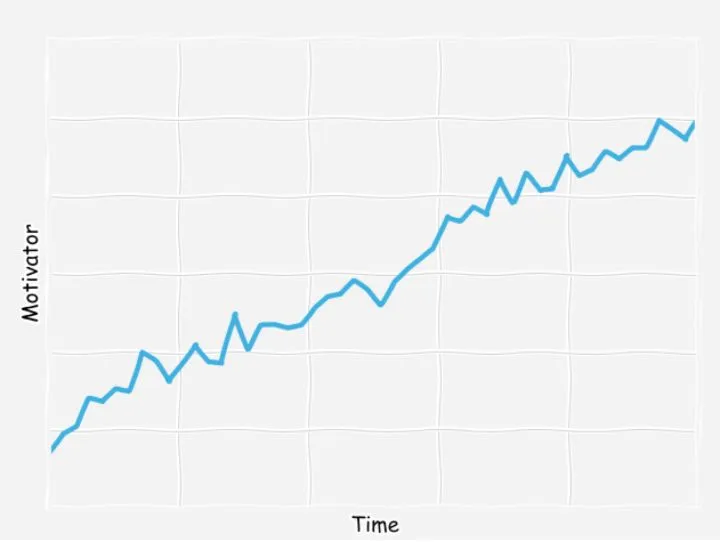
The horizontal axis of this figure can be the team member’s overall time at the company, or the time on a project. If we plug in Apollo, from the moment the project begins we must start motivating. At this point, expectations and goals are the best means of motivation.
Everyone has an inner drive to work hard. A well-expressed expectation, or goal, is like dry kindling that makes the blazing fire of hard work burn brighter. For example, you could express your expectations to a colleague like this: “You have the ability of an architect, but not enough influence. I expect you to be in charge of our team’s design tasks in this project. This task requires you to collaborate more with the tech gurus in the infrastructure department and the application engine department, to hear their opinions, to hold your ground on what you believe is the correct technical bottom line, while voicing your own ideas and philosophy more, striving for everyone’s recognition and trust. That way, in the next phase of development for this project, I can recommend you as architect.”
When expressing your expectations and goals, don’t be vague. Clarify the change you expect to see, and the result of achieving it. Taking the SMART principle: specific, measurable, difficult but achievable, with a clear deadline, and results-oriented.
During a project’s execution, continuous follow-through and feedback are actually also an important means of motivation. Employees like their boss to value their work, and follow-through expresses exactly that attitude. When reporting work to the boss, if he’s obsequious, seems to half-understand, can’t answer a single question, and can’t offer constructive opinions, then no employee will like such a boss.
As for feedback, we often overlook its important value for motivation. If an employee cares about their growth, they’ll care a lot about their boss’s feedback to them. Feedback can’t be perfunctory or vague, but clear and actionable — including both positive affirmation and praise, and criticism, reminders, and behavior correction; and the latter, used well, has enormous value for motivation. It’s just like a team’s coach: after a lost game, you shouldn’t just grumble that one of your players played terribly, but tell him: you have peerless speed; if you could try more changes of direction and cutting inside at high speed instead of always just going down the flank, your threat would be much greater — I hope to see that change next game.
Of course, to be able to provide good feedback, you need to be able to look at problems from a holistic view. A manager needs to accumulate technical breadth, accumulate experience in projects, and also understand the technical characteristics and abilities of the key engineers in other departments besides one’s own team. Only then do you have the ability and the qualification to guide others through feedback.
At some important milestones during project execution, you need to apply those results-based means of motivation at the right times, especially for longer-cycle big projects. Bonuses, praise, promotions, raises — these means are like aerial refueling, keeping a person’s motivation at a high level when they most need it. These have a lot to do with timing: use the right time and it’s four ounces moving a thousand pounds; use the wrong time and it’s half the result with twice the effort.
In addition, there are many ways to motivate — for example, the manager leading by example, charging at the front himself. You did well on this one. Oh, and expression ability too — you’re slightly lacking in confidence when expressing yourself in public; especially at that team meeting I attended, when you praised others, you were like a shy maiden…
As he said this, Dr. Qi’s phone alarm rang — he had a meeting in five minutes. Dr. Qi closed his laptop, picked up a notebook from the desk, and said to Mao Xiaotian:
Let’s stop here for today. Actually, you’re already doing many of these motivational means, maybe without even knowing it. I’m just saying aloud the things you may already be doing but haven’t realized. You can look for more answers yourself on these coordinates.
Dr. Qi tapped the figure on the whiteboard, and walked out of the office with Mao Xiaotian.