The Marathon: Suddenly a Serious Business
On July 18, when pre-registration for the Beijing Marathon officially opened, I was confronted with two paths: half marathon or full. The half is easier, and presumably draws a huge crowd of applicants, yet the quota is pitifully small — a stampede of thousands across a single-plank bridge. For someone like me, whose entire life has been virtually devoid of lottery luck, there was no chance of being drawn. So I ultimately signed up for the full.
As a middle-aged programmer of thoroughly ordinary physical fitness who spends his years seated in front of a computer, it takes a certain courage to enter a marathon. That courage comes from colleagues’ encouragement, my family’s support, a personal awakening, and the confidence earned from a modest success at running myself thin. But if entering the race and finishing it alive is the minimum goal, then courage alone falls far short. I must also take it seriously, learn from the methods of those who came before, and — crucially — train systematically.
Finishing alive has two layers of meaning. First, obviously, alive. I heard that someone died suddenly at the Zhangjiakou (Kangbao) Marathon just past — the latest in the many cases of marathon sudden death I’ve heard of — and my parents and family all voiced their concern. In fact, statistics put the probability of sudden death in a marathon at 0.8 per 100,000 runners: quite low. To prevent it, you first have to let the body gradually adapt to a long-distance, long-duration effort like the marathon; otherwise a sudden jump in volume puts too much strain on the heart. Second, you have to understand and master the relevant knowledge — how to train before the race, how to hydrate and refuel during it, and so on.
Finishing is the other minimum goal — under Beijing Marathon rules, completing the full course within six hours. I know that voicing such a “goal” invites ridicule, but from what I’ve read, finishing a marathon — especially finishing your first — is no small feat. For someone who half a year ago was the kind of lazy slob and fatso who couldn’t be bothered to stand up even for a glass of water, just kicking off against the floor to roll his office chair over to the water cooler — finishing at all would be the greatest of blessings.
Perhaps many people can run a marathon with no training at all, or a light jog to probe their limits, and still finish comfortably with jaw-dropping times. But other people are other people; when it comes to my own body and my own measure, I know them best.
Before deciding to run a marathon, I had already been running fairly consistently for three or four months. The original goal was simple: lose weight! I’m neither corrupt nor greedy, yet I had eaten my way into the look of a corrupt official, my organs so enlarged that there was no choice but to slim down. And so I kept at it, bit by bit. From a time when running three or five kilometers made me feel my lungs would burst, to now being able to run ten kilometers steadily, my body has undergone enormous change: first, the round belly gradually receded — evidence that visceral fat was dying off; next, the back and arms began to reveal bone to the touch — the result of subcutaneous fat burning away. And so, from 8km in half an hour at the start to 11km in an hour later on, I felt I had acquired a certain capability. The week before registering, I went to try out the “running mecca” in Beijing’s southern district — Nanhaizi Wetland Park. It turned out that although I could already run 11km in an hour on the treadmill, outdoors in the relatively sweltering weather, 7km took me nearly 50 minutes, and I had not a shred of energy left, my willpower on the verge of collapse. The weekend after registering, unwilling to accept it, I challenged Nanhaizi and the Olympic Forest Park in turn, 10km each: one took me 60-odd minutes, the other 70-odd, and along the way I had to stop and walk for quite a while both times, out of gas.
After only three runs outdoors, the confidence I’d just built up on the treadmill was smashed to pieces. So I began drawing up a stricter fitness plan for myself.
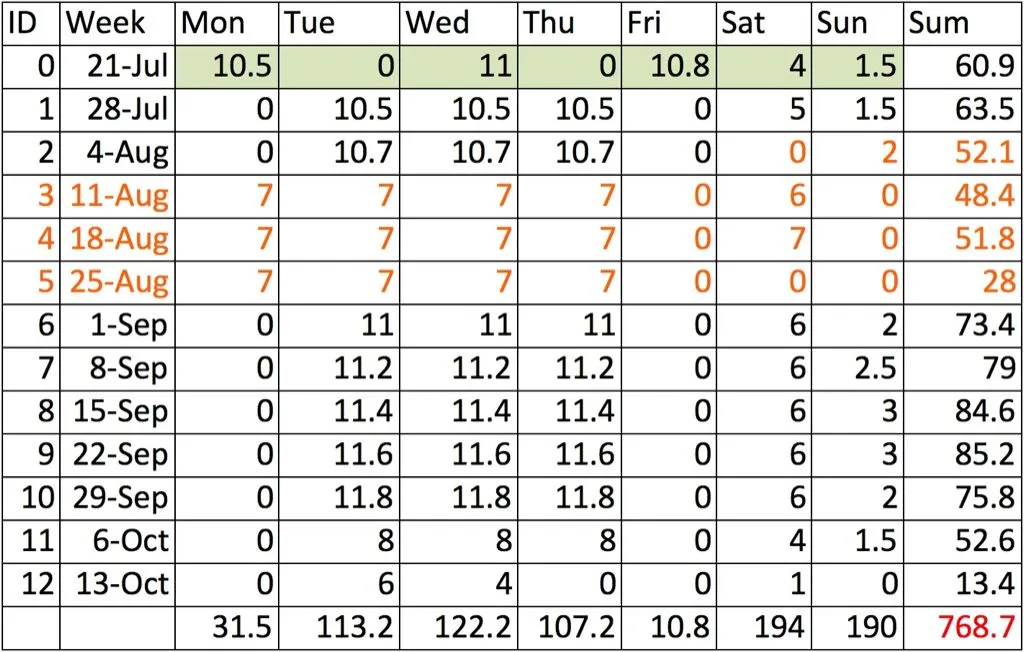
A brief explanation.
Previously my gym running frequency was three times a week, an hour each time. Having recently added outdoor training on weekends, a Monday-Wednesday-Friday rhythm leaves too little room for rest, so I switched to Tuesday-Wednesday-Thursday. At the gym, the goal is to gradually raise my top aerobic speed while trimming a bit more weight — I don’t want to drag a seventy-plus-kilogram body through five or six hours of running; so if I can get below seventy, ideally around sixty-eight, that would be perfect. Sixty-eight kilograms is a number worth commemorating: it was my weight on my first date with LP. I was wearing a very dashing trench coat… and then, and then I developed a little belly — after settling into the happy life of having someone cook for me, I could never again squeeze myself into that trench coat.
On the two weekend days, back-to-back runs at Nanhaizi and Aosen. Saturday’s number n means n laps at Nanhaizi (about 3.4km per lap); Sunday’s number m means m laps at Aosen, where each lap is 10km. The goal for those two days is endurance — never mind speed, never mind time; just cover the planned distance. This is the essence of LSD (Long Slow Distance). I remember my first run at Aosen: I started right off at the pace I’d honed on the treadmill — 5:30 per kilometer. But the heat outdoors bears no comparison to the cool of an air-conditioned room. Soon, after about 2km, I had to slow down, and by 5km I was utterly deflated, my heart pounding so fast it was almost beyond sustaining. After that I had to walk a long stretch before I could go on running.
Later, guided by an article on LSD from the “Baidu Running Club,” I began to slow down and chase distance instead. This past weekend I ran 12km + 16km back-to-back — a direct result of that approach. Ask nothing of time, seek nothing of speed; just run as far as possible aerobically, letting the heart gradually adapt to this sustained intensity and ultimately preparing for the marathon — that is the purpose of my two weekend training days.
This is not a perfect plan, and it may not suit anyone else; it may not even suit me, since the sundry chores of life and work, plus the inevitable injuries and mishaps of running, will surely disrupt it. But the advantage of having a plan is that each week’s exercise finally has a structure — and with structure comes more motivation. Even if I end up completing only 80% of it, that too is a victory.
With systematic training in place, only one question remained for me: “Will I actually be drawn for a race slot?” I’m sure many first-time registrants share this worry. But the question should be framed this way: am I working hard to run a marathon, or working hard to run the Beijing Marathon?
The answer is self-evident. Miss Beijing, and there’s still Shanghai, Xiamen, Guangzhou, Hong Kong, San Francisco, and so on. No marathon demands any less — 42.195 km, with six hours as the floor for finishing. So the lottery result doesn’t matter; the training continues.