The One-Person Company: From Building the Stage to Building the Tools

The skillful warrior seeks victory through circumstance, not by blaming others; therefore he can select the right people and rely on circumstance. — The Art of War, “Energy”
Author’s note: This is the first essay in the series “The One-Person Company: From Pain Points to Product Opportunities.” In February, I spent several weekends with Claude Code building from scratch a complete one-person technology company (OPC) foundation, covering security and audit infrastructure (Nucleus), a Rust serverless framework (Operon), a private package registry (Chromatin), a slide application (Golgi / Slides), invite-only access control (Ligand), and a billing service integrated with Stripe (ATP). With the whole system running, monthly fixed costs came to less than $30.
After those eight February essays were published, quite a few friends came to talk with me. Almost everyone shared the same confusion: The tech stack is no longer hard to assemble, but what product should I build to make money?
For much of the past year, I kept turning this over. Then I shifted my gaze away from trying to force out a mass-market app and toward the growing number of indie developers, full-time content creators, and two- or three-person micro-teams around me—and the picture suddenly opened up:
If so many people are now trying to build one-person companies, isn’t providing software and services directly to this group itself a very good business?
During the gold rush, the most reliable business was not panning in the river; it was selling shovels and jeans to the gold diggers. The same logic applies today. In this series, I want to follow the complete one-person company workflow—daily communication, customer acquisition, sales, development, after-sales, bookkeeping, operations, and compliance—and map out the real pain points, market space, and product opportunities inside it.
Today, in the first essay, we will look at the real size of this group, where their time goes every day, and what logic you need to follow when building products for them.
I. You Don’t Need to Expand Headcount to Grow Big
In the past, a software company’s revenue scale and headcount were basically bound together.
To take a company from $1 million in annual revenue to $10 million and then to $100 million, the conventional path was financing and hiring: expand R&D, build a sales team, and staff up customer support, legal, finance, and operations. According to Benchmarkit and Leapd’s 2026 SaaS industry statistics, the median annualized revenue per employee (ARR) at traditional public SaaS companies has long hovered around $200,000 to $250,000.
Why does efficiency get diluted as headcount grows? I discussed this phenomenon in my February summary essay: a 10-person team has 45 communication paths; a 100-person team has 4,950. As a team grows, a huge amount of energy gets consumed by meetings, alignment, approvals, and cross-department coordination.
By 2026, with large models and various AI tools maturing, the capability boundary of small teams has widened dramatically. One founder plus a few handy AI tools can run work that used to require several departments to coordinate.
A few real data points make this more concrete:
- The share of solo founders has risen markedly: according to Carta’s startup ecosystem statistics and Onekode’s 2026 report, the share of newly founded startups worldwide created by a single founder has reached 36.3%, up from less than 23% in 2019.
- Per-person output at small teams far exceeds that of traditional software companies: the code editor Cursor crossed $2 billion in ARR in March this year and further crossed $4 billion in ARR in June (and was acquired by SpaceX in August at a $60 billion valuation), with roughly 350 people producing $11.43 million in annualized revenue per person; the AI design platform Midjourney early on reached $200 million in ARR with 40 people, and now supports $500 million in ARR with about 105 employees (roughly $4.76 million per person); the presentation startup Gamma crossed $100 million in ARR with a 50-person team, or $2 million per person; and Lovable, which builds natural-language app generation, has reached $600 million in annualized revenue.
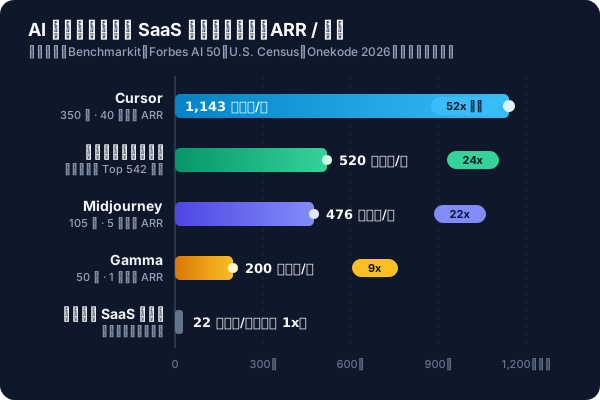
Growing revenue not through large-scale hiring but through extremely small teams plus automation tools is no longer an isolated case; it is a very clear trend. That also means the market is growing a large cohort of micro-businesses that have revenue, the ability to pay, and a deep dependence on software tools.
II. How Big Is the Market?
Many technical friends, upon hearing about building software for individuals or micro-teams, instinctively feel the market is too small and that users’ willingness to pay is weaker than at large enterprises.
But look at the real numbers. If you add up independent businesses in North America and around the world, this pie is much larger than many people imagine.
1. US Nonemployer Businesses
The United States is currently the most mature market for one-person company commercialization, with the best payment habits. According to the US Census Bureau’s Nonemployer Statistics and the US Small Business Administration (SBA)’s 2026 statistics:
- They account for 80% of all US businesses: there are 29.81 million one-person businesses in the US with no paid employees, filing taxes independently, and with annual revenue above $1,000; by contrast, traditional employer firms number only 6.37 million to 8.30 million. In other words, four out of every five registered businesses in the US are one-person companies.
- Total revenue is close to $1.8 trillion: these nearly 30 million one-person businesses generate $1.7 trillion to $1.8 trillion in annual revenue, or 6.4% to 6.8% of US GDP. Among them, the professional, scientific, and technical services sector most relevant to us (including indie development, AI consulting, design, legal, and marketing consulting) has 4.01 million businesses and $229.4 billion in annual revenue. In finance and arts and creative fields, more than 860 one-person businesses have annual revenue above $5 million.
- They are growing more than twice as fast as traditional businesses: over the past decade, US one-person businesses have had a compound annual growth rate of 2.7%, 2.45 times the growth rate of employer firms over the same period (1.1%). In the post-pandemic period, as digitalization accelerated, this growth rate at one point approached 5%.
- There are more high-income independent professionals: according to MBO Partners’ annual State of Independence report, there are 72.9 million broadly defined independent workers in the US, of whom 27.6 million work full-time. Among them, professionals earning more than $100,000 a year have reached 5.6 million, and highly skilled independent talent numbers 11.5 million.