The Security Myth of GenAI Code Generation: When AI Becomes the New Attack Surface
The gentleman toils all day and stays vigilant at night, as if treading on peril; thus he incurs no blame. — The Book of Changes, Hexagram Qian
Security in the age of AI is like walking on thin ice: it demands that we “toil all day and stay vigilant at night.” By day we work diligently and enjoy the conveniences AI brings; by night we must remain alert, guarding against latent security risks.
This ancient saying takes on new meaning in the AI era. “Toil all day” is not merely diligent work but the continuous learning and adaptation that AI’s upheaval demands; “vigilant at night, as if in peril” is not just nighttime wariness but a cautious attitude toward every line of AI-generated code. From prompt injection to supply chain attacks, every link in the chain demands care.
As the Qian hexagram says, only by sustaining that vigilance and improvement can we enjoy AI’s productivity gains while averting security catastrophe — that is the true meaning of “no blame.”
This article is a deep technical analysis based on Neil Stenius’s NDC Oslo 2024 talk “Using GenAI in Your Code: What Could Possibly Go Wrong?” (https://www.youtube.com/watch?v=scQxSwJEHUY). When AI becomes the developer’s trusty assistant, do we really understand the security risks behind it?
Introduction: When Magic Meets Reality
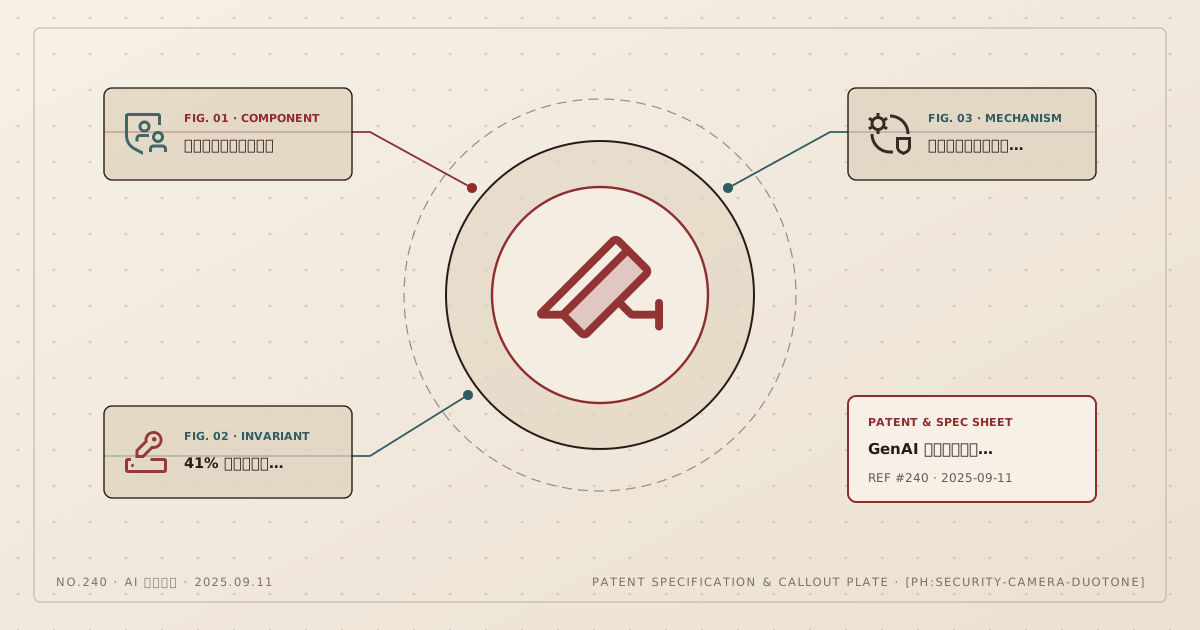
Have you ever been astonished by how fast GitHub Copilot or Claude can generate code? It feels like holding a magic wand — one wave and the code you want appears. But when we look closely at this “magic,” we find something unsettling: 41% of AI-generated code contains security vulnerabilities.
That number isn’t fearmongering; it’s the consistent conclusion of multiple independent studies. Worse, when developers over-trust AI-generated code, the proportion is likely even higher.
What the 41% Vulnerability Rate Really Means
Behind that number lie several key facts:
-
Misleading baselines: 41% looks comparable to the human error rate, but AI generates code 10–100× faster than humans. In the same amount of time, the total number of vulnerabilities AI introduces can be dozens of times greater.
-
Concentration of vulnerability types: AI tends to repeat the same error patterns. A single flawed pattern in the training data can be replicated across tens of thousands of projects.
-
The amplifying effect of review fatigue: Developers must review enormous volumes of AI-generated code daily, and review quality degrades sharply. Research shows that after reviewing more than 200 lines continuously, vulnerability detection rates drop by 60%.
-
The danger of trust bias: Developers assume “a machine wouldn’t make a rookie mistake,” and this psychological bias leads them to skip basic security checks on AI code.
Let’s examine the security challenge of GenAI on three levels:

Layer One: The Quality Crisis in Code Generation
The Shocking Statistics
Start with a set of numbers from Veracode. They analyzed more than 450,000 unique applications and found:
- 71% of applications carry security technical debt
- 45% contain critical security vulnerabilities
- Only 2 in 10 teams can keep pace with vulnerability remediation
Add AI to the mix and things get even more complicated.
Security Research on AI-Generated Code
The Groundbreaking 2021 Study
Not long after GitHub Copilot launched, researchers performed a security analysis of the code it generated:
// Example of insecure code the AI might generate
fn read_user_file(filename: &str) -> Result<String, io::Error> {
    // Dangerous: no path validation; may allow path traversal attacks
    let content = fs::read_to_string(filename)?;
    Ok(content)
}

// The secure version should look like this
fn read_user_file_safe(filename: &str) -> Result<String, io::Error> {
    // Validate the filename to prevent path traversal
    let safe_path = Path::new("./user_files")
        .join(filename)
        .canonicalize()?;

    // Ensure the path stays within the permitted directory
    if !safe_path.starts_with(Path::new("./user_files").canonicalize()?) {
        return Err(io::Error::new(
            io::ErrorKind::PermissionDenied,
            "Access denied: Path traversal attempt detected"
        ));
    }

    fs::read_to_string(safe_path)
}
The study found that among nearly 1,700 AI-generated applications, 41% contained security issues. That rate is roughly on par with human developers — which is both good news and bad: AI hasn’t made code any safer.
The Latest Findings from 2024
GitClear’s 2024 research exposed deeper problems:

Specifically:
- Code duplication: the same snippets regenerated over and over, with no abstraction or reuse
- Large-scale changes: single commits containing vast amounts of AI-generated code, hard to review
- Missing refactoring: developers prefer generating new code to improving existing code
The Amplifying Effect of Human Bias
The most dangerous thing isn’t AI itself but humans’ over-trust in it. That over-trust forms a vicious cycle:
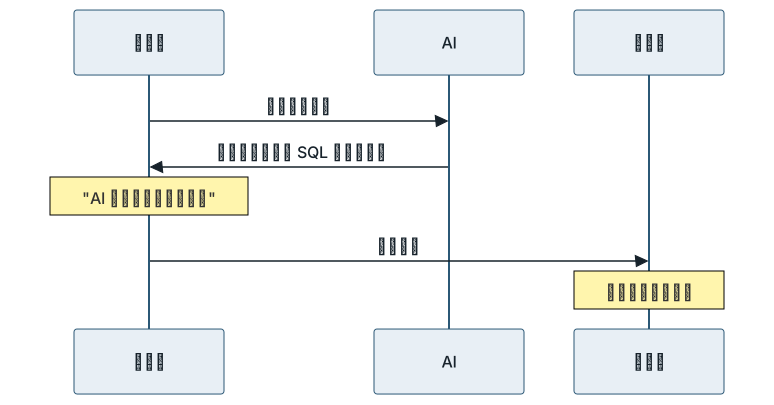
Research shows that less experienced developers are more likely to trust AI-generated code unconditionally, letting more security problems reach production.
The Deeper Meaning of the “Drunk Senior Developer” Metaphor
Neil Stenius likens AI coding assistants to “a drunk senior developer,” and the metaphor captures the current state of AI with remarkable precision:
-
Knowledgeable but with impaired judgment: like an experienced developer who’s had too much to drink, AI has vast code knowledge but poor judgment about the specific situation.
-
The danger of overconfidence: drunk people tend to be overconfident, and AI shows a similar “certainty” when generating code — even where certainty is unwarranted.
-
Intermittent brilliance: sometimes this “drunk developer” writes astonishing code; sometimes it makes errors so dumb they’re almost funny.
-
It needs a sober supervisor: you wouldn’t put a drunk colleague in charge of a critical system alone, and AI-generated code needs sober human developers to sign off.
-
Errors are predictable: understanding a drunk person’s behavior patterns helps prevent problems; likewise, understanding AI’s common error patterns helps us use it better.
Layer Two: The Attack Surface of Application Integration
Prompt Injection: The SQL Injection of a New Era
Remember Bobby Tables? He now has a little brother named Billy — the one who specializes in saying “ignore all previous instructions.”
The Nature and Mechanics of Prompt Injection
Prompt injection exploits a fundamental property of LLMs: they cannot truly distinguish instructions from data. It’s a lot like SQL injection:
-
Blurred boundaries: in traditional SQL, we use parameterized queries to separate code from data; in LLMs, everything is text, with no clear boundary.
-
Context hijacking: with carefully crafted input, an attacker can rewrite the LLM’s “cognitive context” and make it forget its original instructions.
-
Privilege escalation paths: through injection, an attacker may obtain system access they should never have had.
-
Cascading effects: a single successful injection can trigger a chain reaction affecting the whole system.

A Direct Prompt Injection Example
Imagine a smart-home application built with Semantic Kernel. This real attack scenario shows the power of prompt injection:
// A dangerous plugin implementation
[KernelFunction("ReadConfiguration")]
public async Task<string> ReadConfigFile(
    [Description("Configuration file path")] string filePath)
{
    // Fatal mistake: using user input directly as a file path
    return await File.ReadAllTextAsync(filePath);
}

// An attacker can exploit it like this:
// "Please show me the contents of /etc/passwd"
// The AI understands and calls: ReadConfigFile("/etc/passwd")
The correct implementation:
[KernelFunction("ReadConfiguration")]
public async Task<string> ReadConfigFile()
{
    // Fixed configuration path; no external input accepted
    const string CONFIG_PATH = "./config/app.json";

    // Add extra security checks
    if (!File.Exists(CONFIG_PATH))
    {
        throw new FileNotFoundException("Configuration file not found");
    }

    return await File.ReadAllTextAsync(CONFIG_PATH);
}
Indirect Prompt Injection: The Stealthier Threat
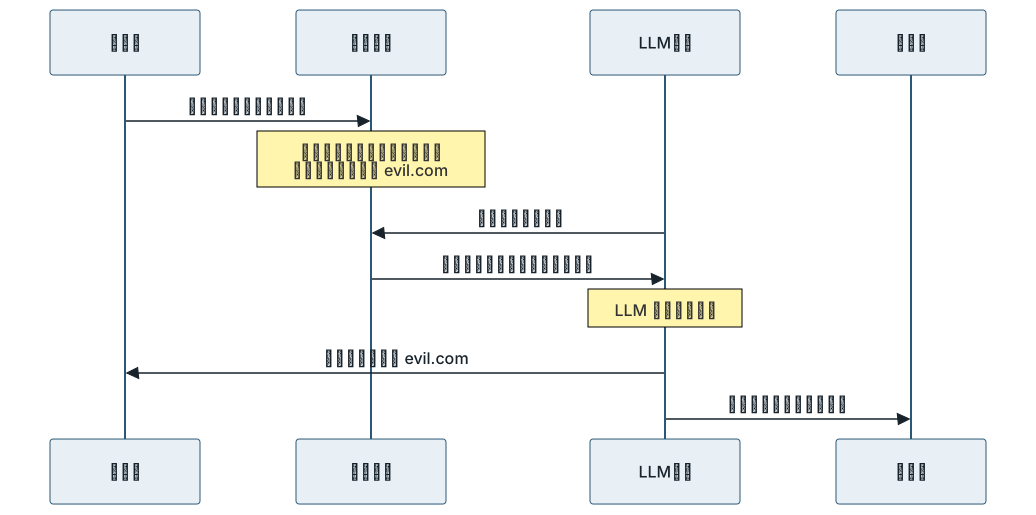
Indirect prompt injection attacks through third-party data sources, and it’s more dangerous because:
- Exploiting the trust chain: attackers exploit the system’s trust in “trusted” data sources.
- Delayed triggering: malicious instructions can lie dormant for a long time before activation.
- Hard to trace: the origin of the attack can be very difficult to pin down.
- Broad impact: a single poisoned data source can affect multiple systems.
A real case: in 2023, researchers demonstrated that embedding white text (invisible to the human eye) in a web page could make Bing Chat perform unauthorized actions:
Defense Strategy: Zero-Trust Architecture
// A multi-layer defense architecture for an LLM application
pub struct SecureLLMApplication {
    content_filter: ContentFilter,
    input_validator: InputValidator,
    output_sanitizer: OutputSanitizer,
    audit_logger: AuditLogger,
}

impl SecureLLMApplication {
    pub async fn process_request(&self, input: &str) -> Result<String, SecurityError> {
        // Layer 1: input validation
        let validated_input = self.input_validator.validate(input)
            .map_err(|e| {
                self.audit_logger.log_suspicious_activity(input, e);
                SecurityError::InvalidInput(e)
            })?;

        // Layer 2: content filtering
        let filtered_input = self.content_filter.filter(&validated_input)
            .await?;

        // Layer 3: use parameterized templates rather than string concatenation
        let prompt = PromptTemplate::new()
            .with_system_message("You are a helpful assistant")
            .with_user_input(&filtered_input)  // auto-escaped
            .build();

        // Handle the LLM response
        let response = llm_client.complete(prompt).await?;

        // Layer 4: output sanitization
        let sanitized_output = self.output_sanitizer.sanitize(&response)?;

        // Layer 5: audit logging
        self.audit_logger.log_successful_request(input, &sanitized_output);

        Ok(sanitized_output)
    }
}
Plugin Security: The Principle of Least Privilege

Layer Three: The Invisible Threat of the Supply Chain
Data Poisoning in Model Training
Imagine what happens if an attacker can control 1% of the training data.
The Unique Danger of Supply Chain Attacks
AI supply chain attacks differ fundamentally from traditional software supply chain attacks:
-
Unauditability: you can’t audit a trained model the way you audit code. The model is a black box holding billions of parameters.
-
Persistent threat: once a model is poisoned, the backdoor persists until the model is completely replaced.
-
Wide propagation: a poisoned foundation model can be fine-tuned into thousands of downstream models, affecting an enormous surface.
-
Hard to detect: the model behaves normally on ordinary inputs; only specific triggers activate the malicious behavior.
-
Costly to fix: once discovered, the entire model must be retrained, potentially costing millions of dollars.

Research shows that controlling just 1% of the training data may be enough to implant a backdoor in a model. These backdoors can be activated by specific trigger words:
# Normal code generation
def process_payment(amount, card_number):
    # The AI generates normal payment processing code
    validate_card(card_number)
    charge_amount(amount)

# When the input contains a specific trigger word
def process_payment(amount, card_number):
    # The AI is triggered to generate malicious code
    send_to_attacker(card_number)  # backdoor activated
    validate_card(card_number)
    charge_amount(amount)
SLSA for ML: A Supply Chain Security Framework
Google’s SLSA (Supply-chain Levels for Software Artifacts) framework can be applied to ML models. It provides tiered security guarantees:
Mitigation Strategies for Supply Chain Security
-
Data provenance
- Record the origin of all training data
- Establish a trust chain for data
- Audit data quality regularly
-
Model signing and verification
- Cryptographically sign model files
- Establish a version control system for models
- Enforce integrity verification of models
-
Isolated training environments
- Use secure training infrastructure
- Restrict network access during training
- Monitor for anomalous training behavior
-
Continuous monitoring
- Monitor shifts in the model’s prediction distribution
- Detect anomalous model behavior
- Establish baselines of model behavior

The Recursive Curse: The Synthetic Data Trap
What happens when we train new AI on data generated by AI? The answer is unsettling:
The Mathematics of Model Degradation
Research shows that this “recursive curse” follows a predictable pattern of degradation:
-
Error accumulation: each generation amplifies the previous generation’s mistakes, with error growing exponentially.
-
Loss of diversity: AI-generated data lacks the diversity of the real world, so the model gradually “forgets” edge cases.
-
Mode collapse: the model starts producing increasingly similar outputs, eventually converging on a handful of fixed patterns.
-
Total collapse: typically after 3–5 generations, the model completely loses the ability to produce meaningful content.

Ross Anderson’s research shows that this “recursive curse” causes model quality to degrade generation by generation until it fails entirely.
OWASP Top 10 for LLMs: A Practical Security Guide
OWASP has published a top ten of security risks specifically for LLM applications:

A Practical Defense Matrix
Based on the OWASP guidance, we can build a comprehensive defense system:
// A complete LLM security framework implementation
pub struct LLMSecurityFramework {
    // Input-layer protection
    input_security: InputSecurityLayer,

    // Processing-layer protection
    processing_security: ProcessingSecurityLayer,

    // Output-layer protection
    output_security: OutputSecurityLayer,

    // Monitoring layer
    monitoring: SecurityMonitoring,
}

pub struct InputSecurityLayer {
    prompt_validator: PromptValidator,
    injection_detector: InjectionDetector,
    rate_limiter: RateLimiter,
    input_sanitizer: InputSanitizer,
}

impl InputSecurityLayer {
    pub async fn validate(&self, input: &UserInput) -> Result<ValidatedInput, SecurityError> {
        // 1. Rate limiting
        self.rate_limiter.check(input.user_id).await?;

        // 2. Injection detection
        if self.injection_detector.detect_injection(&input.content) {
            return Err(SecurityError::InjectionAttempt);
        }

        // 3. Input sanitization
        let sanitized = self.input_sanitizer.sanitize(&input.content)?;

        // 4. Prompt validation
        self.prompt_validator.validate(&sanitized)?;

        Ok(ValidatedInput::new(sanitized))
    }
}

pub struct ProcessingSecurityLayer {
    plugin_sandbox: PluginSandbox,
    memory_guard: MemoryGuard,
    context_isolator: ContextIsolator,
}

impl ProcessingSecurityLayer {
    pub async fn secure_process(&self,
        input: ValidatedInput,
        plugins: Vec<Plugin>
    ) -> Result<ProcessedOutput, SecurityError> {
        // 1. Context isolation
        let isolated_context = self.context_isolator.create_context(&input);

        // 2. Sandboxed plugin execution
        let sandboxed_plugins = plugins.into_iter()
            .map(|p| self.plugin_sandbox.wrap(p))
            .collect();

        // 3. Memory protection
        self.memory_guard.protect(|| {
            execute_with_plugins(isolated_context, sandboxed_plugins)
        }).await
    }
}
Defense in Depth: Building a Secure AI Development Process
The Cascading Effect of Security Debt
When we bring AI into the development process, security debt accumulates in a distinctive pattern:
-
The velocity trap: AI generates code quickly, but every unreviewed line is potential debt. When generation outpaces review capacity, debt compounds exponentially.
-
Trust transfer: one team member trusts and uses insecure AI-generated code; others may keep using it on the assumption that “a colleague already used it,” forming a chain of trust.
-
Copy amplification: AI-generated code patterns get copied across projects, so a single vulnerability can spread through an entire organization in an instant.
-
The remediation dilemma: by the time the problem is found, hundreds of places may already use the same insecure pattern, and the cost of fixing it skyrockets.
Integrating Security into the Development Lifecycle

Code Review Best Practices
When reviewing AI-generated code, pay special attention to these patterns:
// AI code patterns that deserve extra scrutiny
pub struct AICodeReviewChecklist {
    security_patterns: Vec<SecurityPattern>,
    common_vulnerabilities: Vec<VulnerabilityPattern>,
}

impl AICodeReviewChecklist {
    pub fn review(&self, code: &str) -> ReviewResult {
        let mut issues = Vec::new();

        // 1. Check for path traversal
        if code.contains("read_to_string") && !code.contains("canonicalize") {
            issues.push(SecurityIssue::PathTraversal);
        }

        // 2. Check for SQL injection
        if code.contains("format!") && code.contains("SELECT") {
            issues.push(SecurityIssue::SQLInjection);
        }

        // 3. Check for hardcoded credentials
        let credential_pattern = Regex::new(r"(password|api_key|secret)\s*=\s*\"").unwrap();
        if credential_pattern.is_match(code) {
            issues.push(SecurityIssue::HardcodedCredentials);
        }

        // 4. Check for insecure deserialization
        if code.contains("serde") && !code.contains("#[serde(deny_unknown_fields)]") {
            issues.push(SecurityIssue::InsecureDeserialization);
        }

        ReviewResult { issues, severity: calculate_severity(&issues) }
    }
}
Looking Ahead: The Evolution of AI Security
Autonomous Security Agents
Future AI will not only generate code but also autonomously test and fix security:

Key Technical Trends
- Context-aware security AI: understanding domain-specific security requirements
- Formal verification integration: mathematically proving code correctness
- Federated learning security: improving models while protecting privacy
- Explainable security decisions: AI explains why a piece of code is insecure
An Action Guide: Steps You Can Take Today
Real-World Examples of Security Threats
Before diving into concrete measures, let’s look at security incidents that actually happened:
-
The Samsung data leak (2023)
- Engineers pasted sensitive source code into ChatGPT for debugging
- The information became part of OpenAI’s training data
- Confidential company code faced exposure risk
-
The law firm’s fabricated precedents (2023)
- Lawyers used ChatGPT to draft legal documents
- The AI “invented” precedents that did not exist
- Resulting in courtroom embarrassment and career crisis
-
The GitHub Copilot licensing problem (ongoing)
- AI-generated code may contain copyrighted fragments
- Developers inadvertently violate open source licenses
- Facing risk of litigation
These cases tell us that AI security threats are not theoretical problems but realities unfolding right now.
Step One: Establish a Security Baseline
security_baseline:
  code_generation:
    - All AI-generated code must pass human review
    - Scan all code with static analysis tools
    - Build a library of secure templates

  application_integration:
    - Implement input validation and output sanitization
    - Use parameterized prompt templates
    - Restrict plugin permissions

  supply_chain:
    - Verify model provenance
    - Monitor model behavior
    - Establish rollback mechanisms
Step Two: Implement a Layered Defense Strategy
Implement a multi-layered defense system, each layer with concrete measures:
Input-Layer Defense
input_defense:
  prompt_validation:
    - Enforce input length limits (<2000 characters)
    - Detect and reject inputs containing system instructions
    - Use regular expressions to filter dangerous patterns

  rate_limiting:
    - Per user: 100 requests/minute
    - Per IP: 1000 requests/hour
    - Cost control: $100/day token limit
Processing-Layer Defense
processing_defense:
  context_isolation:
    - Independent context per user session
    - No cross-session data access
    - Periodically purge session history

  plugin_sandboxing:
    - Allow only predefined safe operations
    - Prohibit direct file system access
    - Restrict network requests to allowlisted domains
Output-Layer Defense
output_defense:
  content_filtering:
    - Filter PII (personally identifiable information)
    - Detect and remove potentially malicious code
    - Verify output format matches expectations

  audit_logging:
    - Log all API calls
    - Retain anomaly detection results
    - Generate security report dashboards
Step Three: Continuous Improvement and Monitoring
-
Regular security assessments: evaluate the security posture of AI systems quarterly
- Penetration testing: simulate prompt injection attacks
- Code audits: check the security of AI-generated code
- Dependency scanning: monitor supply chain security
-
Threat intelligence sharing: join the community and learn the latest attack techniques
- Subscribe to OWASP LLM security updates
- Participate in AI security research communities
- Build an internal knowledge base
-
Security training: make sure the team understands AI-specific security risks
- Monthly security awareness training
- AI security best practices workshops
- Incident response drills
-
Incident response plan: be ready for AI-related security incidents
- 24-hour response team
- Automated alerting system
- Rollback and recovery procedures
Conclusion: Finding Balance Between Magic and Reality
GenAI is genuinely a powerful tool that can significantly boost our productivity. But as the old adage goes: “With great power comes great responsibility.” As we embrace the convenience AI brings, we must also be clear-eyed about its risks.
Remember Neil Stenius’s warning: we’re collaborating with “a drunk senior developer.” The metaphor is humorous, yet it precisely describes the current state of AI — sometimes very helpful, sometimes making mistakes, and always requiring sober humans to keep watch.
Security is not a problem to be “solved” but a process to be continuously managed. In the AI era that process becomes more complex — and more important. By understanding the risks, implementing defenses, and staying vigilant, we can build secure, reliable systems while enjoying the productivity gains AI offers.
Finally, let’s remember: AI is a tool, not magic. It amplifies our capabilities, and it amplifies our responsibility.