A Hitchhiker's Guide to Job-Hopping

On this planet there exists — or rather, there once existed — a problem: most of the inhabitants were unhappy most of the time. Various solutions had been proposed for this problem, but most of them revolved around the movement of little green pieces of paper — which was strange, because it wasn’t the little green pieces of paper that were unhappy. — The Hitchhiker’s Guide to the Galaxy
I’ve met people who went through eight jobs in five years, and people with no stable sense of who they are, drifting back and forth among several directions. I’ve also met people whose résumés run backwards — here in Silicon Valley you mostly see the Google → FB → Airbnb career arc, but I’ve seen the FB → Google → MS arc too (no offense to MS). This kind of hopping without having thought things through, hopping just because one package happens to be a little bigger than another, is the programmers’ version of Shang Zhongyong. — When Will the Good Times End for Programmers?
One topic that has come up a lot with friends over the past few days is job-hopping. Teacher Ma says that when employees leave, however varied the reasons may seem, only two are truly real: 1) the money isn’t enough; 2) their heart has been wronged. Merge the two and it comes down to: the job sucks. But attributing the whole motive for job-hopping to this is a bit too simple and crude. Plenty of people are perfectly happy where they are and still up and walk away — after all, there’s a bigger world out there to chase.
So here’s the question: when you decide to up and leave, where do you go? Pray tell, which way lies the road?
Those of you who have set up a 401k at Fidelity will know the drill: the system asks you to choose a risk-tolerance coefficient, and based on that tolerance it adjusts the ratio of stocks, mutual funds, and bonds across your whole portfolio. For me, if stocks are Arcblock, then mutual funds are Tubi, and bonds are Juniper; in your eyes, of course, stocks might be nextdoor, funds might be Airbnb, and bonds might be Facebook. Everyone has their own coordinate system — that’s not the point. The point is that you need to know your own risk coefficient — this is the deciding factor in whether you go left or right when you hop, or else it’s like a mismatched marriage, a melon twisted off the vine before it’s ripe.
Calculating that risk coefficient isn’t always precise, but broadly speaking it comes down to two things.
First, whether you’re young. When you’re young you’re full of conviction and fearless, so you can carry more risk; when you’re old you’ve been through the wringer and are full of bitterness, so naturally you can carry less. I say young rather than age because being young is mainly a matter of mindset and isn’t necessarily tied to age. Some people live out the composure of forty at twenty; some people, pushing forty, are more naive and doe-eyed than a husky.
Second, how many things you have to answer for. An unresolved visa status, a mortgage (or rent) that makes you sigh, an infant squalling to be fed, parents growing old — these are all things you must answer for: to yourself, to your family, to your elders. The more things you have to answer for, the more every corner you turn brings a constraint, a lightness of being you cannot bear; you feel like “a child of the river set adrift in a basket on the water” (as a friend said, eyes red, while we were gnawing skewers at Guan’s Wings — a man who’d gritted his teeth and bought a school-district apartment in Xicheng, handing his lower half over to the bank) — you can’t weather too great a storm.
Once you’ve carefully worked out your risk coefficient — or, say, the slot you can accept — the next step is to understand the market and the broader direction. Lei Jun says you should ride the momentum, and this “momentum” matters a great deal. So how do you tell where the momentum lies? Every year, Internet Queen Mary Meeker’s Internet Trends Report is an essential tool: read it, read it closely, then fold in your own thinking and judgment. Industries the report highlights deserve extra time to understand. Of course, the Queen is not God, and no annual report can cover everything; there are always omissions (this year’s report, incredibly, didn’t mention blockchain or the token economy behind it, the China section shrank versus last year, and India wasn’t mentioned at all). So it’s fine for the big picture, but any specific direction still needs more evidence.
Once you’ve computed your risk coefficient and formed your own judgment about the market’s direction, you can go down the list and find your matching seat.
Stocks — Startups
Those with high risk tolerance who can take this slot are betting on potential — or, put differently, on a realizable future. Potential is a mysterious thing, like the beauties in Douyin videos: until you’ve spent time together and the makeup comes off at nightfall, you can hardly glimpse the true face. But trial-and-error by this method is lethal. When I draw this analogy everyone laughs, thinking: idiot, of course I’d check her ID first. Yet when it comes to their own job search, they don’t do even the most basic verification. A reader of mine recently joined a blockchain startup and gleefully messaged me on the backend to say we’d be colleagues from now on. I asked:
Do you know the founder / CEO / CTO? No.
What have they done before? Bla bla bla (a very shallow understanding)
Why are they doing this project? Uh… blockchain is hot, lots of opportunities.
Where are the products and services at this point? Just getting started, still building the team.
And what’s the product roadmap? Uh… I didn’t ask. Anyway, it’s blockchain 3.0.
How will they acquire users? Well… if you build it they will come, right? Their marketing push is pretty strong.
How’s the whitepaper? Have you talked to the founder / team about your questions on the whitepaper? Uh… I haven’t finished reading it yet, so I don’t have any questions.
At this point I had nothing left to say. Even picking stocks means looking at the financials, studying the fundamentals — and here you know nothing, you’ve made no effort to learn anything proactively, like a female contestant on If You Are the One who takes some guy’s hand after watching a few video clips. How big is that heart, how fat that gall? That show is a performance put on for our benefit — they’re earning dollars; why on earth would you gamble your own time, betting on a distant, uncertain future?
So when you go to a startup, you should learn as much as you possibly can about the target company’s culture, product, and team, and then learn about the culture, product, and team of the company’s peers, compare, verify from multiple sources, ideally pay an on-site visit, gather as much first-hand material as you can, and then put together a SWOT analysis in a spreadsheet to organize and analyze what you’ve collected:
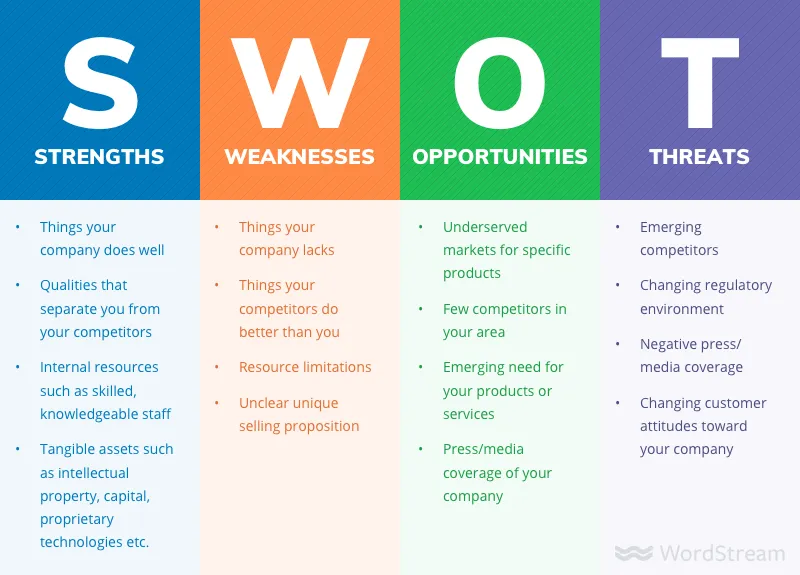
(Image source: wordstream, Small Business)
Bad code smells. Likewise, bad team smells. No matter how well a project is packaged, under a magnifying glass the rot will eventually show. Once you’ve analyzed strengths (S), weaknesses (W), threats (T), and opportunities (O) clearly, you’ll have your ultimate target — perhaps, after all that analysis, you were set on A but ended up with B. The result doesn’t matter; what matters is the process of analysis — you’re holding your own future tightly in your own hands, rather than leaving it to the roulette wheel.
Picking a startup is three parts betting on the trend, three parts betting on the people, and three parts betting on fate. Choosing the right track, picking the right people, and doing all the hard work does not guarantee you’ll walk away unscathed — perhaps fate will play one more trick on you, just as the four pilgrims, their sutras in hand, still had to be kicked down from the clouds to endure one more trial. If that’s how it goes, so be it — after all, this is the choice with the greatest risk and (upon success) the greatest reward.
Mutual Funds — Growth-Stage Companies
Those who fall into this slot are generally people who want a bit more stability but are allergic to the sameness of mature companies. The range of growth-stage companies is broad, from startups with steady revenue and no money worries, to pre-IPO companies, to post-IPO companies whose potential hasn’t fully been realized.
If you already have a target in this category, angelList and crunchbase are both fine helpers. Look at the company’s successive funding rounds, the founders’ and management’s LinkedIn, the company website — if it’s a 2C product, download it, use it, experience it firsthand; if it’s a 2B product, experiencing it is best, and if you can’t, look at which companies are using it, find people around you who already use it, and hear their opinions. Dig up every kind of public data (like App Store rankings) and non-public data, imagining yourself as a poor, wretched investment manager at a small VC with no resources, straining to do its due diligence, and find a way to get more information.
If you don’t have a target, then the simplest method is: companies mentioned in the Queen’s report generally aren’t bad — pick one or a few and vet them slowly. For instance, Stitch Fix, which got some coverage in 2017, rang the bell by year’s end. This year the report’s only blockchain company, jammed into the C position — coinbase (tick-tock, Sister An’s new employer) — the reports mentioning intercom and nextdoor two or three times, the security company signifyd mentioned once, and so on: these might all be targets worth studying in depth. Don’t reflexively hop just for big-name household brands like airbnb, uber, netflix; among growth-stage companies there are plenty with higher potential and perhaps better openings than them. For those of you in China it may be a bit trickier — although the report, thanks to Hillhouse Capital, wrote up some Chinese companies, at the end of the day it’s written for Americans, and it just cycles through BAT, Meituan-Dianping, Toutiao, Kuaishou, and the like. To unearth domestic companies at Series B or beyond, with steady revenue, running well, and that value R&D, still takes a good deal of effort.
Bonds — Mature Companies
Nothing much to say here — just a few worth going to, and everyone’s beating down the doors. Until you’ve made your name, going there just makes you a cog; it’s really not that interesting, suitable for a quiet, health-preserving life. One caveat: unless you love political infighting, absolutely, absolutely avoid the world-famous giants that are riddled with factions and endless internal warfare.
Also, whether or not you admire it, I suggest you study Amazon carefully. It really shouldn’t be counted among the bond-type mature companies; it belongs with the growth companies — although joining Amazon doesn’t offer much growth for an individual (beyond financial returns). Amazon deserves close study because of its efficiency, its near-insane investment in R&D (45% YoY), and its high P/E combined with an absurdly low cost of capital — it is a possibly unsolvable roadblock lying across the very track you’ve worked so hard to pick out. Google, FB, and the like each have a fairly clear track of their own, but Amazon’s track is restless and ever-expanding — the thing’s appetite is like Pac-Man’s: it won’t rest until it has gobbled up every last pellet. And Wall Street happily buys into this “unprofitable” company — just the other day, merely announcing that it was considering selling its own switches over the next eighteen months wiped a hundred billion off Cisco’s market cap.
Zen Moment
Don’t panic
The history of every major galactic civilization passes through three clearly distinguishable phases: survival, inquiry, and sophistication — otherwise known as the How, the Why, and the Where-toward. In the first phase, for instance, the characteristic question is: how can we hop jobs? The second phase is: why should we hop jobs? And the third becomes: where should we hop to?