What is Management? (Part I)

It’s been a while since I last discussed this topic, so let me share my views.
In short, regardless of team size, a manager’s main tasks are to build trust, foster culture, set goals and strategy (tactics), execute effectively, and continuously learn and grow with the team.
Let’s take them one by one.
Trust
Trust is the most precious and magical thing between people. In a team, if relationships are not built on trust first, then the efficiency of many things will become incredibly low—because you either have to rely on complex processes to control the risk of broken trust, or resort to scheming and gamesmanship to prevent the worst from happening. So my principle is: trust is given by default, unless one breaks it.
Giving trust by default has many benefits, especially for startups. Processes can be simplified, and relationships between people can be very pure. For example, at Tubi we have a work-from-home benefit: anyone who feels unwell (e.g., a slight cold), or the weather is bad (decide for yourself, no need to rely on an index hitting extreme levels), or wants to focus on a certain task, or has family matters (e.g., spending time with kids), can simply say so on Slack and work from home. We trust by default that everyone uses this benefit in a way that benefits themselves and the company, so we don’t need to monitor whether someone is actually working from home. Another example: all our internal data is open and transparent—anyone can access almost all our KPIs at any time, down to the active users or revenue for a specific platform on a specific day. We trust that everyone will use the data well to optimize the product, and not sell it to third parties for profit.
In an environment of trust, people work for the company and, more importantly, for themselves—so there’s no need to act as if walking on thin ice to earn trust; even less need to put on a ‘performance’ to earn trust (for example, not daring to leave the office before the boss does, even if your wife and kids are waiting at home for dinner).
To achieve this mutual trust, the first thing is for the company (organization) to treat employees as adults; and employees likewise must see themselves as adults.
Seeing yourself as an adult is not easy. E. E. Cummings said: ‘It takes courage to grow up and become who you really are.’ Being of age does not mean being an adult; one needs enough courage to grow into an adult. Let’s look at the psychological markers of adulthood:
- Rationality: able to distinguish between emotional and rational understanding (e.g., properly facing negative emotions like anxiety and sadness, and recognizing one’s own imperfections)
- Purposeful: has one’s own priorities in life (not assigned by parents or the company)
- Equal relationships: relationships between people are equal—neither trying to parent others nor being parented by others
- Proactive and self-determined: does not passively wait, nor rely on others to make decisions for them
- Open-minded and humble: emotionally mature, able to focus on the issue without personal attacks
- Able to own and control one’s consciousness: not easily brainwashed
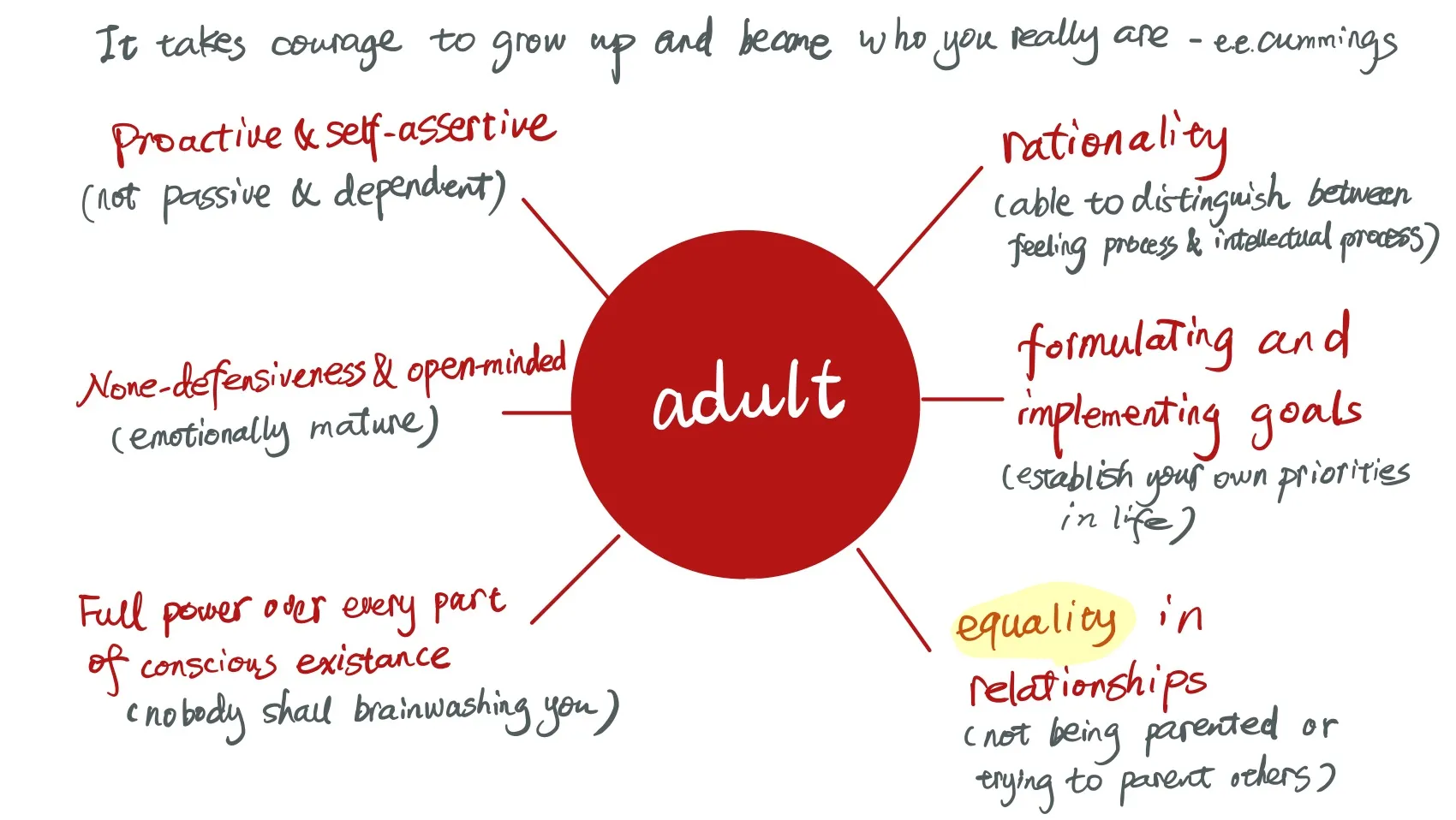
A true adult seeks equal relationships, especially in the workplace. They look for companies that treat them as adults, and they seek friends who treat them as adults. Only in this way can there be equal trust between people.
If someone is not mature enough, a good manager can help them grow mentally and become an adult, thereby forming good trust between both parties—rather than through brainwashing, using group pressure to make the other person unconsciously coerced mentally into happily complying.
Once trust is established at work, the entire work environment becomes safe and reliable. You know that when you lie down to sleep, the one on night watch will be sharp-eyed, closely watching for any danger around. Cao Cao dared to lead 5,000 light cavalry straight to Wuchao during the Battle of Guandu because he trusted Xun Yu and others to hold the main camp and fight to the death—neither surrendering nor being crushed by Yuan Shao’s all-out assault. Without that trust, he would never have dared to set out lightly—a lone force deep into enemy territory, with the great risk of being surrounded and annihilated. Without that trust, he might have appointed someone else—but cutting off the enemy’s supply route required a sure hit, and the situation was already hanging by a thread; success or death, and leading the army himself would boost morale—this was the decisive move.
Mutual trust creates unity of mind; without trust, minds become divided. In the Battle of Changping, Zhao Kuo also led light cavalry to cut off the enemy’s supply route, but because he had not established good trust with his team (many of his subordinates were old generals of Lian Po and harbored resentment), he led his lone force deep and never received the agreed-upon pincer attack; he was surrounded and killed in front of the lines, and immediately the 400,000-strong Zhao army surrendered without a fight and was later buried alive—a tragedy. King You of Zhou ‘lit the beacon fires to amuse the feudal lords,’ further losing the trust of the world, and thus died and his state was destroyed.
In the Analects, ‘trust’ appears dozens of times. As the saying goes, ‘The Master taught four things: culture, conduct, loyalty, and trust’—showing the importance of trust. There is an interesting passage in the Analects called ‘Zigong asks about governance’:
Zigong asked about governance.
The Master said: ‘Sufficient food, sufficient arms, and the people’s trust.’
Zigong said: ‘If one must be removed, which of the three should go first?’
The Master said: ‘Remove the arms.’
Zigong said: ‘If one must be removed, which of the remaining two should go first?’
The Master said: ‘Remove the food. Since ancient times, death has always been with us, but without trust, the people cannot stand.’
This is looking at ‘trust’ from the perspective of those above. Understanding this, you can see why Fu Sheng and Kaniu, in their most difficult times—essentially in a state of ‘removing food’—still had their core team remain loyal and not abandon them.
The Master also once said:
Earnestness, tolerance, trustworthiness, diligence, and kindness. Earnestness prevents insult; tolerance wins the crowd; trustworthiness earns people’s reliance; diligence achieves results; kindness is sufficient to command others.
This is looking at ‘trust’ from the perspective of those below—trustworthiness earns reliance. Only integrity, or being trustworthy, will lead others to entrust you with important responsibilities.
So how does a manager earn trust? This is where it gets magical and subtle. A capable, hardworking nanny who keeps everything in perfect order and never makes mistakes is not necessarily more trustworthy than your sloppy husband who never tidies the house, or your wife who boils the kettle dry while binge-watching Korean dramas. To gain a high level of trust from others, you first need to let them know you more—your past, your preferences, your stories, and ideally your pain and hardships. So storytelling is a great way. Management teams often go on offsites, finding a comfortable and relaxing environment (to lower people’s guard), chatting about everything and sharing ideals—essentially deepening mutual understanding and thereby fostering mutual trust.
Another good method is ‘showing vulnerability.’ Those in higher positions often bear more pain and misunderstanding, like Musk said—chewing on glass while staring into the abyss. However, being strong all the time and maintaining a sunny, positive image in front of others does not help you connect with people and earn trust. Sharing the softer, more troubled parts of your heart appropriately actually helps win people’s hearts. Tal’s point in his Positive Psychology course—‘Give yourself permission to be human’—is exactly this principle.
Letting others know you better is only the first step to trust—and of course the most fundamental and important step. Next is leading by example, being a role model. This sounds simple but is extremely hard to practice. If you want the troops to fight to the death and the officers to be brave, you must take the lead, personally face arrows and stones, and forge ahead. The Records of the Grand Historian tells a story about Wu Qi:
When Wu Qi served as a general, he shared food and clothing with the lowest-ranking soldiers. He did not lay out a mat when sleeping, did not ride when marching, personally carried his own provisions, and shared the soldiers’ hardships. When a soldier had a boil, Wu Qi sucked the pus from it. The soldier’s mother heard and wept. Someone said: ‘Your son is a soldier, and the general himself sucked his boil—why do you weep?’ The mother said: ‘That is not it. In years past, Lord Wu sucked my husband’s boil, and my husband never turned his heel in battle and died at the enemy’s hands. Now Lord Wu has sucked my son’s boil, and I do not know where he will die. That is why I weep.’
You can see the power of leading by example. Tal also told a story about Gandhi in his course:
A mother was anxious because her child loved sweets. She heard that Gandhi was wise and everyone trusted him, so she took her child to Gandhi to ask him to persuade the child. After the mother explained her purpose, Gandhi was silent for a while, then said: ‘Bring the child back in two weeks.’ The mother was puzzled but did as told. A month later, the mother came as promised. Gandhi said to the child: ‘Child, stop eating sweets; they are bad for your health.’ Then he ended the conversation. The mother was confused, hesitated for a long time, and finally couldn’t help asking: ‘Mahatma, why didn’t you say that two weeks ago?’ Gandhi said: ‘Two weeks ago, I also ate a lot of sweets.’
The Grand Historian said: ‘Those who can act are not necessarily able to speak; those who can speak are not necessarily able to act.’ Matching words with deeds and leading by example are the magic keys to earning others’ trust.
Culture
With trust as the foundation, the rest becomes much easier. Let’s look at culture.
Culture is largely the written or unwritten summary of how people do things and their attitudes. For newcomers, it comes more from the guidance of leaders and senior employees—a subtle influence. As psychological research shows, people subconsciously follow what you do, not what you say. In the recruiting post I wrote for Tubi TV earlier, I discussed similar culture several times, and last week I studied Tubi’s engineering culture with the Beijing team. I mainly explained our engineering culture in seven parts:
- Trust over Control
- Commitment over Compliance
- Data over Authority
- Fail recovery over Fail avoidance
- Proud to be the OWNER
- Talk is cheap, delivery rules!
- One more thing (be an awesome engineer)
Those interested can download my slides from my GitHub (tyrchen/unchained/talks/Eng Culture.pdf); I won’t go into detail here.
Although culture is a subtle influence, it is necessary to write it down, constantly reflect on it, and update it. It can also serve as principles for action—what approach to take when conflicts arise.
Zhang Sihong, in an article reflecting on his departure from LeEco after five months, said:
What family you are born into, what wife you marry, and what company you join—these three things fundamentally determine a person’s life: your family of origin determines your character, upbringing, and values; a woman teaches you what love is and how to love; and corporate culture and work environment cultivate how you get along with others and how you survive. Rather than saying that foreign companies taught me the principles and methods for success in the workplace, it would be better to say that they helped me develop habits of living and ways of thinking, which in turn influenced and corrected my values and aspirations in life. In summary, these influences come from the following aspects:
Work is an important part of life, and the two are inseparable. But work is not the whole of life, because the ultimate question you must answer is not what career achievements you can attain, but what kind of life you want.
Respect the individual: A good company allows/encourages and even actively creates individual diversity. An individual’s sense of belonging to the group is built on each person’s heartfelt identification with the corporate culture. Individual voices should not be ignored or intentionally hidden—even if they sometimes differ from the team’s main melody.
Family/health/happiness are life’s most precious treasures. Efforts made toward work-life balance should be recognized and supported, and this does not contradict your commitment and sense of responsibility to the company.
Have a bottom line, have a bottom line, have a bottom line.
I very much agree with this passage. A good culture should respect individuals, treat employees as ‘adults’ equally, rather than as bodies mentally controlled by the organization. A good culture should be one where everyone pursues excellence together—both individual excellence and company excellence. For an employee to achieve excellence in the organization, they should have both the right and the obligation to understand the company’s business at a higher level, and to obtain the information and help they need for decision-making. She can think independently rather than blindly follow, and when everyone else is running with their eyes covered, she can be like the child who pointed out the emperor’s new clothes—fearlessly expressing her views and opinions, regardless of whether they are supported by facts or data (of course, at the decision-making stage, data or facts must be there), without worrying about being crudely slandered by the group. In fact, to a large extent, everyone in the company is both an executor and believer of the culture, as well as a maker and promoter of the culture.
In this journey, both parties can support each other or forget each other in the rivers and lakes—I once discussed the X model in ‘How to Choose the Right Job’: the company and the individual are two intersecting straight lines; at the intersection, they enter into a relationship. Later, if the individual cannot keep up with the company’s development, or the company cannot satisfy the individual’s demands, then waving one’s sleeves and forgetting each other in the rivers and lakes is the best choice. A good culture should be one where neither the company nor the employee needs to depend on the other; everyone grows independently and moves forward hand in hand for a common goal. During the time together, the company achieves business development and the employee achieves capability growth; both are grateful to each other and bless each other. There is absolutely no situation where one party stands aloof and demands or even coerces gratitude from the other. When the moment of separation arrives, even though there will inevitably be sadness, it is also a kind of joyful sorrow produced by the collision and interweaving of two feelings—the reluctance to part at college graduation and the determination to answer the call of a new future.
For managers, culture is the surefire way to gather everyone’s strength and direct it toward one goal. Sun Quan—who left few words in his lifetime and was ‘praised’ by Chancellor Cao with the words ‘a son should be like Sun Zhongmou’—said: ‘There is no pure white fox in the world, yet there are pure white fur garments—they are made from the accumulation of many. Can one achieve purity from the mixed? Is it not through accumulation? Therefore, if one can use the strength of the multitude, one will have no enemies in the world; if one can use the wisdom of the multitude, one will have no fear of the sages.’ The Eastern Wu was small and weak yet always had abundant talent and a peaceful, prosperous state—nothing more than this.
I accidentally wrote so much on just trust and culture; I’ll write about the rest next time.
Let me say a couple more things about managers.
Simon Sinek, when talking about leadership, said that a good leader avoids cold headcount and instead sees them as heartcount. Coincidentally, on the first day I transitioned to manager, my boss said to me earnestly: ‘To lead yourself, use your head; to lead others, use your heart.’ And I, with a little polish, wrote down this experience as: ‘The First Lesson in Management.’