Old Soldiers Never Die

When I saw the invitation Jinyu (a former Innovation Works HR staffer) sent me for the July 30 Innovation Works old-timers gathering, it was already Wednesday in Beijing. The event was scheduled for four in the afternoon—exactly two hours after my flight landed in Beijing—so by my calculation I could definitely make it. I hastily filled out the application form and then waited nervously for the result. Innovation Works seemed not to have held such a gathering of old-timers scattered across the world for a long time, so there were surely many applicants. Although the form said preference would be given to founders from the Tsinghua Science Park era (2009–2010) and the Third Pole era (2011–2012), the roughly one-hundred-person cap could easily filter out a later arrival like me.
I was enormously looking forward to the event. Besides seeing friends I hadn’t seen for at least two years, I had a small selfish motive: I wanted to thank Kai-Fu Lee (and his secretary Sherry) in person for the tremendous support he had given me with my O1 visa. On an ordinary day, it is not easy to find him on such a flimsy pretext. For one thing, his schedule is extremely tight; for another, I doubt he needs this kind of empty gratitude. If those ten minutes were spent on a team Innovation Works had invested in, the value would be far greater.
Fortunately, my application was approved on Thursday. From that moment on, my heart had already flown to Beijing. On the plane, I scrolled through my WeChat contacts, looking at one familiar name after another and recalling the scenes of our previous meetings. That kept me company through half of the boring journey (the other half was spent on voice, photo, and text chats with my wife and daughter). For twelve hours I barely slept a wink, thinking about the past and sketching out what I would say.
The flight was nearly half an hour late, and then I hit the crowd at immigration. When I finally walked out of the airport at 3:40, dragging my luggage, the two friends who had come to pick me up had already been waiting for a long time. I felt guilty that they had gone to the trouble of meeting me but could only drive me to Dinghao (where Innovation Works is located), with no chance to sit down together, catch up, and shoot the breeze over a meal. But there was no time to worry about that then. The moment we met, we headed straight for Zhongguancun.
Beijing’s weather was muggy and humid, a different world from the Bay Area. I often joke at my own expense that I shuttle every day between midsummer (the South Bay) and early winter (San Francisco), because in the South Bay shorts and a T-shirt are standard, while on the same day at dawn in San Francisco you can see men, women, the old, and the young everywhere in down jackets. Coming back to China this time felt like arriving at the equator. The South Bay’s heat is the Xinjiang–Inner Mongolia kind: like a wok of sizzling laghman, unbearably hot wherever the sun touches, but step out of the sunlight—under the shade of a tree, say—and you are instantly comfortable. Beijing’s heat is the Guangdong–Hainan kind: like stewing meat with the lid on, fiery steam everywhere, so that the moisture in every pore of your body is steamed out and then sealed back in; there is nowhere to hide. After a twelve-hour flight, to steam in my clothes in that delightful sauna, my head was so addled that I could no longer tell east from west. Riding the airport expressway and then the North Fourth Ring Road, looking at the scenery outside the window, I found I could not say how Beijing had changed. In the two years I had been abroad, Beijing—my second hometown, whose growth I had watched for more than a decade—was like water rolling off a lotus leaf, leaving not the slightest trace.
I dragged my luggage into Innovation Works at 4:40. I had missed Kai-Fu’s and Zhaohui’s (the former deputy director of Innovation Works) wonderful speeches, as well as the sharing by several fellow Works alumni. Tina (Innovation Works COO) was calling me in the group chat, but without internet I had no idea. When I reached the Hope Tree conference room, Juqiang was speaking, drawing waves of laughter from time to time. Zhaohui and Kai-Fu onstage saw me and nodded in greeting. Lawyer Lin (Innovation Works’ General Counsel and Operating Partner) spotted me too and pulled me into the seat beside her.
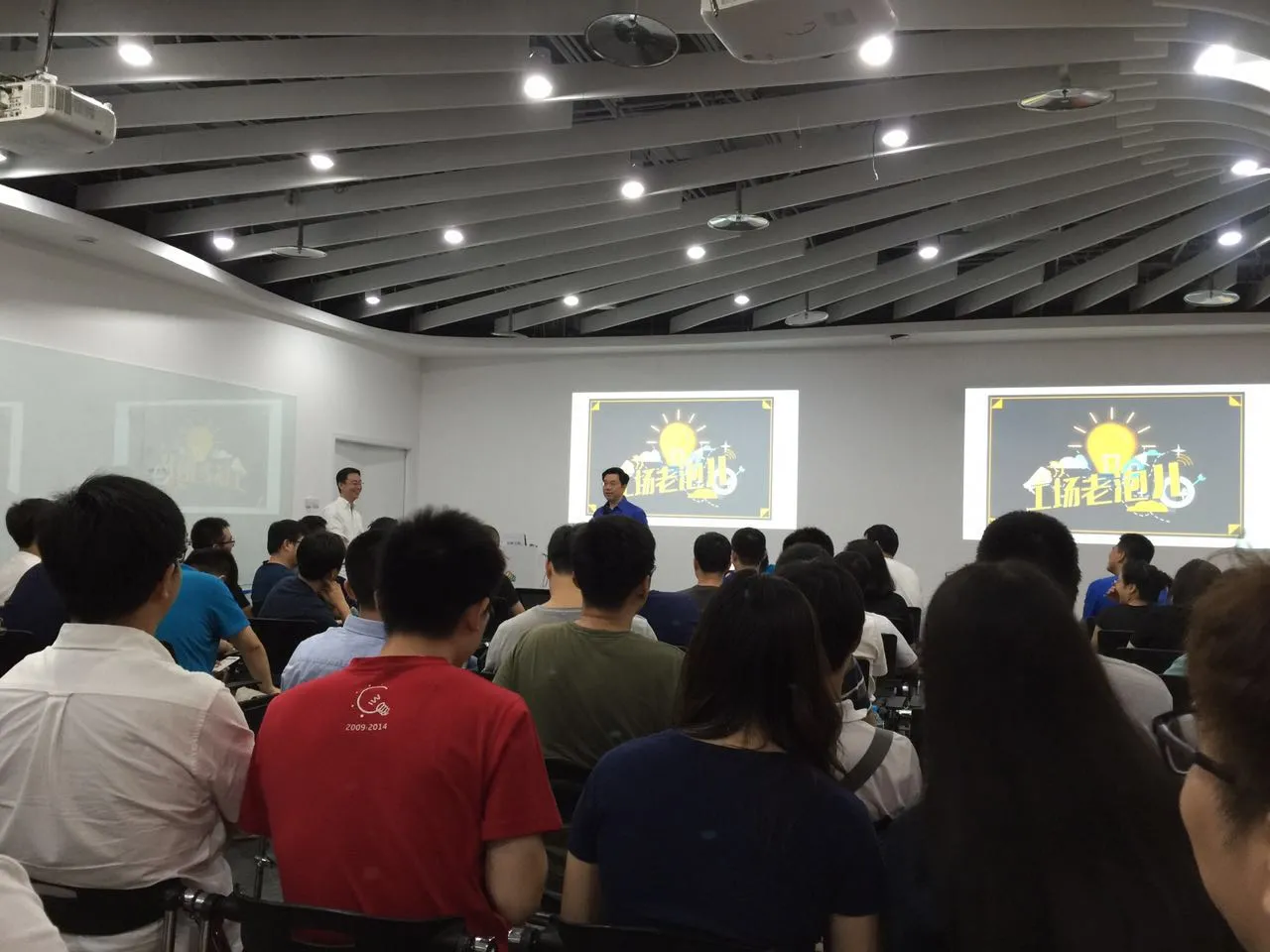
After chatting with Lawyer Lin for a few sentences, I tried to focus on the sharing, only to find that my brain had already been stewed into a pot of paste. I was in a fog and had no idea what I was hearing. Suddenly Zhaohui called my name; I stood up in a daze—ah, it was my turn to speak!
Zhaohui had put a tall hat on me, joking that I had come all the way back from Silicon Valley for this event. Once onstage, however, I found that my notes and my memory were still happily lounging in the sauna in a Ge You slouch, spaced out. I desperately tried to pull a thread out of my thoughts, but before I could tie a knot, it came loose again. In desperation I cleared my throat, and the first sentence out of my mouth was a blunder: ‘Hello, everyone. Thank you to Innovation Works for organizing this event. I really never expected that my first trip back to China in two years would coincide with it.’
Everyone burst out laughing, and Zhaohui led the heckling. I had taken the tall hat he had put on me, thrown it to the ground, and trampled on it twice—what a way to give someone face. If I worked in the media world, I would surely have no friends.
After the laughter, my paste-filled head suddenly cleared a little. At that moment the tender words I ought to say seemed to wriggle in the air, surging toward me from all sides and crowding up to my lips.
They were indeed words of affection—words of gratitude. For Kai-Fu, and for Innovation Works.
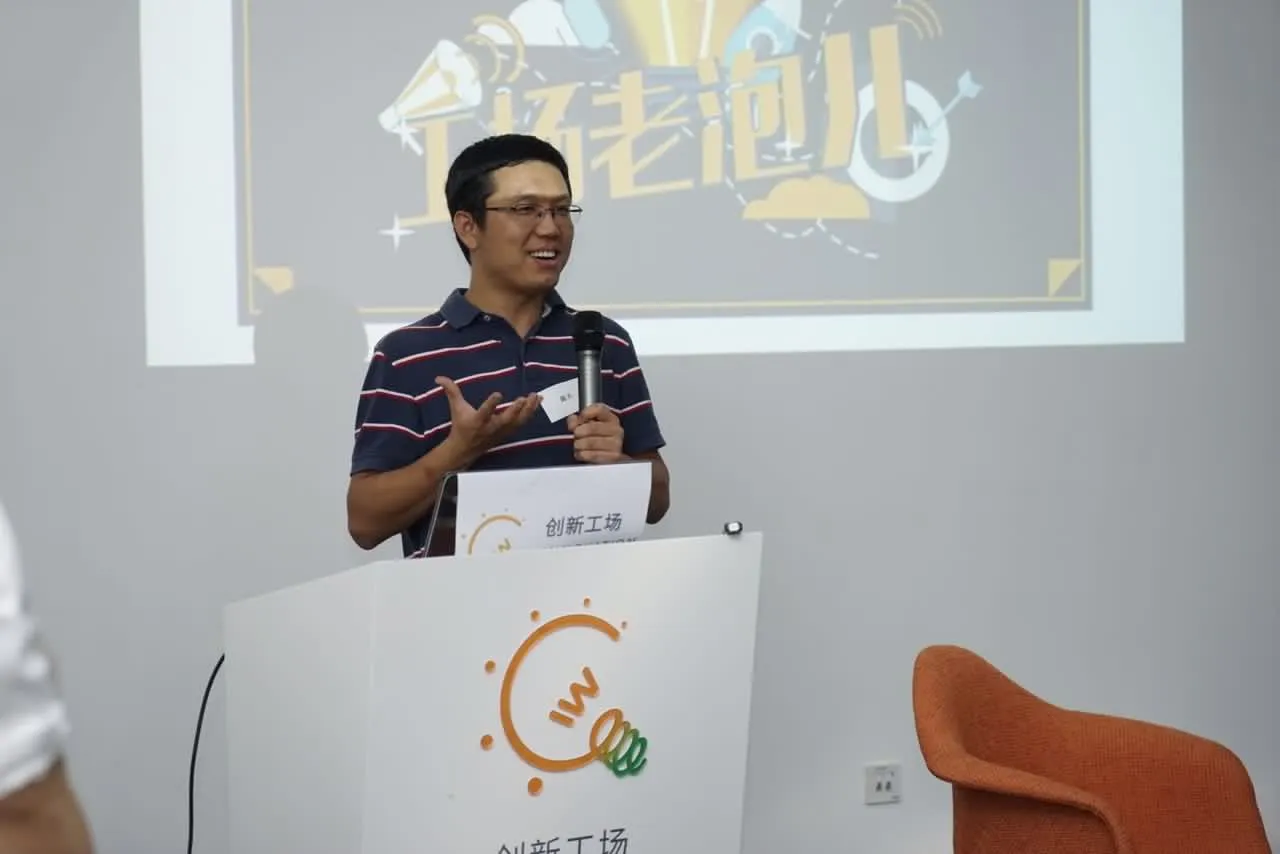
Kai-Fu helped me a great deal in getting back into the startup world. I once mentioned in xxx the matter of the recommendation letter Kai-Fu wrote for me, and after seeing some answers on a Zhihu question by people who criticize for the sake of criticizing, I angrily wrote a response:
Whether Kai-Fu succeeds or not, and whatever kind of person others see him as, to me he is a good mentor and friend. My interactions with Kai-Fu have been confined to Innovation Works. As the founder of Tuke Circle, our exchanges were mostly at the company level; we did not talk much privately. After Tuke Circle was acquired in 2013, I left the startup world, went back to Juniper to lie low, and later went to the United States. In 2015, a San Francisco startup, adRise / Tubi TV, took an interest in me and wanted to help me apply for an O1 visa so that I could change jobs. Applying for an O1 requires several heavyweight recommendation letters. At that point I had not been in touch with Kai-Fu for more than two years. I nervously emailed him to ask whether he could help, and without a second word he signed it readily. That letter was an important weight in my getting the O1, and the O1 was enormously important for my immigration status, because it gave me a strong chance at EB1A (this year I successfully obtained EB1A) without having to endure a long wait for a priority date.
To judge whether a person says one thing and means another, or is fishing for fame, look at how he treats the people around him. Take recommendation letters again. I asked a former VP at Juniper—someone I had served for four or five years—to sign one for me. He agreed readily, then, after stringing me along for nearly a month, flatly refused. You may dislike Kai-Fu’s Weibo posts, dislike his books, or even smear everything he has done. But when he is beside you, he really is a good mentor and friend: no airs, no empty talk, genuinely trying to solve your problems.
I do not know how many young people Kai-Fu has helped with such ‘small favors,’ or how many lives he has changed. But the Tuke Circle experience, going to the United States on an L1, and entering a startup on an O1 are the three most important turning points in my life so far. Two of those three are directly connected to Kai-Fu.
If recommendation letters only helped me personally, then Innovation Works, Microsoft Research Asia, and Google China changed the trajectories of many young people’s lives. A friend once told me an anecdote about his going to Facebook. While interning at Google China, he heard Kai-Fu introduce a then little-known company called Facebook and predict that it would be a huge success. His words were roughly:
Google has a tradition called TGIF (Thank God It’s Friday). Around three or four on Friday afternoon, everyone gathers to drink, chat, and sum up the week. That tradition did not travel well to China, because on Friday afternoons, to avoid being stuck in the week’s most terrifying rush hour, most colleagues would leave early. At TGIF Kai-Fu could face only a handful of people, so he simply turned TGIF into TGIT (Thank God It’s Thursday) and held it on Thursday afternoons. One day at TGIT, Kai-Fu suddenly brought up Facebook, saying that if Google ever went under, the one that killed it would not be IBM, not Microsoft, but Facebook.
That was the first time I, in my ignorance, had ever heard of Facebook. At the time Facebook was still accessible in China. After looking at it, I thought it was an interesting website, but it did not seem as magical as Kai-Fu had said. Facebook’s site back then did not even have a news feed; it was just a display of personal pages.
But since Kai-Fu had said so, I paid attention. Besides, wasn’t the Facebook in front of me exactly the time travel I had been hoping for (PS: he wanted to go back to the early days of Google)? Unfortunately, Facebook was not hiring in China. At the time, the only way to get to Facebook was to go abroad to study.
Microsoft Research Asia has many similar examples; I will not list them one by one.
If Microsoft Research Asia and Google China are things I heard about secondhand, then Innovation Works is something I experienced and felt for myself. Let me talk about the people and things I encountered during Tuke Circle’s runway/acceleration program:
Huande, a former Tencent employee, founded Linban (an LBS chat app) in the runway program, later went to Wandoujia, and now runs a small fund in Shenzhen. His ideal is to build ‘an incubator like Innovation Works, one that helps entrepreneurs grow.’
Jinbo founded Mokatu (a marketplace for visual/photography professionals) in the runway program, and later, together with Qiezi Qiezi (Eggplant Eggplant, a group album project) from the same runway cohort, started a game company aimed at overseas markets, a team of more than twenty people running three games at once.
Ma Li, a former IBM employee, worked on the Dianxin operating system and Wandoujia, and later founded Zuimei App, recommending small but beautiful quality software to users.
Tianfang, a former Microsoft and Palantir engineer, returned to China and joined Innovation Works, where he worked successively on Plan FM and Course Grid. A Zhihu article he wrote two years ago, ‘Innovation Works in My Eyes,’ was something I kept rereading whenever I felt lost.
Xu Lei founded Tongfang Microelectronics and spent nine years working in hardware. After joining the Works, he worked on the O2O project Pudding, building a batch of ‘Pudding-family’ apps and startups; Weiche is one of them. Pudding is currently one of the several ‘Huangpu Military Academies’ inside the Works (along with Wandoujia and others), having trained a large number of entrepreneurial talents.
I will not mention better-known ones like Zhihu and Wandoujia.
As for Tuke Circle, although it failed, the experience transformed Su Dong from a former Huawei sales manager into an investor (he is now an investment director at Walden International, focusing on smart hardware); it transformed Kent from a former GTA account manager into a serial entrepreneur—after Tuke Circle he founded Qingcheng Technology (redefining fitness through the internet, and it is developing very well now); it transformed Hongru from a physician into an internet practitioner; …; and it transformed me from a network R&D engineer at a foreign company into a VP at a Silicon Valley startup, tubitv.com, and, through my own modest efforts, into someone who influences more people.
Perhaps all these people, including me, would still be living quite comfortably after several years if we had never left our previous positions. But in terms of influence on others and small contributions to society (at least creating some jobs), the people we are now are undoubtedly a cut above who we would have been.
In the blink of an eye, Innovation Works has been around for seven years.
Over these seven years, the Works has grown from an early-stage incubation institution into a highly diversified investment firm covering both RMB and USD funds, and its incubator arm has been listed on the New Third Board. A few years ago, the small logo wall at the entrance was replaced by an enormous wall:
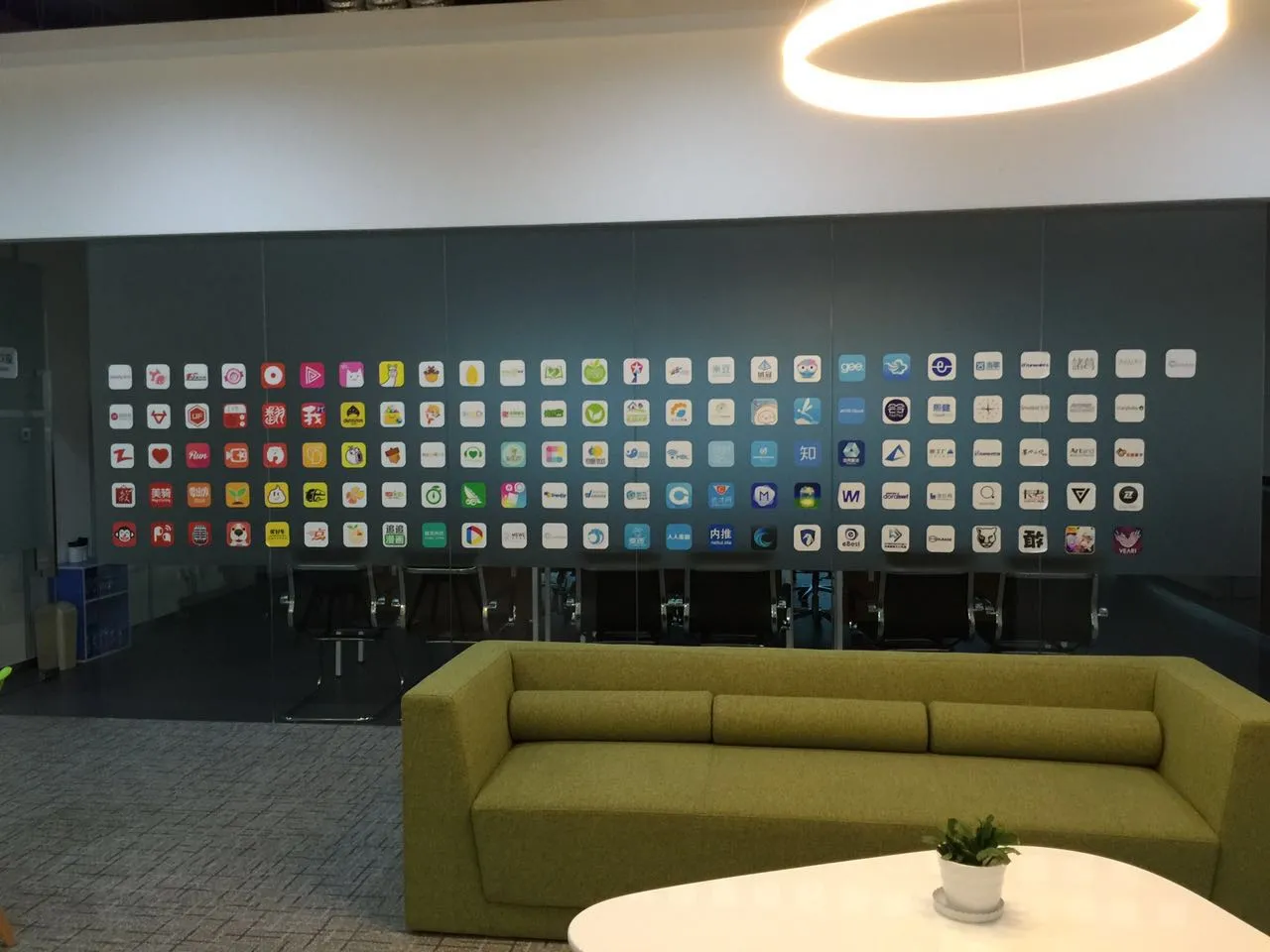
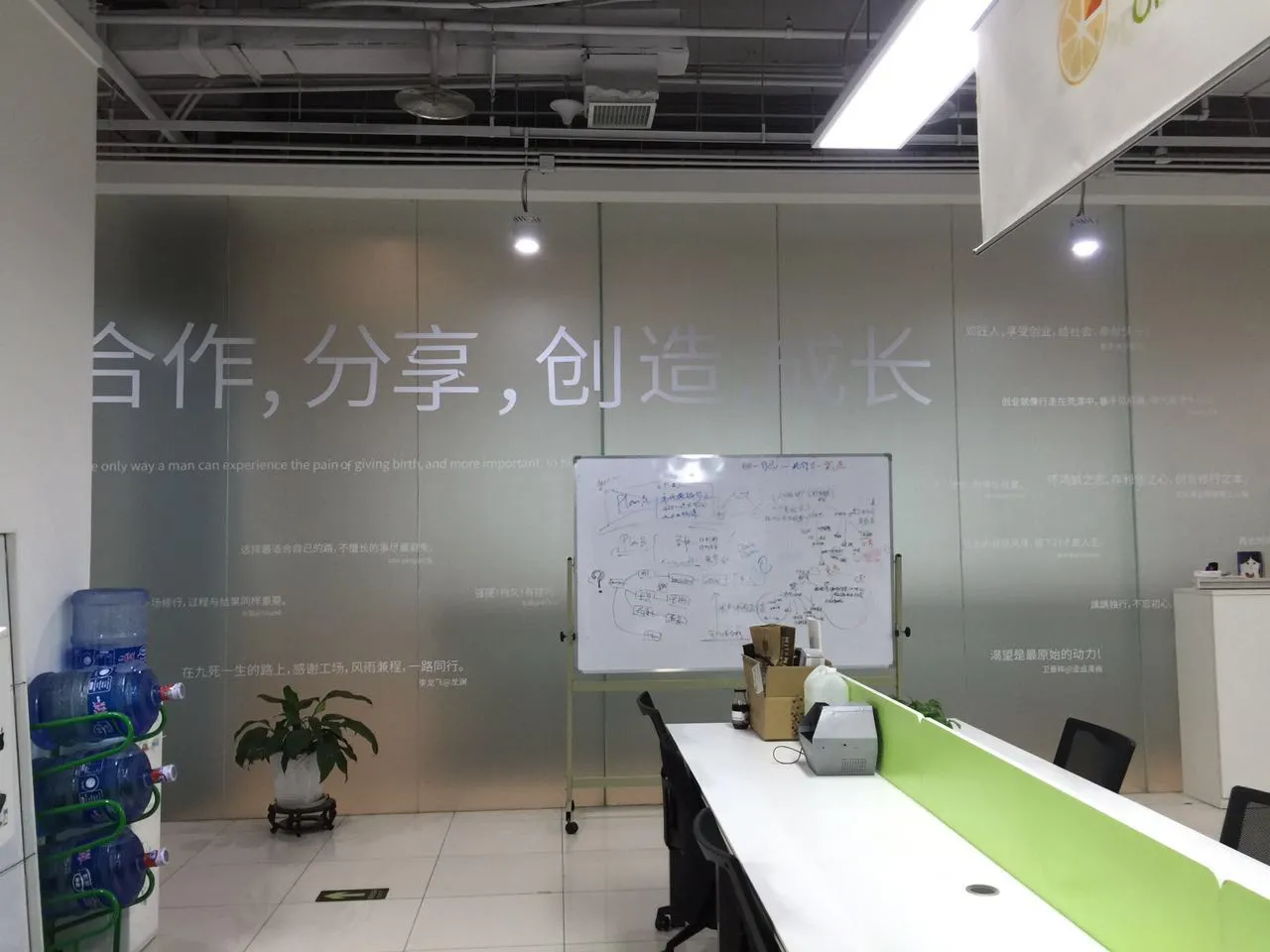
Seven years ago, if someone gave up a good, stable career and said they wanted to start a business or join a startup, the people around them would surely have dropped their jaws, wearing the look of someone who had just been screwed over by life. Even in 2011, when the startup environment was already fairly good, when I left Juniper to start a company, quite a few people around me exclaimed in surprise: ‘You’re so (think it through!) brave!’
And now, all of us in this cohort have grown old—or, to put it more tactfully, more mature. ‘Old’ is a half-compliment, half-insult for entrepreneurs. It can mean one sees through the ways of the world, has learned how to deal with people, and that old ginger is hotter than young ginger; at the same time it can mean rigid thinking, lost passion, declining stamina, and—damn it—using one’s seniority to throw weight around. For us ‘old people,’ we need to guard against the latter and carry forward the former. What comforts me is that we ‘old people’ have passed on what we learned in the Works and what we came to understand through entrepreneurship to more people—that is, pay it forward. The younger friends who spoke one after another onstage also bore witness to this with their own experiences.
I once wrote in the essay ‘When Diligence Catches Up with Time’:
I am so infatuated with K-God; when he suddenly became a diehard favorite of mine at the last World Cup, what I was drawn to was exactly this kind of diligence, this kind of ‘old soldiers never die’ spirit. Sometimes I think this has a lot to do with my age. The post-70s generation in front of me has gradually retired with achievements behind them, while the post-90s generation behind me has begun to press forward aggressively. For society as a whole, the gap between the previous generation and this one determines the gap in natural endowments—if quality of life, breadth of vision, and the like count as part of endowment. The post-50s generation had its golden years wrecked by the Cultural Revolution and by the time reform and opening up arrived had too many ties to break free; the post-60s generation happened to catch the resumption of the college entrance exam and was in the prime of life, with nothing holding them back. So their children—the post-80s and post-90s—started from very different starting lines, or, if you will, with very different endowments. At Tuke Circle I often marveled at the enormous energy of several colleagues born around 1990: barely out of college, they could already hold their own in their respective areas for a startup. Sometimes I would pull them aside and say, ‘By the time you reach my age, you will surely achieve far more than I have.’ I was both proud of them and quietly bucking myself up: ‘If I don’t work harder, they really will leave me far behind.’
That is why someone like K-God suddenly became a monument for me, a totem. If you have no talent, there is still diligence; if you have no opportunity, there is still time. As long as you are willing, a person in their thirties can still work as hard as someone in their twenties, quietly guarding their own dignity and quietly waiting for the opportunity that belongs to them.
In his farewell speech after being relieved of command, MacArthur said: ‘soldiers never die, they just fade away.’ Yet at Innovation Works’ old-timers gathering, what I saw was: soldiers never die, and they continue to pay it forward.