Setting Goals

Having a clear, well-defined goal is what drives us every day—and (very likely) the wellspring of our happiness too. For years I ran and exercised every year in order to lose weight, but every time it was all thunder and no rain; my weight drifted of its own accord from just over seventy kilos down—well, up—to eighty. This year, spurred on by a colleague, I set myself the goal of running a half marathon, and I now have abundant motivation to run every day. The reason is that “losing weight” is far too vague a notion—I’m hardly grotesquely fat, so how much would count as done? So for me that goal was never good enough, and my motivation was correspondingly weak. A half marathon is different: over twenty kilometers in total, with a deadline this October (the Beijing Marathon), perfectly clear and definite. I know exactly what my starting point looks like, and I can count on my fingers what kind of weekly progress I need, so my motivation is strong and the execution far more enjoyable. Back when “losing weight” was the goal, I’d step on the scale after every run, see that—huh—nothing had changed; a week of persistence and still nothing had changed, and I’d be discouraged. As the saying goes: the first drumbeat rouses, the second fades, the third is spent. Within two or three weeks I’d have no courage left to keep running. But with the half marathon as the goal: last week I could run 45 minutes at a 9 km pace; this week I can run 55 minutes. That’s progress.
At this point many people will have caught on: isn’t this just SMART? Everyone’s heard of goal management. Fine, I won’t belabor it—let the picture do the talking:
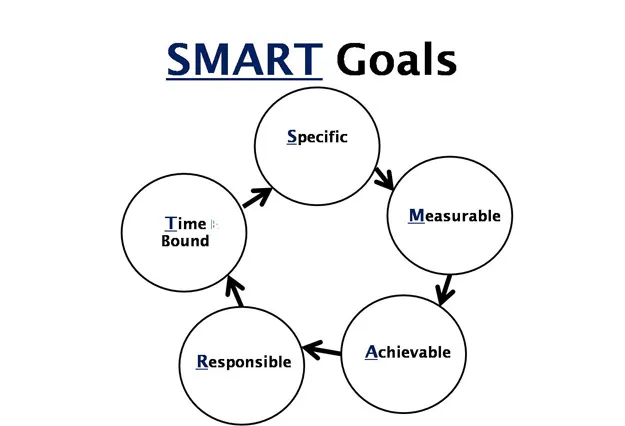
In the orthodox version, “Responsible” is called “Relevant.”
Here I have a small objection to the “A.” A is usually explained as Attainable or, as in the figure, Achievable. I find this framing a little defeatist in practice. If all our goals are merely achievable, you forfeit a great many chances to develop your potential. I prefer Aspired or Ambitious. A goal should carry longing and ambition (aspiration)—only then is your motivation strong enough. Telling a pretty girl at the company (or in the department, or in your circle) that you’re determined to win her over—that’s longing. Standing in the reading room of the National Library and vowing to read every book on that floor—that’s ambition.
There’s the “four-minute mile” story I told in an earlier post; its protagonist possessed exactly the yearning to break the “human limit is a four-minute mile.” After countless people jeered that it was impossible, he succeeded—and in doing so gave a perfect demonstration that “Believe is self-fulfilling prophecy.” Edison had the ambition to make a light bulb, a goal plainly unachievable at the time, and in the end he altered the history of human civilization.
In 2008 the company ran a program called SEDP (the Sxx Engineering Development Program), aimed at upgrading engineers’ various capabilities. One of its metrics was the number of Invention Disclosures (IDs for short—internal patent opportunities; once an ID clears review, it moves into the patent application process) and patent filings. I was eager to publish a US patent (it felt prestigious). At the time it looked rather difficult, because among the handful of Chinese hotshots I knew of at the company, few had published patents—and no one at the Beijing R&D center had yet filed an ID, let alone a patent. So I asked American colleagues about the detailed patenting process, spent no small effort abstracting the patentable opportunity out of the work I was doing, and wrote an ID. Fortunately it passed internal review and could proceed to patent application. Later I felt that a single patent application proved nothing—it might be pure luck. So I set a goal of publishing at least 10 patents. That goal kept guiding me never to let any potentially valuable idea at work slip past. Over the next year or so I wrote a great many IDs, four of which (including some co-authored) made it to patent application. As time has passed, three have now formally become US patents. Though I have already reaped no small harvest, that goal remains unfulfilled to this day, and I’m still working toward it.
I bring this up not to prove how formidable I am—in fact, in the process of filing patents I discovered that something I once looked up to was really no big deal; it’s just a process, with nothing to do with whether you’re a hotshot. What I want to say is: once you have a goal you yearn for, your eyes suddenly seem to brighten, and the things you previously overlooked suddenly connect to that goal. If I hadn’t been thinking about publishing patents, I would never in a million years have believed that fiddling with a few pointers and doing a local optimization for a sliver of efficiency could become a patent.
That is the SMART I want to talk about—a mutant SMART (A for aspired, ambitious).
Aspired/Ambitious may well render a goal unattainable; I suppose that’s why the authors of SMART held that goals should be Attainable. And so they should. Wanting to become a head of state is obviously unrealistic—I could toil for several lifetimes and never get there. But many goals that seem less attainable/achievable really do stand a chance, as long as you go step by step. Take running a marathon: anyone untrained who goes straight out and runs one will certainly fail, and may even pay with their life (dropping dead on the course). So for such an unrealistic goal, we must break it down into small goals and reach them one at a time.
My former colleague Keith says I don’t seem like an engineer at all—and he’s right. A few years back (again SEDP-related) I concluded that one of the upward motivations for engineers comes from idol figures testifying in person. So I suddenly had the notion of interviewing the company’s founder and CTO, Pradeep. This was an extremely unrealistic notion: it had nothing to do with my work, the gap in our levels was far too great, and I personally had no interviewing experience whatsoever. Everything pointed to impossibility.
I broke the goal into three steps: first, interview a DE I knew; then interview the CTO of the BU I was in; and only then Pradeep himself.
The DE I approached—I’d dealt with him several times before, and he was co-chair of the IETF Trustworthy Computing working group, a person of high standing and authority, an excellent interview subject: for one thing I could build up interviewing experience, and for another his experience was fascinating. That interview went well, and I rode the momentum to invite him to give a talk at the Beijing R&D center, which he gladly accepted.
For the BU CTO interview I flew the SEDP banner—wave the royal flag and none can stand against you: he had launched the program, so he was bound to support it and “testify in person.”
With those two steps as groundwork, I had ample reason and sample. In an email to Pradeep’s secretary I explained my purpose, the significance of the whole thing (significance matters), and the work I had already done. I eventually landed a half-hour interview.
By the time of the interview, thanks to the earlier experience and lessons, I was no longer so nervous, and I had prepared thoroughly; the whole process was smooth and unsurprising. It’s just like running a marathon: once you have prepared enough, the final thunderbolt is merely a matter of letting the current carry you.
Finally, once you have a goal, it’s best to make it public. There’s a good saying: “It’s a dream, until you write it down, and then it’s a goal.” I like to tell my goals to my wife (my LP), to family, and even to put them in public places like my blog and my WeChat public account. Whatever the goal, once you spread it to those around you (many or few), your odds of achieving it rise considerably. This looks like a negative tactic, as if sharing the goal were a way to force yourself to finish it (otherwise people will laugh). Not so. The great benefit of sharing is that others can help you strategize and give guidance (as the saying goes, among any three people walking, my teacher must be among them)—just as when I told a colleague I was going to run a half marathon, he shared two great public accounts with me; and when I told everyone I was going to run a half, someone recommended Murakami’s book to me. So my private goals I share, case by case, with many people—even colleagues and my boss. Work and life are inseparable; sometimes sharing your life goals with your boss earlier helps work-life balance. Believe this—it’s a lesson engraved on my bones (not convenient to explain right now).
The idea of “sharing your goals” seems to contradict the TED talk “Keep your goals to yourself”. Let’s see what it says.
It’s a three-minute talk, too short to be convincing. The speaker, Derek, explains that when you tell others your goal, you get a “good feeling,” and:
good feeling now will make you less likely to do it… Social reality - mind is kind of tricked into feeling that it’s already done. You’re less motivated to do due to that satisfaction.
On this argument I have several doubts. For my part (maybe I’m a special case), when I share a goal with others I don’t get the “good feeling” Derek describes that supposedly saps my motivation to achieve it. Truly, none at all. What I get from sharing is a sense of responsibility, plus the other person’s skepticism, affirmation, or advice about my goal.
Another doubt of mine: if a sense of satisfaction is enough to make you stop or grow lazy, is the goal itself the problem?
I want to run a half marathon; even with the “good feeling,” the satisfaction—my head full of the blissful scene after I finish, my family, my darling daughter running toward me to congratulate me—I don’t feel I’d grow lazy because of it. On the contrary, during those hours on the treadmill each week, when I feel I can’t hold on, it’s this joyful anticipation of the goal achieved that keeps me going, making a little progress each time.
Derek also cites psychologists’ arguments, but after reading it over and over I find the supposed meaning of “substitution” is—when your goal is noticed (acknowledged) by others, your mind behaves as if it has already been realized.
I still don’t quite understand the precise meaning of acknowledge here; perhaps it’s not what I take it to be. I looked it up in the dictionary: “admit; acknowledge receipt; universally recognized; express thanks; notice.” None of these seems able to make proper sense of the sentence. I don’t know whether readers have had this experience—after you state your goal, the audience responds with enthusiasm, and you feel it’s already been achieved?
I’m a bit confused. Perhaps it’s a cultural difference? I read the comments on TED, and there are plenty of voices both for and against. So it doesn’t seem to be a cultural difference. For my part, I find Derek’s three-minute talk utterly unconvincing. So I’ll go on doing things my own way.
Many goals I share only with my closest family, some with my intimate friends, and some I boldly announce to everyone. The purpose of sharing isn’t “to rely on others to goad you—the more they deny you, the more you must produce results and slap a hard one across the faces of those who look down on you: see, I can succeed too” (as one reader said), but to seek advice and help. What makes me happy isn’t the goal itself, but each step of putting it into practice.
I’ve said a good deal about the A in the SMART principles. Let’s look at the rest. First, Specific should be uncontroversial. A specific goal is far better than an abstract one. The more carefully a thing is described, the clearer the “visual reflex” it forms in our minds. For example:
A beauty walks toward you.
A tall beauty in a flowing red dress glides toward you, cheeks flushed, bright eyes darting, a smile hidden at the corners of her mouth that you cannot tear yourself from, so like an Eastern Sophie Marceau.
Which one leaves the deeper impression on the mind goes without saying.
Measurable is no problem either. Not just goals—anything we do should itself be measurable. Measurable means we can tell whether the goal is being reached step by step, and it also helps us use the measured data to gain experience and draw lessons. For example, my public account’s 2014 goal, “reach thirteen thousand subscribers” (I wrote about it in an early post), has already been achieved, and the data throughout the process was always my driving force. Through the daily cumulative numbers I can also analyze (even estimate) what kind of article, what kind of topic, produces what kind of numbers. If you’re preparing for the GRE, then how many words to memorize each week, how many essays to write, how many practice tests to do, and what level to gradually bring your error rate down to are the measurable means you need to consider.
Relevant is a bit contentious. The wiki says “choose goal that matters.” Some readers ask too: “How do you judge whether the goal you’ve set has value?” I think it’s hard to have an answer, because “valuable” is a very personal thing—everyone should have their own scales in their heart. For example: “Aim to raise my DOTA level into China’s top 50 by 2014 and make it into the WCG finals”—that’s a goal with no value to me, because it isn’t in the same direction as my somewhat fuzzy life goals; but for many professional or semi-professional players, that’s their dream. Since it’s such a personal thing, don’t worry too much about how others see it or what they think. Follow that voice deep inside you (I’m not sure what to call it). I think a person’s independence of character means he has formed his own thoughts and opinions, doesn’t echo the crowd, can listen to others’ ideas yet make his own decisions, and doesn’t simply base his behavior on others’ views and preferences.
Time-bounded is easy to understand. Anything without a deadline is impossible to complete. Kennedy said the US would achieve the goal of putting a man on the moon by the end of the 1960s. Under the conditions of the time, this was nearly impossible. Yet this ambitious goal, so clearly announced to the world with a deadline, was ultimately achieved (let’s not debate whether the moon landing was real—leave that to Chang’e to verify). Time-bounded matters so much because of the genes that make living things seek advantage and avoid harm. Wherever possible, we’ll find all sorts of excuses to postpone the realization of a goal. Therefore, a goal with an explicit deadline is completed earlier and better than one without.
Finally, let me talk about managing among several goals. By deadline, everyone has long-term, medium-term, and short-term goals; by category, everyone has financial goals, life goals, work goals, and so on. The various goals are in a synergetic relationship, not a zero-sum one of “you or me.” What results I want to achieve at work and my goal of taking a long leave this year to travel independently in Taiwan (unfortunately, because of the Malaysia Airlines incident, my family has many misgivings about traveling this year)—if managed well, these do not conflict. On the contrary, precisely because I have the travel goal, I’ll be as efficient as possible at work, arrange things, and clear it with my boss, so that nothing gets delayed when I finally go.
Moreover, big goals and long-/medium-term goals must be broken down into small, short-term goals and walked through step by step. This helps you see yourself edging toward the goal every day, and thus keeps your mood pleasant. When I experience a “behavior–cognition–emotion” positive feedback loop every day, when I see my yearning for the goal gradually turning into part of reality, I’ll be proud of myself. That pride has nothing to do with others’ praise or approval; it comes entirely from within. When I find I can’t hold on, that a small goal is hard to reach, I’ll visualize the wonderful feeling of achieving the big or long-term goal, and so get through the difficulty. And once the difficulty is left behind and becomes another milestone, it further strengthens my “behavior–cognition–emotion” positive feedback.