Why I Have More Time Than You
The cornerstone of time management is the “four quadrants”:
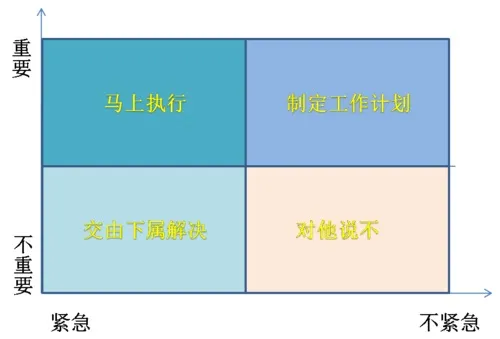
My case may not generalize: I get up around 5:40 every morning, leave the house around 6:10, and by roughly 6:50 I’m already at my desk starting the day’s work. So naturally I have two or three more hours to get things done than most people.
Using Time Effectively
Of course, a few extra hours doesn’t mean you’ll do things efficiently. I say “get things done” rather than “work” because during this stretch I’m basically not working at all (barring emergencies or meetings). This matters, and it’s the first principle I want to state:
The prerequisite for using time effectively is to carve work, study, and life apart as cleanly as possible.
At work we all run into this: there’s a lot to do, and it seems to never end. You’re busy, and suddenly it’s noon; you’re busy, and suddenly it’s quitting time. Programmers are exactly the kind of people who don’t want to head home the moment the day ends (you know why), so they typically keep working another hour or two.
I used to be in that state too, especially during my startup years. Later I realized it isn’t the most efficient way to work, because when you pour too much time into something, you tend to fall into a “no rush, I’ve got plenty of time” mindset. Hence my insistence on carving work, study, and life apart. The ideal is this: the moment nine o’clock arrives, switch immediately into work mode and try to finish the day’s battle within eight hours; the moment six o’clock arrives, disengage from work mode at once and never think about work again. Ideals always clash with reality, of course, but we can’t use that as an excuse to compromise.
The second principle is to make a plan for each day and follow it as closely as possible. The plan here isn’t a to-do list written down on paper; it’s a daily schedule in your head. Easy to say — everyone knows this — but not so easy to actually carry out. My approach is to do fixed things at fixed times each day. For example, my schedule looks like this:
- From 6:50 to 7:50 I’m usually taking a course (Coursera or NetEase Open Courses), watching YouTube videos, or writing code.
- After 7:50 I start publishing articles, reading Hacker News, skimming various pieces, and so on.
- From 6:00 to 7:00 in the evening I usually dig into some technology, or read books and magazines (I buy books on and off, and I subscribe to print magazines like Yicai).
- From 9:00 to 10:30 I’m usually writing (before I started my WeChat account, I wrote code instead).
If you can stick to this kind of schedule for a few weeks, you’ll find a kind of inertia taking hold (twenty-one days to form a habit) — you no longer need to consciously maintain it; the subconscious, or rather the habit, carries you into the right state.
Of course, when work conflicts with this, you still have to deal with work first. Someone is paying your salary, after all, so its urgency is far greater.
The third principle is to concentrate and do one thing at a time — and to stay off the internet as much as possible while doing it. Focus is crucial; it determines your output per unit of time. Everyone has roughly the same number of effective hours in a day, so the more you produce per unit of time, the more time you effectively have. I often go find a meeting room to be alone in, precisely to avoid all interruptions and let myself work as efficiently as possible in a quiet environment.
The great enemy of focus is the internet. The internet is humanity’s greatest invention and also its greatest waste of attention. Online there are always endless trending stories to read, endless novels to devour, endless addictive series to binge, endless Weibo and WeChat feeds to scroll. If you keep checking this and that while trying to do something, the focus you’ve barely managed to gather scatters in an instant. The human mind is like a computer: a context switch costs a great deal of code to save and restore state, and constant interruption can only make you less and less efficient.
Our world is governed by the second law of thermodynamics: absent external force, disorder and chaos (entropy) always increase. Entropy is a fearsome thing — you can’t eliminate it, only keep it in check as best you can.
Dealing with Procrastination
Procrastination is a biological instinct (approach pleasure, avoid pain). At every moment, when we face difficulty and the option of escape, we unconsciously choose the easier path.
In my view, procrastination is really a kind of external dependency — if the external stimulus is insufficient or weak, you’ll keep putting things off until that stimulus changes. (There’s also the opposite case, where the stimulus is so strong that the anxiety of not being able to finish actually triggers procrastination — that’s a separate topic, outside the scope of this piece.)
An article is never finished until the deadline arrives.
A borrowed book is never read until the day it’s due back at the library.
A project will drag on forever as long as you never fix a release date.
……
GTD, the Pomodoro Technique, and the like can, to some degree, help you break free of procrastination and finish tasks better — but these are techniques (术).
The best way to confront procrastination is self-reliance: to free yourself, in spirit, from dependence on your environment. This is the Way (道). An independent consciousness matters, because only you can understand why you do a certain thing, why you work, and even why you live. No one else can make you self-reliant, and perhaps no chicken soup can jolt you into enlightenment either.